Freedom of association
Funding cuts raise concerns across civil society
In October 2024, the Danish government announced plans to cut millions from integration programmes, particularly those run by local non-governmental organisations (NGOs) and municipalities. A separate administrative reform, unveiled on 10th October, also risked undermining civil society organisations (CSOs) by eliminating coordination posts that facilitate funding flows. These measures prompted warnings from civil society groups about their potential impact on inclusion and social cohesion.
Pressures on Danish CSOs intensified in early 2025 amid broader global challenges to humanitarian and development funding. In February, it was reported that the Danish Refugee Council (DRC) planned to lay off around 2,000 staff—about a quarter of its workforce—following President Donald Trump’s suspension of US aid funding. The cuts, mainly affecting national staff in country-level programmes, reflect wider upheaval across the humanitarian sector, with organisations such as the Norwegian Refugee Council and Catholic Relief Services also reducing staff or suspending operations.
Copenhagen residents challenge discriminatory law in EU court
In September 2024, the Court of Justice of the European Union (CJEU) heard a case challenging Denmark’s controversial “Ghetto Package”, which led to the sale of over 200 homes in Copenhagen’s Mjølnerparken neighbourhood. Supported by the Open Society Justice Initiative and local groups, residents challenged the law in front of the EU court, arguing it amounted to racial discrimination by targeting citizens of “non-Western” background.
Passed in 2018, the “Ghetto Package” aims to reduce social housing in so-called “ghettos” – areas with majority “non-Western” populations – to 40% by 2030, including through demolition or sale. Thousands nationwide have already lost or face losing their homes.
Critics describe the policy as “ethnic engineering”, accusing the government of using socioeconomic indicators as proxies for race. In a February 2025 advisory opinion, CJEU Advocate General Tamara Ćapeta deemed the measures direct discrimination, warning that they stigmatise “non-Western” Danes and deepen exclusion rather than promote integration. The Open Society Justice Initiative welcomed the opinion, noting that, although not binding, the Advocate General’s advisory opinions often influence the final ruling by the Court’s judges, and that the opinion’s recognition of the policy as unlawful represents a “hugely significant milestone” for the residents in their fight for justice.
Denmark refuses Japan’s extradition request for Paul Watson
In December 2024, authorities in Greenland rejected Japan’s request to extradite environmental activist Paul Watson, founder of Sea Shepherd, who had been detained in Nuuk under an Interpol Red Notice. Watson faced criminal charges in Japan over anti-whaling activities that took place more than a decade earlier, including allegedly boarding a Japanese vessel in the Antarctic Ocean in 2010. According to Reuters, French President Emmanuel Macron personally intervened in his support, while Sea Shepherd France director Lamya Essemlali travelled to Greenland to attend the proceedings and show solidarity. During his detention, more than 4,000 letters of support were sent on his behalf.
Lawmakers call for government inquiry into transnational repression from China
In May 2025, Danish lawmakers from the Unity List, the Danish People’s Party and The Alternative called for a government inquiry into China’s transnational repression, following the China Targets investigation by the International Consortium of Investigative Journalists and Danish daily Politiken. The investigation revealed how the Chinese government seeks to silence critics abroad through intimidation, surveillance, and cyberattacks.
One case highlighted was that of Chinese activist Liu Dongling, who was targeted after seeking asylum in Denmark. She reported that, during her stay in a reception centre in southern Denmark, she and her son were approached by unknown Chinese men who made comments about “finding” her. After her asylum application was rejected, she relocated to Sweden, where the harassment continued online. A US-based influencer falsely accused her of being a Chinese spy in social media videos, and sent the same allegations to Danish authorities.
The lawmakers condemned China’s actions as a threat to democracy and urged stronger protection for dissidents residing in Denmark.
Freedom of peaceful assembly
Report finds hostile climate for environmental protests in Denmark
A report published in October 2024 by Friends of the Earth Denmark (NOAH) documented widespread repression of environmental activists between 2019 and 2024. Based on interviews with 15 activists from nine organisations, the study found repeated incidents of police brutality, excessive force, and criminalisation through lengthy legal cases.
Activists described unequal treatment based on citizenship, race, and gender identity. The report found examples of EU citizens receiving threats of deportation and racialised policing of Greenlandic activists. Furthermore, non-binary and transgender individuals faced transphobia during ID checks and arrests. In addition to mistreatment and intimidation by authorities, many activists also reported online harassment and death threats following media appearances.
The report warned that Denmark’s political and media climate discourages public protest and creates a chilling effect on peaceful assembly. It called for an independent watchdog to protect the right to protest, stronger safeguards for marginalised groups, and an end to police violence against environmental defenders.
Climate activist acquitted, court cites “emergency” provision
On 8th April 2025, Copenhagen City Court acquitted climate activist Ida Dalsgaard Nicolaisen of charges linked to her January 2022 protests against construction on Amager Fælled. The court invoked Section 14 of the Criminal Code, an emergency provision allowing otherwise illegal acts to prevent imminent harm.
Nicolaisen had staged a sit-in to block the felling of a tree and later refused to leave City Hall after meeting officials. She argued that civil disobedience was necessary to protect a legally protected habitat and endangered species. The judge ruled that her actions were proportionate and necessary, marking a rare use of the emergency provision in cases of civil disobedience against environmental destruction. The only known precedent dates to 1993, when Greenpeace activists were acquitted after blocking wastewater discharge from a chemical plant.
Nicolaisen was convicted in several other cases related to non-violent civil disobedience as part of climate protests, including roadblocks. In those instances, the court ruled that the emergency provision did not apply, finding that the harm she sought to prevent was not imminent or localised at the protest sites. She was fined 1,500 kroner for minor offences, far below the 11,500 kroner requested by prosecutors.
Discriminatory parenting tests repealed after protests
In November 2024, Denmark faced national and international backlash over the use of psychometric tests to assess new parents’ competency which watchdogs warn discriminate against Greenlandic people. Human rights bodies have consistently criticised the assessments as culturally biased and amounting to cultural racism. Critics argue that they fail to consider linguistic and cultural differences, a concern also raised by the Danish Institute for Human Rights (DIHR).
The issue gained renewed attention after the case of Keira Alexandra Kronvold, a woman of Greenlandic heritage whose baby was taken from her just two hours after birth. According to The Guardian, Kronvold was told the purpose of the test was to determine whether she was “civilised enough.” Her psychological assessment was conducted by a Danish-speaking psychologist, even though her first language is Kalaallisut (West Greenlandic) and she is not fluent in Danish. Her case file reportedly stated that her “Greenlandic background, where even small facial expressions have communicative significance”, would make it difficult for her to prepare her child for “social expectations and codes necessary in Danish society.”
Kronvold’s case and the continued use of such tests sparked protests in Nuuk and Copenhagen, organised by activist Aka Hansen and the NGO Foreningen Mapi, led by Laila Bertelsen. On 20th January 2025, the Danish and Greenlandic governments announced that the practice would be abolished.
Allegations of excessive force against activists protesting military shipments to Israel
On 24th February, demonstrators, including Swedish climate activist Greta Thunberg, blocked the entrance to shipping giant Maersk’s Copenhagen headquarters to protest the company’s alleged transportation of military equipment to Israel. Around 200 protesters gathered, with 10–15 climbing onto the roof. According to media reports, 20 were arrested after police intervened. Authorities stated the demonstration was illegal, occurred on private property, and that proportionate physical force was only used after repeated warnings, with no reports of injuries. Activists, however, accused police of brutality, reporting the use of tear gas, pepper spray, batons, and police dogs. A medic present at the protest told the Arbejderen newspaper, the outlet of Denmark’s Communist Party, that 60–80 protesters suffered injuries including contusions and open wounds from baton blows and kicks, as well as sprains and pain from being forcibly restrained by police.
Activists allege that Maersk’s shipments support Israeli genocide, referencing a Danwatch report which states that 14 Maersk-owned ships transported military equipment to Israel 43 times between October 2023 and September 2024. Maersk responded that the cargo was transported on behalf of the US government, contained no weapons or ammunition, and complied with all applicable laws under the US-Israel Security Cooperation Programme.
Despite police repression, protests continued. On 13th May 2025, over 50 climate and Palestine solidarity activists, including Thunberg, staged a demonstration at subsidiary Maersk Tankers' Holmbladsgade offices in Copenhagen. Members of the Green Youth Movement had earlier entered Maersk Tankers’ offices and then protested outside. Police reported that the removal was carried out quietly, with some activists physically escorted off the premises. This action was part of the ‘May:hem’ campaign, a ten-day coordinated series of protests across Europe organised by the Green Youth Movement and other climate and Palestine solidarity activists, targeting Maersk’s alleged arms shipments, high CO₂ emissions, and “greenwashing” through sponsorships of cultural institutions and events. The campaign included demonstrations, cultural interventions, and events coinciding with Nakba Week – commemorating the anniversary of the Nakba, the mass displacement and dispossession of Palestinians during the 1948 Arab-Israeli war.
In June 2025, Maersk announced it would cut ties with companies linked to Israeli settlements in the occupied West Bank, following pressure from activists and the Palestinian Youth Movement. The decision aligns its screening with the UN OHCHR database, though critics note Maersk continues transporting Israeli military components.
Protests against US plans for Greenland
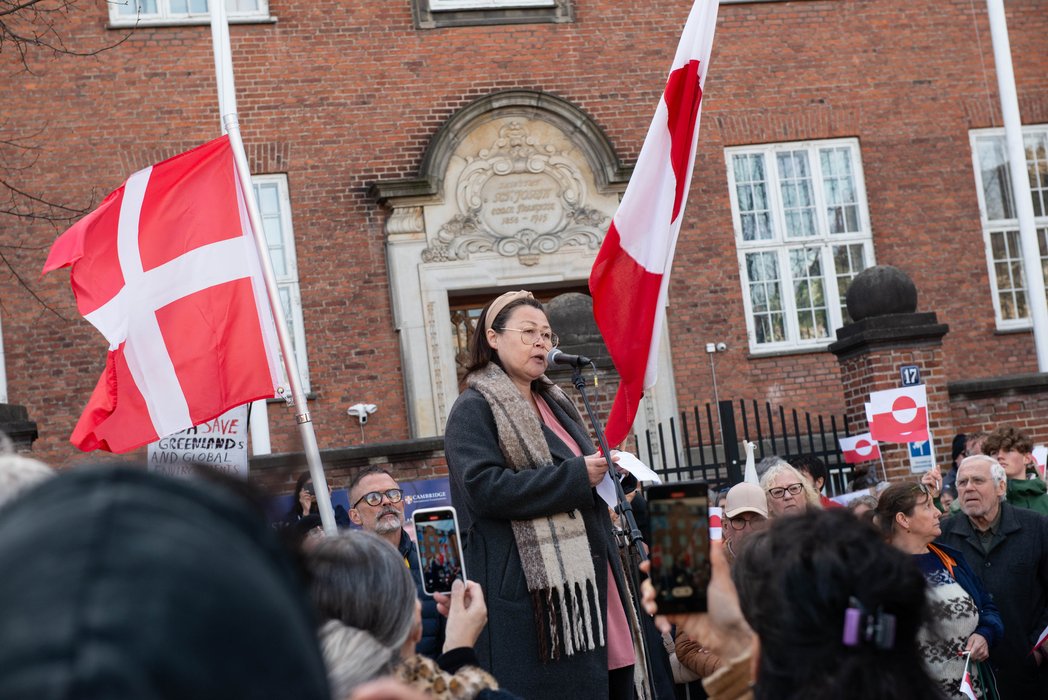
In March 2025, a series of protests occurred in response to the U.S. administration’s statements about taking control of Greenland for strategic and national security reasons.
On 15th March, around 1,000 Greenlanders marched in Nuuk to protest US President Donald Trump’s remarks questioning Denmark’s sovereignty over Greenland and suggesting the island could be acquired by the United States. Demonstrators carried Greenlandic flags, shouted slogans, and held placards reading, “Respect Greenland’s sovereignty” and “Make America Go Away.” Acting head of government Mute Egede and political leaders from all five Greenlandic parties addressed the crowd, condemning Trump’s statements as “unacceptable.” A similar demonstration took place in Sisimiut, where protesters sang the Greenlandic national anthem.
On 29th March, hundreds gathered in front of the US embassy in Copenhagen, following a visit by Vice President JD Vance to Pituffik Space Base in Greenland, where he criticised Denmark’s governance and suggested Greenland would be better off under American protection. Protesters held signs reading “Greenland Not for Sale” and “Back Off, USA”, voicing opposition to U.S. interference and asserting Greenland's right to self-determination. Former Danish Foreign Minister Mogens Lykketoft spoke at the protest, stressing the need for international support against what he termed American aggression towards Greenland. Similar sentiments were echoed in Aarhus, where further demonstrations took place.
The controversy arises from remarks by US President Donald Trump and other officials announcing the United States’ interest in acquiring Greenland, citing its strategic location and natural resources. Trump has suggested economic sanctions against Denmark and hinted at possible military action if the acquisition is blocked. Greenland’s leaders, supported by a significant majority of the population, have firmly rejected any suggestion of becoming part of the United States, emphasising their desire for autonomy and self-governance. Formerly a colony, Greenland has been a self-governing nation within Denmark since 2009, with Denmark retaining control over foreign policy and defence matters. The situation has strained relations between Denmark and the United States, with Danish Prime Minister Mette Frederiksen warning the US that “you cannot annex another country”.
Protests against Tripartite Agreement
In November 2024, Denmark adopted the Agreement on a Green Denmark, or Green Tripartite Agreement, making it the first country to introduce a climate tax on agricultural emissions. The deal aims to cut up to 2.6 million tonnes of CO₂ by 2032, in addition to rewilding 140,000 hectares of farmland, planting 250,000 hectares of new forest, and creating five national nature parks.
However, the agreement sparked protests from climate activists, who argued it did not go far enough to address the climate crisis. On 20th November, activists from the Green Youth Movement blocked the Ministry of the Green Tripartite in Copenhagen, demanding a “fair, science-based renegotiation.” They set up a symbolic “people’s negotiation room” inviting citizens, farmers, and civil society groups to propose a more inclusive, science-driven climate policy.
Protesters criticised the agreement for favouring industrial agriculture and corporate interests. They argued the CO₂ tax of 120 kroner per tonne, delayed until 2030, was far below the 1,500 kroner per tonne recommended by Denmark’s Climate Council, and condemned reliance on unproven technologies instead of supporting plant-based, regenerative farming. The Green Youth Movement described the deal as “a historic climate failure” for preserving intensive animal production. They staged further climate marches in Aarhus and Copenhagen in November, demanding a fundamental transformation of Danish agriculture.
Farmers also expressed discontent, with some responding to calls from the group “No Farmers, No Food, No Future”, which organised demonstrations in several European countries, to stage tractor blockades in Aalborg, Kolding, Holstebro, and Aarhus on 13th January. Several other tractor demonstrations took place in Denmark in January and February. However, public broadcaster DR reported that, unlike in other European countries, the tractor blockades do not have the support of the major official agricultural organisations in Denmark, with some representatives from Danish agricultural organisations expressing support for the Tripartite Agreement’s provisions.
Freedom of expression
Unions welcome law on freedom of expression for public sector workers, but call for stronger safeguards
In May 2025, Denmark’s parliament adopted a law to safeguard freedom of expression for public employees, aiming to protect their right to speak openly about workplace issues and public service conditions. While unions welcomed the initiative, they criticised it as insufficient, arguing that it largely reiterates existing constitutional protections without real mechanisms to ensure their enforcement. Union leaders from Djøf, FOA, BUPL, DSR, and the Danish Journalists’ Association called for stronger safeguards, including sanctions for employers who retaliate against employees, clearer guidance for managers, and protection for private contractors performing public tasks. They warned that fear of reprisals continues to silence vital voices in the public sector.
Journalists face legal intimidation and obstruction
In Reporters Without Borders’ (RSF) 2025 World Press Freedom Index, Denmark ranks 6th out of 180 countries. RSF describes Denmark as providing strong institutional and societal protection for journalism, though challenges remain. Access to public information is restricted by the 2014 Freedom of Information Act, and sexism in newsrooms has attracted scrutiny. Despite these issues, the watchdog notes Danish journalists generally work freely and face minimal threats. The Mapping Media Freedom Project has recorded several incidents of legal intimidation and obstruction of journalists’ work in the country in late 2024 and the beginning of 2025.
On 13th November 2024, Google announced plans to test restricting content from EU-based press publishers in several countries, including Denmark, France, and Spain, as part of a “small, time-limited test” intended to assess how excluding EU news content affects users’ search experience and traffic to publishers. The company stated the test would impact 1% of users but did not specify its duration or selection criteria. The International Federation of Reproduction Rights Organisations and media groups condemned the move as a violation of EU copyright rules and press freedom. France’s Paris Commercial Court ordered Google on 14th November to suspend the experiment or face a €900,000 daily fine, prompting the company to pause its implementation in the country. By mid-December, some Danish journalists discovered that their content had disappeared from Google search results.
On 4th December 2024, jewellery designer Mai Manniche filed a complaint with the Danish Press Council against Berlingske, claiming the newspaper had violated the Act on Mass Media Information Databases by refusing to delete two 2023 articles accusing her of copying jewellery designs. Although the Council had previously criticised the articles, it rejected Manniche’s request, ruling that deletion would be disproportionate under Article 10 of the European Convention on Human Rights, which protects freedom of expression and information. Berlingske also added a disclaimer at the top of the article informing readers of the Council’s criticism.
On 8th December 2024, a journalist from Ekstra Bladet covering a gala dinner at Christiansborg Palace during Egyptian President Abdel Fattah al-Sisi’s state visit was reportedly threatened with being removed from the event and blacklisted after asking King Frederik a critical question about al-Sisi, referring to him as a “dictator”. On 10th December, Ekstra Bladet’s editorial director defended the journalist, calling the question legitimate and expressing concern over threats to press freedom. The newspaper reported the incident to the Royal House’s communications department and questioned whether journalists should fear being denied access to events if they ask critical questions. In response, the Royal House stated that questions are not permitted during the ceremonial arrival of royals, which is broadcast live.
Between 27th December 2024 and 29th January 2025, investigative outlet Danwatch received four legal letters from the Moscow-based law firm ELWI, representing the sanctioned Russian insurance company Ingosstrakh. The letters followed a joint Danwatch–Financial Times investigation revealing that Ingosstrakh insured oil vessels suspected of helping Russia evade Western sanctions. The investigation found that this poses environmental risks to European coasts due to the terms of the insurance policies. Ingosstrakh demanded documentation and information on sources used for the investigation, which Danwatch refused to provide in order to protect its sources. Denmark’s foreign minister condemned the threats as politically motivated, while Danwatch described them as a strategic lawsuit against public participation (SLAPP).
On 31st January 2025, journalist Anders Ejbye-Ernst from the investigative outlet Frihedsbrevet was denied access to documents by the administration of the Central Denmark Region concerning issues at Randers Regional Psychiatric Hospital, which Ejbye-Ernst had been investigating along with a colleague. The region claimed Frihedsbrevet was not a recognised mass media outlet under the Freedom of Information Act but “a niche news outlet that [...] only addresses a limited number of paying members” and stated that “there is no longer any news value” in covering issues at the hospital, also citing excessive prior requests. Ejbye-Ernst criticised the refusal as discriminatory against smaller media and an infringement on editorial independence.
On 12th February 2025, Danish People’s Party spokesperson Alex Ahrendtsen demanded “consequences” for DR editor Thomas Falbe over alleged inaccuracies in DR’s documentary Greenland’s White Gold, which examined cryolite exploitation in Greenland. The film, aired on 7th February, drew criticism from politicians and economists for presenting misleading revenue data. Following political pressure, DR director Sandy French announced on 19th February that the documentary would be removed from DRTV and that Falbe would resign. Journalist unions in Denmark and Greenland condemned the decision, warning against political interference and urging DR to uphold press independence.
On 4th April 2025, Journalisten.dk reported that former Radio4 presenter Sanne Gottlieb had received rape threats while hosting her late-night show The Night Watch in December 2024. During a live broadcast, where listeners could call in or send live text messages, Gottlieb received a text stating, “Sanne, you know I'm going to rape you one night in your bedroom.” Weeks later, the same individual sent another message and later reiterated the threat in a recorded call. Gottlieb reported the incident to the police, leading to a criminal case. She left the programme following the incident, while Radio4’s editor-in-chief described it as “tragic” and expressed regret over the delayed response.
On 4th April 2025, business outlet Finans received a legal letter from law firm Plesner ahead of publishing new revelations about systemic sexual harassment within Plesner’s M&A department. The letter was sent before publication, after Finans had provided the full article to Plesner in advance for objections and comments. It contained 15 questions seeking detailed information that Finans’ editor-in-chief, Simon Bendtsen, said appeared intended to identify anonymous sources. Bendtsen condemned the move, emphasising Finans’ commitment to protecting its sources. Despite the pressure, the newspaper published the article as planned on 9th April 2025.