GENERAL
An investigation published by Amnesty International in September 2025 highlighted serious structural failures in Lausanne and Vaud’s policing and justice systems. Drawing on testimonies from victims, expert analysis and the 25th August report of an independent commission set up after the fatal police shooting of Roger “Nzoy” Wilhelm (see previous CIVICUS Monitor update), the investigation found that people of African descent face disproportionate violence, racial profiling and intimidation by police. According to Amnesty’s report, officers frequently file counter-complaints that shift the burden of proof onto victims, making accountability almost impossible without video evidence. It’s further described that police and prosecutors operate within a culture of silence, where internal solidarity, weak oversight and close personal ties between institutions shield officers from scrutiny. Victims often abandon complaints due to pressure, lack of legal support and fear of retaliation, reinforcing what Amnesty describes as an entrenched system of impunity.
ASSOCIATION
Court flags overreach in probe of activists who painted Geneva cycle lane
In July, Geneva’s Coercive Measures Court issued mixed rulings on the controversial investigation targeting Extinction Rebellion activists accused of painting an improvised cycle lane in February 2023, whose case was covered in a previous CIVICUS Monitor update. The court largely upheld the prosecutor’s wide-ranging search measures but ordered the exclusion of certain data, including EasyJet travel records and banking information linked to donations to organisations such as Greenpeace, deeming them irrelevant or overly broad. The decisions concern one accused individual and four others questioned as witnesses. The case has drawn scrutiny because the alleged damage—valued at about 8,900 francs—triggered an unusually intense investigation involving three police brigades. Defence lawyers argued that the volume of seized data amounted to a disproportionate intrusion, while prosecutors insisted the measures were necessary.
EXPRESSION
Report finds proportion of “news-deprived” Swiss citizens is at record levels
Switzerland’s share of “news-deprived” residents has reached a record 46.4%, nearly double the level in 2009, according to the University of Zurich’s Yearbook 2025: Quality of the Media, published in October. Researchers warn this trend undermines democratic engagement, noting that people who consume little or no news, often relying mainly on social media, show significantly lower political knowledge, trust institutions less and participate less in public life. The study also found AI chatbots draw heavily on journalistic sources without compensation and confirmed persistent economic pressures on Swiss media.
Referendum fails, clearing the way for new federal support to Switzerland’s regional press
Switzerland’s regional press will receive increased federal support after a referendum to block the measure failed due to a lack of signatures. The opposing committee confirmed on 9th July that it will not gather the required 50,000 signatures before the 10th July deadline. The aid package, approved by the Federal Parliament in March 2025, provides an additional 35 million francs per year from 2026 to reduce postal distribution costs for regional newspapers, on top of an existing 30-million-franc scheme.
The referendum committee, led by liberal activist Leroy Bächtold, argued the plan contradicts the public’s 2022 rejection of broader media subsidies and invests heavily in an “outdated model”. But regional editors say the support is vital as many local titles face financial strain and job cuts. The scheme will run for seven years, during which publishers are expected to develop sustainable business models.
Swiss journalist raided under banking secrecy law, court blocks prosecutors’ access to sources
On 3rd June 2025, Swiss journalist Lukas Hässig, editor of financial news outlet Inside Paradeplatz, faced police raids at his Zurich newsroom and home as part of a criminal probe into alleged breaches of Article 47 of the Banking Act. The charges are linked to his 2016 reporting on alleged financial misconduct involving former Raiffeisen Bank executives. Authorities seized his devices and documents in the first case brought against a journalist under the amended secrecy provision, which carries penalties of up to five years’ imprisonment. Media freedom groups condemned the investigation as a grave threat to press freedom and urged authorities to drop the case and return the confiscated material.
On 2nd July, the Zurich Coercive Measures Court dealt a major blow to prosecutors, rejecting their bid to unseal Hässig’s seized computer, phone, documents, and notebooks. The ruling blocks investigators from accessing Inside Paradeplatz’s sources, marking a significant setback for the prosecution. The Zurich Public Prosecutor's Office accepted this verdict, which is now final. Responding to the Council of Europe Platform for the Safety of Journalists in September, the Swiss government reaffirmed its support for media freedom, but highlighted that it cannot intervene in legal proceedings and that the main proceeding against the journalist under Article 47 is still pending. It also underlined that, to date, there have been no cases where journalistic publications in Switzerland have led to a final conviction under the provision.
Court finds university censorship of Palestine-related speech unlawful
On 1st July 2025, the Administrative Chamber of the Geneva Court of Justice ruled that the University of Geneva acted unlawfully when it sought to censor an agenda published by the University Conference of Student Associations (CUAE) containing references to pro-Palestinian slogans and historical events. The court found that criticisms of Israel, the use of the phrase “From the river to the sea,” and references to events such as the hijacking of planes in Zarqa, Jordan, by the Popular Front for the Liberation of Palestine did not constitute antisemitism, glorification of terrorism, or discrimination. It upheld the student associations’ freedom of expression. The university said it will study the ruling before deciding whether to appeal to the Federal Supreme Court.
Also in July, Amnesty International condemned the University of Bern for cancelling a public conference featuring Agnès Callamard, Amnesty’s Secretary General, and UN Special Rapporteur Francesca Albanese. The group says the withdrawal violates freedom of expression and denies the university community access to expert analysis on Gaza. Amnesty warned the decision sets a dangerous precedent, noting the university relied partly on partisan social media criticism of Albanese. The organisation highlighted that both speakers are internationally recognised human rights experts and urged the university to reverse its decision and protect academic freedom.
Bank attempts to impose “consent form” on journalists covering their market reports
In early June 2025 the Zurich Cantonal Bank (ZKB) asked Swiss journalists to sign a “declaration of consent” to continue receiving its market reports, requiring the media to adhere to its communication guidelines to avoid “distorted or incomplete reproduction” of statements from its analysts. The bank asserted its right to record exchanges with journalists and forward them to authorities, impose liability for damages over alleged misuse, and demanded input on content. Major outlets, including NZZ and SRF, refused to sign, noting that no other bank imposed such conditions. After widespread criticism, ZKB withdrew the requirement in less than 24 hours and said it would re-examine the consent form.
ASSEMBLY
Protests and unrest in Lausanne highlight concerns about racism and police violence
On 24th August, unrest erupted in Lausanne following the death of a 17-year-old boy who crashed his scooter while being pursued by police earlier that day. The teenager reportedly lost control of a recently stolen scooter at high speed and hit a wall. Hours later, around 100 mostly hooded young people gathered in the Prélaz neighbourhood, setting fire to rubbish bins and throwing pyrotechnic devices at police. More than 60 officers were deployed. Police said they responded by firing 16 rubber projectiles and three tear gas grenades. The disturbances lasted several hours before calm was restored. According to the media, no injuries were reported, and an investigation was opened into the events.
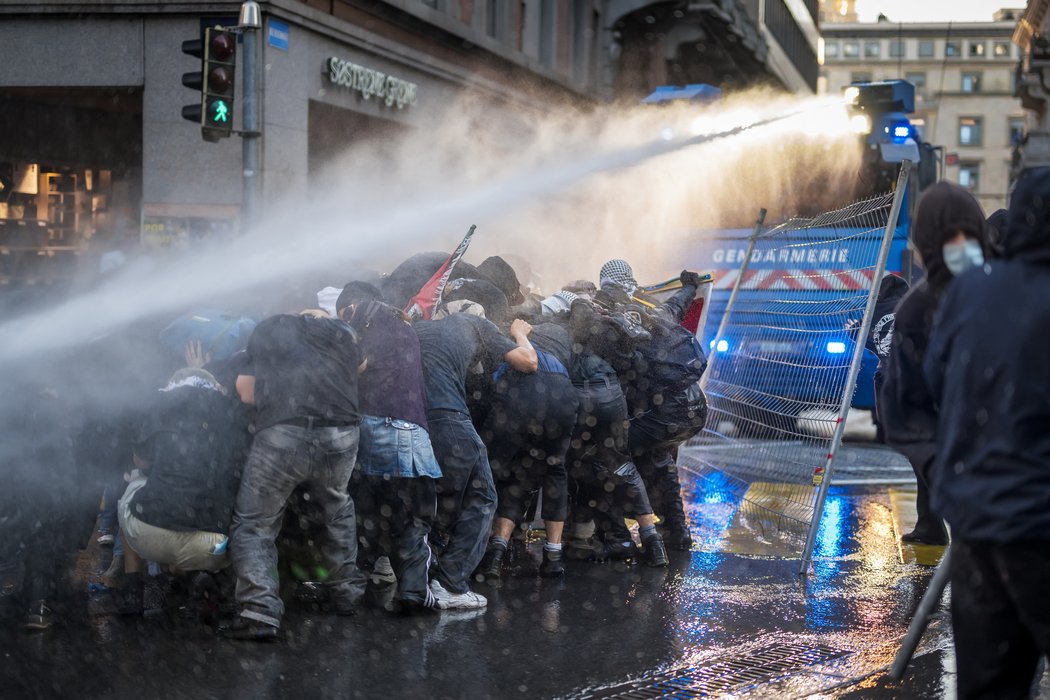
On 25th August, a second night of unrest unfolded in Lausanne, again centred on the Prélaz neighbourhood. Between 150 and 200 people, some masked, erected barricades using burning containers and bins, while further incidents were reported in Boveresses/Praz-Séchaud, where containers were set alight and a public bus was badly damaged. Police patrols came under sustained attack with stones, fireworks, Molotov cocktails and other projectiles. Around 140 officers were deployed, alongside firefighters operating under police protection. Police reported using water cannon, four rubber projectiles and 54 tear gas grenades to disperse the crowd. Police sources reported seven arrests and no injuries.
On 26th August, a fatal altercation outside Lausanne’s Le Vaudois restaurant left 43-year-old Eritrean national Sirage Mohamed Nur dead. On 29th August, after his funeral, over 200 people gathered and a peaceful march of around 100 headed to the site of the incident, demanding justice after the man suspected of delivering the fatal kick was released following questioning. Police closely monitored the demonstration, which ended with a minute of silence. Prosecutors say the conditions for pre-trial detention were not met, but a criminal investigation and an autopsy are under way to determine the exact cause of death.
On 30th August, nearly 1,000 people marched silently through Lausanne in a white march honouring 17-year-old Marvin, who died the week before while fleeing police on a scooter, as mentioned above. The procession ended in Prélaz, the neighbourhood where he lost his life, drawing family, friends, teachers and many members of the Congolese community. The march also remembered Camila, a 14-year-old who died in similar circumstances this summer. Later, around 300 people gathered for a separate mobilisation for Roger “Nzoy” Wilhelm, a man of South African origin fatally shot by police in 2021. As reported in a previous CIVICUS Monitor update, protests followed the public prosecutor’s decision to close the case in November 2024, arguing that the policeman who killed him acted in self defence. Both events called attention to concerns over police violence.
Protests in solidarity with Palestine
On 12th June 2025, in the evening, around 100 people took part in a pro-Palestinian demonstration in Zurich. Police responded with tear gas, rubber bullets, and water cannon, while demonstrators used pyrotechnic devices and set fires. Clashes occurred after demonstrators, who had been mobilised via social media, gathered in Zurich's 4th district following earlier calls to occupy railway stations in other cities. According to police, 11 people were detained.
On 21st June, between 10,000 and 20,000 people marched through Bern in solidarity with Gaza, demanding that the Federal Council push for an immediate, lasting ceasefire. The demonstration, supported by more than 30 organisations including unions, human rights groups and political parties, drew participants from across Switzerland. Police maintained a visible presence, carried out identity checks and reported minor property damage such as graffiti.
On 28th June 2025, around 150 people gathered outside the Vaudoise Arena in Lausanne (Vaud) to express solidarity with the Palestinian people, condemn the genocide, and criticise what they deemed Switzerland's complicity in war crimes perpetrated by the Israeli army. As some demonstrators tried to enter the Arena, police used tear gas to fend them off. The demonstration took place as Switzerland was facing Israel in the U19 basketball World Cup.
On 26th August, several students appeared in a Zurich court for taking part in peaceful sit-ins at ETH Zurich that protested human rights violations in Gaza and the university’s collaborations with Israeli institutions. The students face charges of unauthorised protest and trespassing for two sit-ins held in May 2024. Amnesty International Switzerland condemned the prosecutions, noting that universities in the country repeatedly used police interventions, disciplinary threats and criminal complaints to silence Gaza-related protests. Amnesty underscored that the students’ actions were peaceful, and are as such protected by Swiss and international law, warning that criminalising them undermines academic freedom and free expression.
On 6th September, a car drove through a pro-Palestinian protest in Lausanne, injuring two people and causing panic among the 1,500–2,000 participants. The march, which began at Riponne and moved toward Montbenon, was peaceful until a grey BMW travelled against traffic and accelerated through demonstrators sitting in silence at Chauderon. Videos show the car weaving through the crowd as people screamed and tried to stop it. Police later arrested the 56-year-old Swiss driver, though his motive remains unclear. The calm interaction between officers and the suspect sparked anger among protesters, who accused police of complicity. According to police, a criminal investigation is ongoing.
On 18th September, police in Lausanne used heavy force during two simultaneous demonstrations related to Gaza, including a pro-Israel rally and a pro-Palestinian counter-protest, both of which were peaceful. According to reports, police moved the pro-Israeli demonstration and forcibly blocked the pro-Palestinian counter-protest, using water cannon, tear gas and batons to prevent interaction between the two groups. Amnesty International Switzerland strongly criticised the police response, warning that all peaceful assemblies are protected under international law, regardless of authorisation. Amnesty said the use of force appeared disproportionate and condemned authorities for treating unauthorised protests as illegal, calling for equal facilitation of protests and counter-protests.
On 2nd October, over 3,000 people gathered in Geneva to show solidarity with the Global Sumud Flotilla, seized the previous day with several Swiss nationals aboard. The protest remained peaceful until crossing the Mont Blanc bridge, where police abruptly blocked the march. According to more than fifty testimonies gathered by Amnesty International Switzerland, officers used illegal and unnecessary force: baton blows, tear gas, rubber bullets, and unjustified blockades without any audible warning or communication. Amnesty deemed the actions arbitrary and unsafe.
On 12th October, thousands of people took to the streets of Bern to protest Israel’s war in Gaza, in a demonstration organised by pro-Palestinian groups from across the country. The march, attended by up to 5,000 people, reflected growing anger over the humanitarian situation in Gaza and followed earlier protests in Geneva. As officers attempted to restrict protesters’ movement, clashes broke out, with police deploying water cannon, tear gas, rubber bullets and batons. According to media reports, 18 officers and several protesters were injured. Police reported that one person was arrested, while 536 protesters were temporarily detained for identity checks, including 23 minors.
Other protests
On 13th June 2025, a few hundred people launched this year’s Feminist Strike with a march in Lausanne. After speeches denouncing systemic inequalities and state patriarchy, around 300 participants moved through the city chanting feminist, anti-capitalist and pro-Palestinian slogans. Near the train station, police blocked the march, using pepper spray against protesters. The protest took place on the eve of Switzerland’s annual 14th June Feminist Strike, following calls from feminist and leftist collectives.
On 4th July 2025, around ten activists from the “Droit de rester” collective protested outside the office of Vaud State Councillor Isabelle Moret in Lausanne, opposing the forced deportations of asylum seekers, particularly children. Four protesters climbed onto the building’s front roof, displaying banners and balloons, before being removed by police. The demonstration ended shortly afterward. A police spokesperson reported that complaints were filed against two protesters who had resisted being removed from the roof.
On 2nd August 2025, several thousand people marched through central Bern for the city’s Pride parade. Participants moved through the Old Town under the slogan “Together for joy, resistance and love”, dancing behind floats and waving rainbow flags before gathering on Federal Square for a Pride Festival. Organisers said the march aimed to send a strong signal for equality, queer visibility and social cohesion.
On 16th August 2025, around 5,000 people marched in Bern to demand better access to psychotherapy and mental health care. Protesters highlighted long waiting lists, a shortage of places in therapy programmes, and unclear pricing structures, carrying banners reading “Psychotherapy must not be a luxury” and “Your therapist is angry.” A minute of silence was observed for victims of suicide. Organised by the “Santé mentale pour touxtes” initiative, the demonstration called for affordable therapy, reduced bureaucracy, better training opportunities, and improved working conditions. Political parties and unions, including the Social Democratic Party of Switzerland (PS) and the Greens, expressed support.
On 29th August 2025, around 300 people protested in Mendrisio, Ticino, against announced job cuts at SBB Cargo. The demonstration, organised by a broad coalition of trade unions, followed the company’s decision to cut 65 full-time posts nationwide, including 40 in Ticino, as part of restructuring in the struggling freight transport sector. Protesters rallied under the slogan “Jobs on the rails, not traffic on the roads”, demanding the protection of skilled employment in the canton. During the protest, union leader Pierre-Yves Maillard criticised SBB Cargo’s management for failing to adequately consider workers in its strategic decisions.