This update covers developments relating to the freedoms of expression, association and assembly in Canada from 1st May to 31st July 2026.
Context
Record wildfires expose failures in evacuation and protection of First Nations
Insufficient communication with the Ontario government has been lamented by various First Nations community leaders who say they felt abandoned by Ontario’s provincial government and left to fend for themselves, without warnings or evacuation plans. The Namaygoosisagagun First Nation in north-western Ontario found itself surrounded by flames on 15th July and had to self-evacuate through a nearby lake, without waiting for a mandatory evacuation process. According to Linda Debassige, grand council chief of the Anishinabek Nation which represents 39 Ontario First Nations, the Namaygoosisagagun’s chief Helen Paavola had sent risk inquiries to the federal government leading up to the fire and was told there were no imminent threats.
Similarly, the Northern community of Eabametoong (Fort Hope First Nation), a fly-in community 300 kilometres north of Thunder Bay, started evacuation on 18th July in seven flights that carried around 460 members to Niagara Falls. According to the community’s Chief Sol Atlookan, Eabametoong’s elders and vulnerable had to wait three days for evacuation despite smoke mounting and thickening around them, supporting the feeling that “getting (them) out (didn’t) seem to be a high priority”. A similar episode occurred with Aroland First Nation Chief Sonny Gagnon in the Thunder Bay District, who, upon inaction from the province over whether to evacuate or not, had to utilise his previous firefighting experience to personally drive a school bus of elders and vulnerable members of the community 15 hours through the night to shelter in Sudbury.
Prior to the wildfires, the affected First Nation communities had been a source of increased legislative interest as they sat on a mineral-rich area the government sought to exploit in a project entitled “Ring of Fire”. Condemnations also came from the union representing forest firefighters, who say government mismanagement and negligence in response to the wildfires has occurred ‘at the highest levels’, even though warnings over the Ministry of Natural Resources’ strained capacity to handle such catastrophes had already been sounded in Recruitment and Retentions reports from 2015, 2018 and 2019. Nearly 300 water bombers, helicopters, four CC-130 Hercules aircraft were used by the federal government to mitigate the fires, according to a press release from the Office of the Prime Minister.
In total, two First Nations territories were fully destroyed, namely the Namaygoosisagagun First Nation and Whitewater First Nation, prompting First Nation leaders to call for public inquiry into the inadequate provincial wildfire responses. However, the wildfires were not the only damaging factors to First Nation territory. Upon their return, the 350-people Neskantaga First Nation had to evacuate once more due to a sewage crisis. The wildfire’s aftermath equally saw communities unable to deal with the extent of the damage. The Okanagan Indian Band reported 230 homes damaged by the Bradley Creek wildfire, with the National Chief Cindy Woodhouse Nepinak calling on federal governments to support reconstruction efforts.
Five missing persons found dead in Thunder Bay, distrust of police grows among community
In May 2026, First Nations leaders raised concern about systemic racism, inadequate police investigations and poor coordination with Indigenous search teams following the discovery of five missing persons in Thunder Bay, northwestern Ontario.
On 24th May 2026, Ontario Provincial Police first retrieved the body of 36-year-old Webequie First Nation member Kelsey Anderson, found in the Neebing-McIntyre Floodway of the Neebing River in Thunder Bay. A few days earlier, a team of 85 search and rescue volunteers who had gone out looking for Anderson discovered the body of another man, Richard Graham, who had been declared missing almost two years ago, in July 2024.
Anderson and Graham’s bodies were found a week after more bodies had been discovered, namely those of 25-year-old Nodin Skunk and 23-year-old Ashlynn Bottle from Mishkeegogamang First Nation, who were both found in grain terminals on the southern side of Thunder Bay. Lastly, 62-year-old non-Indigenous Daniella Nekuliak was found dead near a lake on the city’s north side in Late April.
On 27th May 2026, Nishnawbe Aski Nation Grand Chief and spokesperson for 49 First Nations across northern Ontario Alvin Fiddler criticised the Thunder Bay Police Service’s handling of the investigations. Fiddler alleged that police had failed to acknowledge the contributions of Indigenous-led search teams, disregarded information provided by community members and inadequately communicated with grieving families. Fiddler also expressed concern about growing distrust of the police and called for improved coordination between law enforcement agencies, Indigenous communities and search teams. In an interview, he also lamented ineffective police efforts, noting that recommendations from decades-old inquests into the deaths of First Nations territories in the city’s waterways were not taken seriously.
Canada attends US summit on political terrorism
On 16th July 2026, the United States government convened a summit on political terrorism in Washington, D.C., bringing together leaders from over 60 countries, including Canada, to discuss the presumed global threat of “left-wing terrorism.” Secretary of State Marco Rubio, White House Deputy Chief of Staff for Policy Stephen Miller, and Secretary of the Treasury Scott Bessent offered remarks during the programme, painting their image of the threat of leftist ideologies, progressive racial justice movements, and the need to squash the opposition they view as extreme and violent.
US government officials under the Trump Administration have taken to cultivating a narrative that frames organisations engaged in equity and justice work as domestic terrorism and political violence. The same day, New Democratic Party’s (NDP) leader Avi Lewis released a statement outraged by Canada’s participation in what he calls “a spectacle” and “a serious escalation of violent authoritarianism” from a “next-door neighbour” which “puts progressive Canadians at real risk”. He called on the Prime Minister to provide Canadians [with] the reasoning behind involving them in the “ugly episode”.
Peaceful Assembly
Palestine solidarity protester faces terrorism charges over alleged conduct at demonstrations
On 21st July 2026, Toronto police arrested and charged Ahmad Hassan Hajahmad, a 33-year-old Palestine solidarity protester, under section 83.18 of the Criminal Code for allegedly participating in or contributing to the activities of a terrorist group. The charge followed a joint investigation by the Toronto Police Service’s Hate Crime Unit and the Royal Canadian Mounted Police’s Integrated National Security Enforcement Team (INSET) into his alleged conduct at pro-Palestinian demonstrations held in Toronto on 25th May and 7th September 2024.
According to police, Hajahmad used amplification devices during the demonstrations to make statements advocating “harm against members of the Israeli and Jewish communities”. Police further alleged that he had acted for the benefit of and in association with Hamas, which Canada designates as a terrorist organisation. On 7th March 2025, police executed a search warrant at a Toronto residence and seized electronic devices. On 20th July 2026, Ontario’s Attorney General and the federal government consented to proceeding with the terrorism charge. A court-imposed publication ban restricted the disclosure of further details concerning the investigation.
Hajahmad’s lawyer, Mohamed El Rashidy, disputed the allegations, maintaining that his client had no connection to Hamas or any other foreign organisation. El Rashidy argued that the charge arose from statements made during public demonstrations: “Mr. Hajahmad is presumed innocent and has no connection to Hamas or any other foreign group. He faces a single charge arising from speaking at public demonstrations. No violence, no weapon, no one harmed. Speaking out at a protest about the killing of civilians is protected expression, not terrorism. We’ll be looking closely at how and why this case came to be, and we’re confident it won’t hold up when measured against the law.”
In response, on 29th August 2026, over 40 civil society organisations condemned the charges against Ahmad Hajahmad Jarrar, and the repression and criminalisation of the pro-Palestine movement.
The prosecution came amid wider debate over policing and restrictions politically motivated against Palestine solidarity demonstrations. On 14th March 2026, Ontario Premier Doug Ford’s government unsuccessfully sought a court injunction to prevent Toronto’s annual Al-Quds Day demonstration. In a few hours, Ontario Superior Court Justice Robert Centa dismissed the application shortly before the demonstration was scheduled to begin, finding that the province had failed to establish sufficient grounds for a broad preventive restriction on the rights to freedom of expression and peaceful assembly:
“I am not satisfied that the Attorney General of Ontario has met the test for a quia timet injunction to prevent all persons from engaging in the Al Quds Day protest. In the record before me, there is
insufficient evidence to satisfy me that: a. The police see this injunction as necessary to preserve the peace; b. This protest in prior years has given rise to significant criminality or an inability of the police to maintain the peace; c. An anticipatory and blanket injunction interfering with the Charter rights of the participants is reasonable or proportionate in the circumstances of the case.”
Civil society organisations have also raised broader concerns about repression against Palestine solidarity activism. On 22nd December 2025, the Anti-Racism Program of the CJPME Foundation published Policing Palestine Solidarity: A Crisis of Civil Liberties in Canada (2021–2025), documenting disproportionate policing, surveillance and criminalisation of Palestinian solidarity activism. According to the foundation's analysis, pro-Palestinian demonstrations accounted for 10.1 per cent of all protests recorded between 2021 and 2025, but 37 per cent of recorded police interventions, despite more than 96 per cent of these demonstrations being classified as peaceful.
Protest involving Nova Scotia premier leads to criminal charges
On 15th July 2026, around 50 protesters gathered at Acadia University in Wolfville, Nova Scotia, to decry various issues including the province’s plan to promote fracking and mining, raids on First Nation cannabis shops and impending library closures, outside an Annapolis Valley Chamber of Commerce event where Nova Scotia premier Tim Houston was giving a speech on plans to promote economic growth in the province.
Once Houston’s car began to leave campus, protesters gathered around it to draw the premier’s attention to their demands, and prevented it from departing. One person climbed atop the vehicle, attempting to bring it to a halt. After others stood in front of it, the car slowly came to a stop, and its windshield was smashed. According to the RCMP present, who escorted the premier back into the building and later left in police vehicles, no injuries were reported.
Two days later, on 17th July, the RCMP arrested 19-year-old Jacob Victor Stephen Smith in Kentville, Nova Scotia, in relation to the incident and charged him with two counts of intimidation and one of mischief. On 22nd July, he was released on CAD 5,000 bail under conditions of house arrest, with his trial set for 8th September 2026.
According to media reports, on 15th July 2026, the Office of the Premier released a statement describing the protesters as criminals and rioters who “swarmed” the staff’s vehicle. Protesters on-site testified to the rally being peaceful, before the windshield was broken, and that different people had stood together to make their voices heard. A few weeks later, on 29th July, Premier Houston was also met with a small group of protesters at the Pictou Country Chamber of Commerce who voiced their concerns over the peaker plants that have been proposed for Marshdale and Salt Springs in Pictou County.
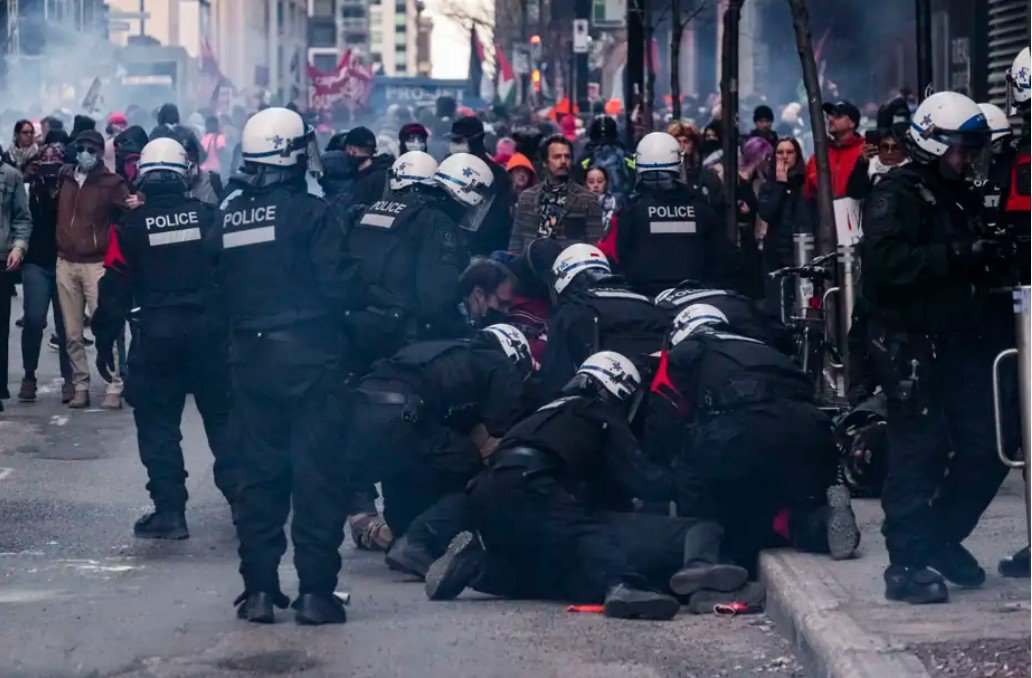
Montreal police disperse May Day protest with tear gas and arrest 13 protesters
On 1st May 2026, hundreds of protesters gathered at Victoria Square in central Montreal, Quebec, for a May Day demonstration organised by the Convergence des luttes anticapitalistes (CLAC)—a Montreal-based anti-capitalist activist coalition—and student, trade union and community organisations. Held under the banner “Towards a social strike, solidarity and popular resistance”, the demonstration denounced austerity, restrictions on labour rights, anti-immigration measures and other provincial and federal government legislation and policies.
The march began in the afternoon under the observation of several units of the Service de police de la Ville de Montréal (SPVM). According to police spokesperson Manuel Couture, officers made targeted arrests after some protesters allegedly threw projectiles at police and a pyrotechnic device towards bystanders. In the evening, near the intersection of Sainte-Catherine and Jeanne-Mance streets, police used tear gas and other chemical irritants to disperse the crowd. Police also alleged that protesters had placed rubbish bins in the street to obstruct officers’ movements. Police reported 13 arrests for alleged offences, including assaulting police officers with a weapon.
Independent media outlet CUTV Montreal also reported the use of batons and pepper spray against protesters, describing the police response as repressive.
Toronto police arrest six people during Walk with Israel event and counter-protests
On 7th June 2026, approximately 60,000 people participated in the 57th annual Walk with Israel in Toronto, Canada’s largest city. The United Jewish Appeal (UJA) Federation of Greater Toronto, a Jewish community and fundraising organisation, planned the annual march to express solidarity with Israel and the Jewish community and raise funds. Organisers described the turnout as the largest in the event’s history. Participants carried Israeli, Iranian and American flags, while pro-Palestinian counter-protesters gathered along the route with signs criticising Israel’s military human rights violations in Gaza. Toronto police maintained a heavy security presence and established designated areas for counter-protesters, using officers and barricades to separate the opposing groups. At one point, police intervened as march participants and counter-protesters exchanged verbal insults.
On 8th June, police confirmed that they had made several arrests during the event. Three pro-Palestinian counter-protesters—John Eusebio, Ghada Hamouda and Diana Bosco—were charged with “obstructing a peace officer after allegedly refusing to leave the walk route and return to the designated protest area.” Authorities charged Eusebio with assaulting a police officer after he allegedly spat at officers. Police also arrested an unnamed woman for breach of the peace after alleging that she displayed anti-Israel signs along the march route, taunted participants and contributed to escalating verbal confrontations. Police released her without charge.
Separately, authorities charged Ali Reza Hojjati, who participated in the Walk with Israel, with assault after he allegedly spat towards a counter-protester and their sign during an argument. Police also investigated another man for operating a drone near the event and issued him a ticket under Canadian aviation regulations.
Rail strike continues amidst anti-scab law violations
On 31st May 2026, the International Brotherhood of Electrical Workers (IBEW), the union that represents rail workers employed by Canadian Pacific Kansas City (CPKC), went on strike after CPKC failed to address issues around “recruitment, retention, compensation and work-life balance.” This came after a 72-hour notice that did not result in an agreement between the parties. CPKC ensured the public that operations would continue as normal and communications and signal workers later noted that contractors were carrying out their work during the strike illegally.
On 29th June 2026, the Canada Industrial Relations Board (CIRB) ruled in one case that the hiring of scab contractors is a violation of Bill C-58, an Act to amend the Canada Labour Code and the Canada Industrial Relations Board Regulations, 2012, which came into force in 2025.
The 12-week strike came to an end on 21st August 2026 following binding arbitration between CPKC and IBEW. Approximately 300 signalling and communications workers were scheduled to return to work on 24th August 2026.
Anti-racism demonstration follows allegations of discriminatory policing in Montreal North
On 15th June 2026, a peaceful protest took place in Montreal North to decry alleged police racist behaviour after Montreal police chief Fady Dagher removed 16 officers from patrol duties who had been assigned to Station 39 in the northern suburb of Montreal on 12th June, two of whom were suspended and under criminal investigation over serious allegations of racism, discriminatory policing and misconduct. The other three were reassigned to administrative duties and the remaining eleven transferred to other assignments.
The demonstration, attended by approximately 300 people, was organised by the Collectif Opposé à la Brutalité Policière (COBP, Collective Against Police Brutality), which gathered outside Montreal Police Service (SVPM) Station 39, brandishing the banner “Police raciste, système complice” (Racist police, complicit system), while residents described experiences of discriminatory policing in the neighbourhood. The area surrounding the station was temporarily blocked and police forces monitored the crowds and nearby streets.
On the same day, the Ligue des droits et libertés (LDL) and the Canadian Civil Liberties Association (CCLA) called for an independent public inquiry into systemic racism and racial profiling within the SPVM. The organisations argued that existing police oversight mechanisms lacked sufficient independence and transparency and demanded an immediate end to arbitrary police street checks.
On 26th June, an investigation was opened by Quebec police’s ethics commissioner at the request of Domestic Security Minister Ian Lafrenière and after a complaint filed by anti-racism organisation the Red Coalition, which asked the commissioner to investigate allegations of racial profiling, harassment and retaliation against employees who reported misconduct.
Palestine solidarity activists protest at Carleton University graduation ceremony
On 11th June 2026, four protesters interrupted a graduation ceremony at Carleton University, a public university in Ottawa, Canada’s capital, to call on Carleton to divest from companies linked to human rights violations in Palestine. In response, Carleton president Wisdom Tettey told the protesters their voices had been “heard”, urging them to allow students “to enjoy” their graduation. Campus security then escorted the protesters from the venue as they continued chanting and displaying banners. Some audience members reportedly applauded them, while others left the ceremony in solidarity.
Earlier in the year, on 10th March 2026, protesters had marched across campus demanding the university’s Board of Governors divest from alleged holdings in more than $34 million in investments tied to the genocide in Gaza.
In a January 2026 statement, Carleton defended its investment approach, citing its fiduciary responsibilities and arguing that engagement with companies generally offered a more effective approach than divestment
Greenpeace Canada delivers Nature Law petition to Minister to halt environmental rollbacks
On 3rd June 2026, civil society organisation Greenpeace Canada delivered a petition to Environment, Climate Change and Nature Minister Julie Dabrusin to call for stronger federal Nature laws. Signed by more than 116,000 people across Canada, the petition was delivered as a 20-metre-long banner which condemned the federal government’s rollback of climate regulations, particularly the reform to accelerate industrial and infrastructure projects in “Economic Zones”. The petition also called for greater respect for Indigenous rights and environmental stewardship.
The action took place amid growing opposition from environmental organisations to the federal government’s proposals to accelerate industrial and infrastructure development, published on 8th May 2026. These included establishing Federal Economic Zones to streamline approvals for major projects and introducing changes to environmental assessment and permitting procedures.
According to Greenpeace’s Biodiversity Campaigner Salomé Sané, “rolling back hard-won environmental protections to promote a 20th-century extraction-first agenda means knowingly worsening conditions for the more than 2,000 species that are at risk of being wiped out in Canada”.
On the same day, Ecojustice and other environmental organisations held a press conference on Parliament Hill condemning the proposed regulatory changes.
Nationwide protests over climate inaction
On 22nd June 2026, nearly 150 environmental defenders and residents peacefully gathered outside the constituency office of Brittny Anderson, a member of British Columbia’s provincial legislature, in Nelson, south-eastern British Columbia. Kootenay Forest Watch, a local environmental organisation, planned the demonstration under the banner “(Still) Broken Promises” to protest what they described as the provincial government’s failure to fulfil commitments to protect old-growth forests and reform forestry practices.
Protesters criticised the “expansion in BC Timber Sales’ ability to undertake commercial thinning, salvage logging and wildfire-risk reduction projects. Organisers planned the demonstration in anticipation of a visit by British Columbia Premier David Eby, the head of the provincial government, who was expected to attend an event in Nelson. Eby did not attend. Anderson later said a Royal Canadian Mounted Police (RCMP) security assessment had prompted his absence.
The demonstration reflected the use of peaceful assembly by environmental defenders and local residents to scrutinise provincial natural-resource policy and demand greater protection of old-growth forests.
In a separate protest, on 25th June 2026, climate activists mobilised nationwide to mark the National Day of Action and the fifth anniversary of the deadly heat dome in the province of British Columbia, demanding a halt on the country’s pipeline expansion projects and more robust government plans to counter climate change. In Milton, Ontario, around a dozen protesters and members of the civil society organisation Sustainable Milton held a rally outside the constituency office of Burlington North-Milton West MP Adam von Koeverden, brandishing signs that urged the federal government to reverse its rollbacks on climate and environmental policies. Following the rally, Sustainable Milton sent a letter to MP von Koeverden, urging him to call for stronger environmental oversight of infrastructure projects, strengthen environmental protections, and expand renewable energy across the country. In Winnipeg, Manitoba, climate activists gathered outside Liberal MP Terry Duguid’s office to decry the federal government’s push for new pipelines, brandishing signs that read “stop pipelines” and “death by climate crisis”.
Meanwhile in Shediac, New Brunswick, activists gathered outside the office of Internal Trade Minister Dominic LeBlanc and tried in vain to deliver a placard-sized copy of the “People’s MOU” to him, a response to PM Mark Carney and Alberta Premier Danielle Smith’s signing of a memorandum of understanding (MOU) to expand Alberta’s oil and gas sector in November 2025. The “People’s MOU” calls on the federal government to “abandon the dangerous recent proposals that exempt mega-projects from safety and environmental regulations”. The demonstration, co-organised by Seniors for Climate Tantramar, the Protect the Chignecto Isthmus Coalition and the Stop Tantramar Gas Plant, sought to decry New Brunswick Power Corporation’s proposed plans to construct a fossil fuel-powered generating plant north of Sackville, New Brunswick and the province’s policy of “climate-burning pipelines”
On 26th July 2026, over 1,000 people participated in the Save Our Waterfront Celebration Rally and March in Toronto, Ontario, organised by NoJetsTO and Environmental Defence. Originally planned as a demonstration against the proposed expansion of Billy Bishop Toronto City Airport, the gathering became a celebration after the federal government announced in late July 2026 that it would not proceed with Ontario’s plans to extend the airport's runway to accommodate larger jets.
Participants gathered at Harbour Square Park before marching along Queens Quay to HTO Park, where they were joined by a flotilla of kayakers and boaters. Carrying NoJetsTO placards, activists celebrated the decision as a result of sustained community mobilisation and opposition to the proposed development. Environmental organisations had warned that expanding the airport could increase noise, air pollution and sewage-related environmental pressures, threaten wildlife habitats and damage public spaces on the Toronto Islands.
The federal decision followed a public consultation that received more than 87,000 responses. Transport Minister Steven MacKinnon said the government would focus on already approved airport safety improvements and would not pursue expansion plans that significantly affected the environment, public spaces or nearby housing development. However, Ontario’s government maintained its support for airport expansion, while environmental campaigners called for continued vigilance to protect Toronto's waterfront.
Montreal March decries housing crisis
On 1st July 2026, approximately 600 people demonstrated in Montreal, Quebec, demanding stronger government action to address rising rents and housing insecurity. The Coalition contre le logement cher (COLOC, Coalition Against High Housing Costs) organised the demonstration, bringing together tenants, housing-rights advocates and representatives of community, feminist, student and trade union organisations.
COLOC, which comprises more than 120 organisations, called on the Quebec government to strengthen rent controls, build more social housing and recognise the right to housing in Quebec’s Charter of Human Rights and Freedoms, the province’s principal human-rights law. The coalition also demanded the construction of 10,000 social housing units each year.
The mobilisation coincided with Quebec’s traditional “Moving Day” on 1st July, when a large proportion of residential leases expire and thousands of tenants move home at the same time. Housing organisations have long used the date to draw attention to rent increases, housing shortages and the difficulties low-income households face in finding affordable accommodation.
Simultaneous demonstrations also took place in Quebec City and Rouyn-Noranda. Organisers called on political parties to support structural housing reforms ahead of Quebec’s provincial election and encouraged supporters to display banners from their balconies and wear keys as symbols of the campaign for housing rights.
Healthcare workers mobilise against privatisation and staffing shortages
Between 25th May and 28th May 2026, Unifor Healthcare workers and social services workers from Ontario gathered at Queen’s Park in Toronto for a legislative lobby to call for a federal strengthening of public healthcare and for the government to counter staffing shortages and halt the expansion of private health services.
The Lobby Week was part of Unifor’s Care Can’t Wait campaign, which called on the provincial government to increase core funding for hospitals and public services, stop the expansion of for-profit clinics and lessen provincial use of private staffing agencies. The initiative concluded on 28th May, when thousands of healthcare workers, patients, trade unionists and community organisers marched from Union Station to Queen's Park in a demonstration organised by the Ontario Health Coalition, with the participation of Unifor, the Ontario Public Service Employees Union (OPSEU/SEFPO) and other labour and community organisations.
Combatting Hate Act enters into force amid concerns over civic freedoms
On 18th June 2026, Bill C-9, an Act to amend the Criminal Code (hate propaganda, hate crime and access to religious or cultural places), received Royal Assent in Parliament, the final step through which a bill becomes federal law. The final text includes some clarifications, stating that people do not commit the access-related offence merely by attending near such a place for the sole purpose of obtaining or communicating information. It also clarifies that public interest speech, including political, educational, religious and scientific expression, remains lawful “if they do not wilfully promote antisemitism by condoning, denying or downplaying the Holocaust.”
As previously documented by the CIVICUS Monitor, this Act could affect freedom of expression and peaceful assembly, particularly demonstrations near religious, cultural and community institutions. On 19th June 2026, a coalition of 65 organisations signed an open letter urging the federal government to adapt this legislation to protect against a “chilling effect” on protest, and ensure it is “precise, evidence-based, and accompanied by appropriate safeguards to minimise risks of overbreadth and inconsistent application.”
Police investigate symbolic guillotine protest during May Day demonstration
On 4th May 2026, the Montreal Police Service (SPVM) opened an investigation into a symbolic guillotine execution performed during an International Workers’ Day demonstration two days earlier at Place des Festivals in Montreal, Quebec. Protesters used a mock guillotine to decapitate a papier-mâché effigy resembling Quebec Labour Minister Jean Boulet, before kicking its severed head.
The activist group Alliance Ouvrière, which organised the performance, defended the action as political satire symbolising popular anger against political and economic elites. The group disputed claims that the effigy specifically represented Boulet, arguing that it depicted a generic member of the elite. However, Quebec officials condemned the performance as violent and unacceptable. Boulet subsequently announced on 5th May that he would file a police complaint, stating that he had felt personally threatened. The four major trade union organisations, the Confédération des syndicats nationaux (CSN), Centrale des syndicats du Québec (CSQ), Fédération des travailleurs et travailleuses du Québec (FTQ) and Centrale des syndicats démocratiques (CSD), distanced themselves from the performance, describing it as an isolated action that did not reflect the largely peaceful demonstration.
On 4th June, the SPVM released photographs of three persons of interest allegedly involved in the performance and appealed to the public to help identify them. The investigation remained ongoing at the time of writing.
In a separate case, on 26th May 2026, the Montreal Police Service (SPVM) confirmed an investigation by its Hate Incidents and Hate Crimes Unit into the display of effigies reportedly depicting Israeli Prime Minister Benjamin Netanyahu, Israeli National Security Minister Itamar Ben-Gvir and US President Donald Trump during a pro-Palestinian demonstration held on 24th May in Montreal, Quebec. Videos circulating on social media showed the three effigies suspended by ropes in a symbolic hanging, prompting criticism from political officials and Jewish community organisations.
Protest group Montreal4Palestine, which organised the demonstration, rejected the allegations of antisemitism, maintaining that the effigies exclusively represented political figures rather than Jewish people or any religious community. The group characterised the performance as symbolic, non-violent political expression. It argued that criticism of governments and political leaders was protected under the Canadian and Quebec Charters of Rights and Freedoms and should not be conflated with hatred towards a religious community.
The critique of governments, political leaders and state policies is a protected and fundamental aspect of democratic expression under the Quebec and Canadian Charters of Rights and Freedoms. Such criticism should never be mistakenly presented as hatred towards a people or a sectarian community as a whole.
- Montreal4Palestine.
Court dismisses Freedom Convoy protester’s appeal over conviction and freezing of bank accounts
On 25th June 2026, the Ontario Superior Court of Justice dismissed an appeal brought by Evan Blackman, a protester in the 2022 Freedom Convoy protests in Ottawa, upholding findings of guilt for mischief and obstructing police and rejecting his request to stay criminal proceedings over the freezing of his bank accounts. Blackman was among the protesters arrested in February 2022, when police moved to disperse the three-week protest against COVID-19 restrictions and government policies, following the federal government’s first-ever invocation of the Emergencies Act. After his release, Blackman discovered that three of his personal bank accounts had been frozen under the Emergency Economic Measures Order, which authorised extraordinary financial restrictions against individuals associated with the protests.
At his initial trial in October 2023, the Ontario Court of Justice acquitted Blackman of all charges after reviewing police testimony and drone footage showing him attempting to de-escalate confrontations between protesters and officers. The trial judge described him as a peacemaker and found that the prosecution had failed to prove his criminal responsibility beyond reasonable doubt. But the Ottawa Crown Attorney’s Office successfully appealed the acquittal, arguing that the judge had made errors of law in assessing the evidence and determining criminal responsibility. The court subsequently ordered a retrial.
On 21st November 2025, the Ontario Court of Justice found Blackman guilty of mischief and obstructing a peace officer. The retrial judge characterised the prolonged obstruction of downtown Ottawa as collective mischief and concluded that Blackman had knowingly participated in it. The judge also found that Blackman had refused repeated police directions to leave the area and had deliberately impeded officers during the operation, including by remaining on his knees as police attempted to advance. Blackman received a conditional discharge, subject to 12 months’ probation, 122 hours of community service and a CAD 200 victim fine surcharge. Under Canadian criminal law, a conditional discharge follows a finding of guilt but does not ordinarily constitute a formal conviction.
During the retrial, Blackman's lawyers, supported by the Justice Centre for Constitutional Freedoms (JCCF), argued that the freezing of his bank accounts violated section 8 of the Canadian Charter of Rights and Freedoms, which protects against unreasonable search and seizure. They sought a stay of criminal proceedings under section 24(1) of the Charter, but the trial judge rejected the application. The court acknowledged that the restrictions had prevented Blackman from accessing his funds for three to four days, affecting him personally and professionally. Nevertheless, it concluded that the financial measures had not affected the criminal investigation or proceedings and therefore did not justify staying the charges. On 25th June 2026, the Ontario Superior Court dismissed his appeal, leaving in place the findings of guilt and refusal to stay proceedings. The JCCF subsequently confirmed that it would not pursue further legal action in his case.
The freezing of Blackman’s bank accounts raises additional concerns about the necessity and proportionality of financial restrictions targeting protesters, particularly where authorities imposed those restrictions independently of the conduct underlying subsequent criminal charges.
The ruling followed a separate Federal Court of Appeal judgment on 16th January 2026, which upheld an earlier decision finding that the federal government’s invocation of the Emergencies Act was unreasonable and exceeded its statutory authority. The Court concluded that the emergency regulations unjustifiably infringed freedom of expression under section 2(b) of the Charter, including by criminalising participation in certain protests regardless of whether individuals had engaged in a breach of the peace. It also found that the financial disclosure requirements under the Emergency Economic Measures Order violated section 8 by authorising access to private financial information without adequate legal safeguards.
Seven Palestine solidarity protesters have charges dropped following MP office sit-in
On 31st July 2026, independent media reported that prosecutors had withdrawn all remaining criminal charges against seven of eight Palestine solidarity protesters who Toronto police had arrested during a sit-in at the constituency office of Liberal Member of Parliament Karim Bardeesy on 9th October 2025. According to several people who attended the court proceedings, the Crown cited a lack of public interest in continuing the prosecutions. One protester continued to face charges of mischief and obstructing a peace officer at the time of writing.
The LSC, a collective providing legal support to people arrested in connection with Palestine solidarity activism in the Greater Toronto Area, criticised the prosecutions as part of a broader pattern of excessive criminalisation of protesters. According to figures compiled by the organisation, police had arrested approximately 178 people in connection with Palestine solidarity actions since October 2023, while prosecutors had withdrawn charges against 114 people and only two cases had resulted in convictions as of July 2026. The organisation argued that repeated arrests, restrictive release conditions and prolonged criminal proceedings imposed legal and financial burdens on protesters and risked discouraging participation in protests.
Toronto police rejected allegations that officers had made arbitrary or politically motivated arrests. Police spokesperson Stephanie Sayer maintained that officers had reasonable grounds to lay charges when the arrests occurred and emphasised that the Crown independently decides whether prosecutions should continue. She argued that the subsequent withdrawal of charges did not establish that police had acted improperly or that the defendants’ conduct had been lawful.
Nine Palestine solidarity protesters sue over police response at University of Calgary
On 4th May 2026, three University of Calgary students, four alumni and two other community members, including a Palestinian woman and advocates for peace, filed a lawsuit against the University of Calgary, members of the Calgary Police Service and the City of Calgary over the alleged damages suffered following riot police’s dismantling of their pro-Palestine encampment on campus. The protest, which took place on 9th May 2024 and led by the Calgary Student Movement, saw demonstrators set up encampments on the campus’ lawn to decry the university’s investments in Israeli companies. On the encampment’s first day, police reportedly used pepper spray, batons and flash bangs to dismantle the protest and violently arrest the remaining protesters. The plaintiffs in the lawsuit accuse the defendants of causing neural injuries such as concussions, headaches and dizziness, physical ones such as cuts, bruises, rib, jaw and back injuries and psychological trauma. Even though all charges against the demonstrators were dropped, the plaintiffs claim they continued to suffer long-lasting effects and are thus seeking over CAD 330,000 in damages, court costs and a declaration that protesters’ Charter rights were breached.
Expression
Proposed online safety bill raises concerns over broad definitions of terrorism and violent extremism
On 10th June 2026, Bill C-34, an Act to establish the Digital Safety Act and the Digital Safety Commission of Canada Act and to make consequential amendments to other Acts, was given a first reading. The bill would require regulated social media platforms and artificial intelligence chatbot services to mitigate risks associated with seven categories of harmful content, including incitement to violence, hatred and terrorism, or violent extremism. It would also establish an independent Digital Safety Commission empowered to oversee compliance and impose administrative monetary penalties. At the time of writing, it remained at second reading in the House of Commons.
In response, on 11th June 2026, the Canadian Civil Liberties Association warned that the bill’s broad obligations could encourage online platforms to restrict lawful expression to avoid regulatory penalties. Digital rights organisation OpenMedia similarly called for substantial amendments, raising concerns about the potential expansion of regulatory obligations to a wider range of online services.
On 16th June, the International Civil Liberties Monitoring Group (ICLMG) warned that the bill’s proposed definitions of terrorism and violent extremism could lead to excessive restrictions on freedom of expression and access to information. The organisation argued that the definition of an “act of terrorism or violent extremism” extended beyond existing terrorism provisions under section 83.01(1) of Canada's Criminal Code.
Sweeping publication ban in alleged Quebec militia case raises press freedom concerns
On 2nd February 2026, Quebec Superior Court judge François Huot imposed a sweeping publication ban on information concerning an alleged plot by an anti-government militia to seize land near Quebec City. The order prohibited journalists and other individuals from publishing information about the facts of the case, including material that authorities had previously disclosed publicly.
The ban followed the release of thousands of pages of court documents concerning a police investigation into four men arrested in July 2025, including two serving members of the Canadian Armed Forces. Three defendants were accused of taking steps to facilitate terrorist activity in connection with an alleged plan to seize land and establish an anti-government militia, while the fourth faced weapons-related charges. Following legal action brought by several Canadian media organisations seeking access to investigative records, the Court of Québec authorised the release of documents in August 2025, subject to redactions, with additional records becoming publicly available in January 2026. Days after the latter disclosure, Judge Huot imposed the publication ban with immediate effect.
According to a Reuters investigation published on 2nd July 2026, the order provided no reasons explaining why the restriction was necessary. Prosecutors and two defence lawyers told Reuters that they had not requested the ban, while one lawyer stated that the judge had imposed it on his own initiative. James Turk, Director of the Centre for Free Expression at Toronto Metropolitan University, questioned the absence of publicly available reasons, arguing that it prevented an assessment of the order's legitimacy. Wayne MacKay, emeritus professor of law at Dalhousie University, also raised concerns about the unusually broad restriction on reporting.
Reuters subsequently joined a coalition of press media organisations challenging the publication ban, with a hearing scheduled for 23rd September 2026.
Closure of six radio stations raises concerns about declining access to local news and media pluralism
On 7th July 2026, Rogers Sports & Media, the media division of major Canadian telecommunications company Rogers Communications, announced that it would close six local news and sports radio stations in four Canadian cities, citing declining audiences, falling advertising revenue and changing media consumption habits. The closures affected 1130 NewsRadio and Sportsnet 650 in Vancouver, 660 NewsRadio and Sportsnet 960 in Calgary, NewsRadio 95.7 in Halifax and 570 NewsRadio in Kitchener.
Rogers said around 80 positions were directly connected to the station closures, while it eliminated 230 jobs across its wider media operations. The company also said it would return the affected broadcasting licences to the Canadian Radio-television and Telecommunications Commission (CRTC), the federal regulator responsible for broadcasting and telecommunications. The following day, Unifor, the largest private-sector trade union and a major representative of media workers, warned that the job losses would further weaken an already struggling local-news sector and contribute to the growth of “news deserts”.
On 17th July 2026, The Tyee reported that journalists at Vancouver’s 1130 NewsRadio received little advance warning before Rogers closed the station. The decision came only months after employees represented by Unifor Local 830M secured their first collective agreement with the company following a unionisation process that began in 2022.
Kelly DeRidder, the Member of Parliament for Kitchener Centre, warned that closing 570 NewsRadio would remove an important source of local journalism and public information from her constituency. She called for stronger federal oversight of telecommunications companies and measures to protect local news services. Adam Chambers, the Member of Parliament for Simcoe North, separately questioned how the layoffs related to commitments Rogers made when the federal government approved its 2023 acquisition of telecommunications company Shaw Communications.
Investigation raises concerns over editorial independence and concentration of newspaper ownership
On 10th July 2026, independent media outlet Ricochet published an investigation examining the concentration of editorial influence of Postmedia, Canada’s largest newspaper chain. Ricochet reported that the company, which owns more than half of the country’s daily newspapers and controls major publications in several large cities, had increasingly interfered in editorial independence, imposing a “right-wing agenda” across its publications during the previous decade.
Drawing on interviews with current and former Postmedia journalists, including several who requested anonymity for fear of professional repercussions, Ricochet described pressure to self-censor or conform to the company’s right-leaning editorial impositions. The investigation examined Postmedia coverage of Israel and Palestine, climate policy, transgender rights and gender-affirming healthcare, and Alberta independence. It also raised concerns about Postmedia’s growing reliance on centrally produced content and the potential consequences for independent local journalism and media pluralism, particularly in communities where readers have few alternative daily newspapers.
Undisclosed federal procurement contracts raise questions over lack of transparency
On 25th June 2026, the Investigative Journalism Foundation (IJF) published an investigation revealing that Public Services and Procurement Canada (PSPC) had been involved in awarding 1,896 procurement contracts worth approximately CAD 5.4 billion that authorities had designated as “not for public disclosure” during the 2025-2026 fiscal year. PSPC confirmed the figures in response to the IJF’s enquiries.
The investigation followed an earlier IJF report examining previously undisclosed spending under a contract between the Department of National Defence (DND) and Palantir Technologies Canada, a subsidiary of the US data analytics company. The findings also drew attention to Canada's national security exception (NSE) in federal procurement.
Salvator Cusimano, Executive Director of Transparency International Canada, acknowledged that “there are legitimate national security reasons why information remains confidential”, but he said “the reflex should be to disclose as much information as possible. This is all the more important at a time when Canada is ramping up defence spending.”
Palantir's provision of data analytics and surveillance-related technologies to US immigration enforcement and security agencies had previously attracted criticism from civil liberties organisations, raising broader concerns about privacy, accountability and the use of sensitive information. The findings raised concerns about transparency in federal procurement and the public's ability to scrutinise government expenditure, particularly in the defence and national security sectors.
Palantir’s data analytics technology for US immigration enforcement and security agencies has raised serious concerns from human rights organisations, including Amnesty International and the American Civil Liberties Union (ACLU), over risks to privacy, due process, and freedom of expression. Similar concerns have been raised in Canada, where parliamentary committees in 2021 and 2022, and the federal Privacy Commissioner have scrutinised the privacy implications of Palantir's technologies and the transparency of government technology procurement.
Journalists take lead on keeping courts open
In May 2026, the Canadian Association of Journalists (CAJ) launched the Court Access National Initiative (CANI), a virtual space for journalists who report on developments in the court system to discuss and strategise around gaining rightful access to public court proceedings and records. Journalists have historically faced challenges to information access despite the open court system in Canada, and this initiative will serve as a collaborative mechanism for reporters to navigate these barriers and respond effectively.
Association
Court upholds conviction of Wet’suwet’en land defender for defying pipeline injunction
On 28th April 2026, the Court of Appeal for British Columbia dismissed an appeal made by a Wet’suwet’en land defender who was criminally convicted for defying an injunction and sentenced to 60 days of house arrest, as previously reported by the Monitor. The land defender, Likhts’amisyu Clan Wing Chief Dsta’hyl of the Wet’suwet’en Nation, was demonstrating in 2024 against the construction of the Coastal GasLink pipeline, which would have disrupted his community and environment, arguing that his conduct was justified by and in line with Wet’suwet’en law. The court maintained his conviction, affirming that his argument, the fact that he was acting in line with Wet’suwet’en law, did not stand as his disobedience to the injunction was not an act of last resort. According to the court ruling, Dsta’hyl did not resort to alternative channels to challenge the injunction. Although the Court recognised the importance of Indigenous law, it concluded that the circumstances did not justify disobeying the injunction.
In response, on 5th May 2026, Amnesty International condemned the ruling, arguing that Chief Dsta'hyl has been criminalised for peacefully defending his community's territory. They also criticised authorities for failing to respect Nations’ rights to free, prior and informed consent concerning the pipeline construction project. In July 2024, Amnesty International designated the defender as a “prisoner-of-conscience” for his conviction and house arrest sentencing, the first designation of its kind to be given in Canada. Canada has approved or moved forward with other projects that have similarly implicated the ecosystem and led to pushback by indigenous communities.
This incident comes in the context of a wider pattern of companies obtaining court injunctions to bar anti-logging and anti-resource extraction protests and blockades, regularly led by indigenous communities to fight infrastructure development on ancestral land. Similar court injunctions were used during the Trans Mountain pipeline expansion in 2018, where protesters were indefinitely prevented from entering within five metres of the work sites to facilitate construction. During the Fairy Creek old-growth logging protests in 2021, a court injunction was used to render illegal any blocking of the logging activity in the Walbran Valley on southwestern Vancouver Island. More recently, in September 2025, a British Columbia court granted an injunction against a blockade opposing logging in the Walbran Valley, involving some activists who had participated in the earlier Fairy Creek protests.
Border authorities accused of obstructing international speakers attending conference in Toronto
From 16th to 18th May 2026, the Muslim Association of Canada (MAC) held its annual convention in Toronto, but efforts to gather were restricted by the Border Services Agency and officials at the Toronto Pearson Airport. Invited international attendees, including scholars, international leaders, and other speakers, who have publicly expressed solidarity with Palestine, faced visa cancellations and prolonged interrogations at the airport, resulting in their inability to participate in the convention.
Among those affected was British Muslim commentator Anas Altikriti, who reportedly was interrogated for around 11 hours by immigration officials before abandoning his attempt to enter Canada on 14th May 2026. Ebrahim Rasool, South Africa’s former ambassador to the United States, also reported being subjected to prolonged questioning.
In response, the Canadian Muslim Public Affairs Council and 46 other organisations signed a joint open letter to the Minister of Public Safety and CBSA raising concerns about a pattern of political and ideological discrimination at the Canadian border. They note that the apparent targeting of Muslim leaders by immigration enforcement and border security has led to the suppression of speech, religious expression, and political dissent, disproportionately aimed at “those engaged in advocacy concerning Palestine and the critiquing of Israel.”
These incidents emerged against a background concern about the discriminatory treatment of Muslim organisations by Canadian authorities. Earlier in the year, in March 2026, French Palestinian EU Parliament member Rima Hassan claimed she was denied entry into Canada just days before she was meant to participate in conferences in Montreal. Hassan’s party, the far-left France Unbowed, said in a press release that her authorisation was revoked by authorities for “failing to disclose a previous visa refusal…as well as an alleged criminal offence, arrest, indictment or conviction”. However, the party claims the refusal resulted from Hassan’s pro-Palestine positions and denied entry to Israel.
The Muslim Association of Canada and other Muslim charities have also faced other forms of targeting including through discriminatory auditing.
Inuit Indigenous group urges consultation over Arctic Mining Project
On 15th May 2026, the Naujaat/Aviq Hunters and rappers Organisation (Arviq HTO), in conjunction with Ecojustice, and the Sanirajak and Igloolik Hunters and Trappers Associations, called for a renewed environmental assessment and for Inuit to be included in consultations over the Baffinland Iron Mines Corporation’s Mary River Project.
The organisations warned that plans to construct a 149-kilometre railway across Baffin Island and a deep-water port at Steensby Inlet could threaten Inuit rights and traditional livelihoods. According to Arviq HTO, the Naujaat had never been consulted over the project, which would gravely disrupt marine species and impact the Baffin Island caribou, forcing Baffin Island hunters to hunt the caribou herds Arviq HTO’s community relies on.
On 6th February 2026, the Arviq Hunters and Trappers Organisation, representing Inuit harvesters in Naujaat, had already requested reconsideration of the project, originally approved in 2012, arguing that the community had not been consulted despite the potential effects on its harvesting activities.
The Naujaat, Sanirajak and Igloolik HTAs have called on the Nunavut Impact Review Board (NIRB) to revisit the project’s terms and conditions and include consultation with Inuit communities moving forward before the railway and port are built. Until then, the HTAs called for the halting of all new permits related to the project. In response, on 4th May 2026, the Board denied their request for re-assessment, arguing the NIRB’s assessment of the Project was extensive, spanning four years and incorporating a plethora of technical studies, public hearings and Inuit community observations.
Senate proposes new restrictions on strikes in rail and maritime sectors
On 11th June 2026, the Standing Senate Committee on Transport and Communications, a committee of the upper house of the federal Parliament, released its report “Keep Canada Moving: Labour, Management and Supply Chain in the Rail and Maritime Sectors”. The committee recommended giving the federal government new mechanisms to prevent or end strikes and lockouts in federally regulated rail and maritime transport when authorities consider that a work stoppage could harm the national interest.
Under its main recommendation, the committee proposed creating a Supply Chain Reliability Act, amending the Canada Labour Code, or both. The proposed system would establish an independent specialised tribunal for the rail and maritime sectors. If the tribunal determined that a potential strike or lockout could adversely affect the national interest, it could initiate a dispute resolution process involving mediation and arbitration. If that process failed, the federal executive, the Governor in Council, could order binding arbitration and prohibit the strike or lockout when it considered such intervention to be in the national interest.
The committee also proposed broadening existing essential services requirements. Section 87.4 of the Canada Labour Code currently allows authorities to require workers to maintain activities necessary to prevent an immediate and serious danger to public health or safety during a labour dispute. The committee recommended removing the requirement that the danger be “immediate”, which would allow the Canada Industrial Relations Board to intervene where it considered that a work stoppage posed a serious but not imminent risk. It also recommended clarifying the federal Labour Minister’s intervention powers under section 107, including by establishing criteria such as an economic harm threshold. The committee said the government should consult unions and employers when reforming these powers.
On the same day, Teamsters Canada, one of the country’s largest trade unions and a major representative of rail workers, condemned the proposals. Union president François Laporte argued that allowing authorities to prohibit strikes and impose binding arbitration would weaken collective bargaining by removing workers’ principal source of bargaining leverage. The union called on the federal government to reject the recommendations.
The proposals must be considered in light of the Supreme Court of Canada’s 2015 judgment in Saskatchewan Federation of Labour v Saskatchewan, which recognised the right to strike as an essential component of freedom of association protected under section 2(d) of the Canadian Charter of Rights and Freedoms. Although the Court recognised that restrictions on strike action could be justified in certain circumstances, it emphasised the importance of meaningful collective bargaining and appropriate safeguards where workers are prevented from striking.
The reality is that more than 95% of collective agreements are settled without a work stoppage because parties negotiated in good faith. But take away the right to strike, and companies have no reason to bargain seriously, and workers lose the leverage to win better wages and working conditions.
- François Laporte, President of Teamsters Canada.
This development coincided with Canada’s participation in the 114th International Labour Conference. On 12th June 2026, delegates adopted Convention No. 193 on Decent Work in the Platform Economy, with Canada voting in favour of this legally binding agreement to set labour standards for the gig platform economy, which consists of digital platforms that facilitate business. Canada’s approach to these labour issues demonstrates dissonance over how the country views the right to strike domestically and internationally.
Court orders renewed Indigenous consultation over KSM mega-mine
On 8th June 2026, the Supreme Court of British Columbia, the province’s superior trial court, quashed the provincial government’s 2024 determination that construction of the proposed Kerr-Sulphurets-Mitchell (KSM) mine had been “substantially started”. The Court found that British Columbia failed to adequately consult the Tsetsaut Skii km Lax Ha Nation (TSKLH), an Indigenous Nation asserting territorial rights in the project area.
The ruling concerned the Crown’s constitutional duty to consult Indigenous peoples when government decisions may adversely affect asserted or established Aboriginal rights or title. The Court concluded that the province had not adjusted its consultation process to reflect its updated understanding of TSKLH’s claim.
The “substantially started” determination carried significant consequences for the project. Under British Columbia’s environmental assessment system, it allowed the mine’s 2014 environmental assessment certificate to remain valid, rather than requiring the developer to seek a new environmental assessment after the certificate’s original deadline. The Court found that provincial authorities failed to increase the depth of consultation after their assessment of the strength of TSKLH’s territorial claim materially changed.
“While the Province claimed that it had conducted a “deep” consultation, the Court found that, where the Province had acknowledged a change in strength of claim yet did not factor this change into its SSD process, deep consultation could not be claimed. While the court did not require consultation to be perfect, it held that more effort is needed when a matter at hand is a critical issue, such as an EA certificate with a duration of over 50 years.”
The Court sent the matter back to the Minister of Environment for reconsideration. It ordered the province to give TSKLH 90 days to make written submissions on whether construction had substantially started before the minister reached a new decision.
The ruling also affected a separate legal challenge brought by environmental organisation SkeenaWild Conservation Trust, represented by Ecojustice. SkeenaWild argued that the government’s substantial start determination was itself unreasonable. The Court did not decide that challenge on its merits, finding it unnecessary to do so after it had already set aside the government’s decision because of inadequate consultation.
The proposed KSM mine lies in north-western British Columbia and would rank among the world’s largest undeveloped gold and copper projects. The project area overlaps with territory claimed by several First Nations, including Tsetsaut Skii km Lax Ha Nation. Environmental organisations have also raised concerns about potential impacts on the Nass and Unuk river systems, which support Pacific salmon and eulachon.
Civil society groups challenge federal climate plan amid Prime Minister Carney’s climate rollback
On 15th June 2026, Marie Maltais, Sophia Mathur and Shirley Barnea, three young climate activists, alongside Environmental Defence Canada and the Canadian Association of Physicians for the Environment (CAPE), filed an application for judicial review in the Federal Court of Canada, asking the court to examine whether the federal government had complied with its legal obligations under the Canadian Net-Zero Emissions Accountability Act.
Represented by environmental law organisation Ecojustice, the applicants argue that the government weakened or abandoned key measures underpinning its 2030 climate plan without formally revising the plan, leaving Canada unable to meet its target of reducing greenhouse gas emissions by 40-45 per cent below 2005 levels by 2030. They also allege that the “government is moving in the opposite direction, doubling down on fossil fuel expansion while weakening key climate safeguards.”
The applicants ask the Court to require the Minister of Environment, Climate Change and Nature to begin the statutory process for amending the 2030 Emissions Reduction Plan.