The state of civic space in Pakistan is rated as ‘repressed’ by the CIVICUS Monitor. Ongoing concerns include the repression against the opposition, the censorship of journalists and attacks on peaceful protests by the opposition and human rights movements. Other ongoing concerns include the criminalisation, threats and harassment against human rights defenders and the failure to hold perpetrators to account. There have also been violations documented against ethnic Pashtun, Sindh and Baloch minorities and women’s rights activists.
On 11th October 2026, President Asif Ali Zardari approved recommendations by the federal cabinet to impose a state of emergency and governor rule in Khyber Pakhtunkhwa (KP) province under Articles 232 and 234 of Pakistan’s constitution respectively, citing an “unprecedented level of violent intensity of terrorist attacks” and a “breakdown of constitutional machinery”. A state of emergency allows the federal legislature (national assembly and senate) to pass laws regarding the province and allows the federal government to suspend fundamental rights such as the freedoms of assembly, association and expression. Separately, the federal government deployed the Pakistan military “in aid of civil powers” in the province under article 245 of the constitution.
Former Prime Minister Imran Khan’s Pakistan Tehreek-e-Insaf (PTI) party has been in power in Khyber Pakhtunkhwa province since 2013. PTI formed its latest government with a two-thirds majority after the 2024 general election.
Over the last two months, two human rights lawyers were re-arrested while the arbitrary detention of Imran Khan’s family was reported. There were restrictions and arrests ahead of a major opposition protest, and arrests of PTI activists. There was a wave of arrests following emergency rule in KP. Balochistan tightened checks on security reporting, new restrictions on TV coverage were imposed, and the KP internet disruption hampered reporting after the emergency. PECA cases were registered against journalists.
Association
Re-arrest of human rights lawyers Imaan Mazari-Hazir and Hadi Ali Chattha
📍Pakistan 🚨Human rights lawyers Imaan Mazari-Hazir & Hadi Ali Chattha remain arbitrarily detained despite the Supreme Court granting them bail on 17 September 2026. The Pakistani authorities must release them immediately and end reprisals and judicial harassment. 🔗 https://t.co/KFxYJvwN3D
— Front Line Defenders (@FrontLineHRD) September 29, 2026
Human rights lawyers Imaan Mazari-Hazir and Hadi Ali Chattha were granted bail and their sentences were suspended by the Supreme Court of Pakistan on 17th September 2026 after nearly eight months of arbitrary detention.
However, on the same day, at around 9:30pm, while the paperwork for their release was being processed, Imaan and Hadi were taken into police custody inside Adila Jail, Rawalpindi, and produced before an anti-terrorism judge, who ordered their remand back to Adila Jail. This was due to terrorism-related charges related to a separate older case in March 2025 concerning their participation in a protest that authorities allege was illegal.
UN experts said: “Invoking an older case immediately after they were granted bail appears to be an attempt to use the criminal justice system as punishment for freedom of expression and human rights advocacy”.
Amnesty International said: “Imaan and Hadi’s re-arrest dispels any pretence that the charges against them are anything other than a politically motivated attempt to punish them for their human rights work. Their case demonstrates once again the authorities’ willingness to weaponise the legal system against critical voices.”
As previously documented, the two human rights lawyers were sentenced to 17 years’ imprisonment under the Prevention of Electronic Crimes Act (PECA) under sections 9 (glorification of an offence), 10 (cyber terrorism), and 26-A (false and fake information). The case was based on tweets published between 2021 and 2025 which highlighted human rights violations in Pakistan. Human rights groups found the trial to be flawed and the two were systematically denied their due-process rights, including the right to mount an effective defence.
Arbitrary detention of Imran Khan’s family
Responding to the arbitrary detention of members of former prime minister Imran Khan’s family, including his three sisters, as well as activists from Pakistan Tehreek-e-Insaf (PTI) ahead of the party’s planned protests and march on 27 September: “The targeting of Imran Khan’s family and PTI party activists is a flagrant violation of their rights to liberty, freedom of expression, association and peaceful assembly. Such actions speak to the severity of the current restrictions in Pakistan. “The pre-emptive arrests of PTI members come ahead of planned country-wide protests by the party on 27 September, which government officials have openly vowed to stop. Roadblocks are already being erected in Islamabad. These developments do not bode well, especially given the authorities’ long track record of reckless and unlawful use of force against protesters. A protest cannot be deemed violent before it has even started. Pakistan’s authorities must uphold their obligations under international human rights law to facilitate peaceful assembly and refrain from unlawful measures to thwart these protests." https://t.co/Kofe3r2LYu
— Amnesty International South Asia, Regional Office (@amnestysasia) September 21, 2026
Human rights groups reported the arbitrary detention of members of former prime minister Imran Khan’s family, including his three sisters, as well as activists from Pakistan Tehreek-e-Insaf (PTI) ahead of the party’s planned protests and march on 27th September.
According to Amnesty International, PTI announced a march towards the capital Islamabad on 27th September to demand Imran Khan’s release, access to adequate healthcare and regular visits from family and lawyers. Imran Khan has been imprisoned in Adaila Jail for three years. He is currently serving a 14-year sentence related to corruption allegations and a separate 17-year sentence for a case involving state gifts.
On 20th September, Imran Khan’s sister Aleema Khan was put under administrative detention at Central Jail, Kot Lakhpat, Lahore, for 30 days under the Punjab Maintenance of Public Order Ordinance, 1960 (MPO).
In the early hours of 21st September, his two other sisters, Noreen Niazi and Uzma Khan, and his nieces and nephews Sakeena Niazi, Shahrez Khan and Shershah Khan were also taken into custody. It has emerged that Noreen and Uzma are in administrative detention at Kot Lakhpat under MPO orders, while the others have been released. Noreen’s daughter and son-in-law were also briefly detained on 20th September.
On 26th October 2026, the Punjab government extended the detention of Khan's three sisters for another 30 days under the Punjab MPO.
Peaceful Assembly
Restrictions and arrests ahead of opposition protest
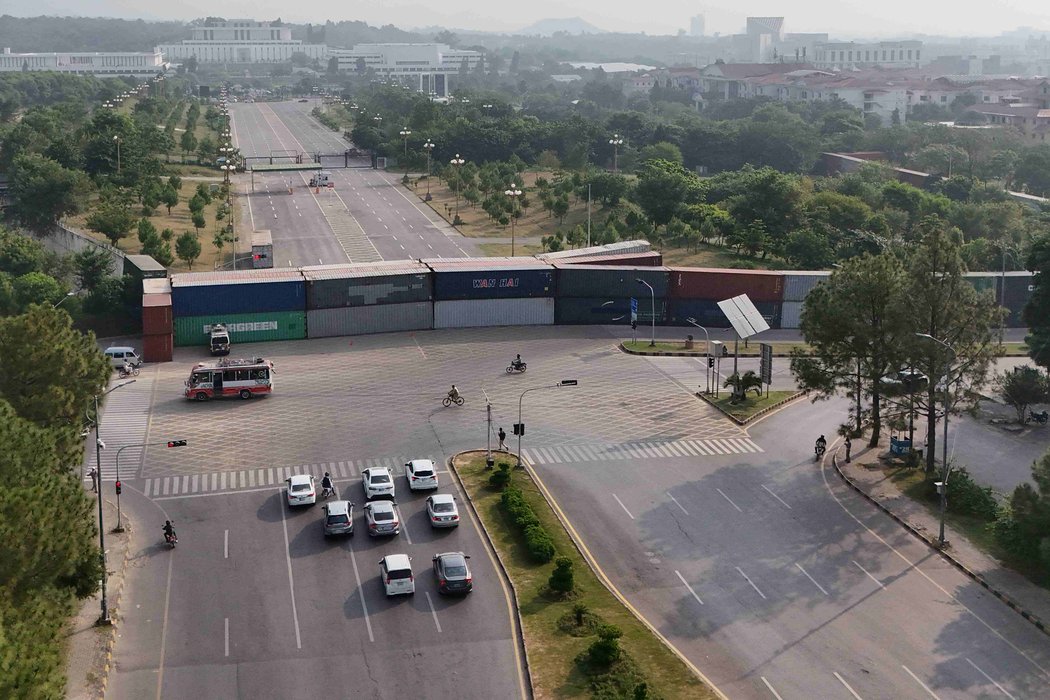
🚨 Islamabad container deployment raises questions over protest management costs Around 3,000 containers have reportedly been placed across Islamabad ahead of the PTI march. According to estimates circulating online, the government is paying around Rs90 million per day in container rentals. If the march is delayed by one week, the reported rental cost alone could reach approximately Rs630 million. This figure does not include additional expenses for deploying thousands of police and security personnel, traffic management, and other operational arrangements. The reported spending has sparked debate over public priorities, with questions being raised about the allocation of hundreds of millions of rupees on security measures while social welfare needs continue to demand attention.
— Naveed Khan (@i_Naveediqbal) September 26, 2026
Authorities in Pakistan's capital blocked main access routes to the city with double-stacked shipping containers ahead of a demonstration by supporters of jailed former prime minister Imran Khan on 27th September 2026.
Police deployed 22,000 security personnel to lock down Islamabad, barring entry and exit to neighbouring Khyber Pakhtunkhwa province, where Khan's party rules. Key highways, entry points, and major intersections were obstructed, completely severing transport links and bringing movement to a virtual standstill.
Furthermore, the Punjab Home Department reportedly asked the federal government to suspend mobile and internet services, as well as the weakening of signals, in selected areas of Attock and Rawalpindi from 27th September 2026. In Rawalpindi, the requested areas include Brahma, Bahter, Taxila, Wah Sadar and Chakri.
PTI’s members of parliament, Sanaullah Mastikhel, Ahsan Jamal Khan and Mian Ghous, were also taken into custody in September 2026, along with dozens of other party activists and workers. PTI Secretary General Salman Akram Raja was also briefly detained by the authorities. PTI workers across Punjab are being detained, and some are being released after signing affidavits stating they will not participate in the protests.
In Rawalpindi more than 100 activists were placed under preventive detention and detained for 30 days at Adiala Jail on the recommendation of the District Intelligence Committee under Section 3 of the Maintenance of Public Order (MPO).
PTI activists booked for rally in Kamalia
On 9th October 2026, it was reported that Kamalia city police had booked 30 activists of the Pakistan Tehreek-i-Insaf (PTI), 10 of them nominated, on the charge of undertaking a rally in Kamalia, Punjab province, demanding the release of the party founder, Imran Khan.
The complainant, a police Sub-Inspector Muhammad Nasir, alleged in the FIR registered under sections 290, 291 and 188 of the Pakistan Penal Code (PPC) and section 16 of the Maintenance of Public Order (MPO) Ordinance that the suspects violated the ban on rallies and blocked Toba-Chichawatni Road and other places to traffic.
Police also conducted raids on the houses of some of the PTI activists nominated in the FIR and arrested one of them, Mukhtar Ahmad.
Wave of arrests following imposed emergency rule in Khyber Pakhtunkhwa
The Peshawar High Court has granted bail to 28 Pakistan Tehreek-i-Insaf (PTI) activists arrested under the Maintenance of Public Order (MPO) Ordinance following the imposition of emergency and governor’s rule in Khyber Pakhtunkhwa. https://t.co/buHnv9Q3Jp
— Dawn.com (@dawn_com) October 25, 2026
After the federal government imposed emergency rule in Khyber Pakhtunkhwa, a new wave of detentions followed.
Two police officials told AFP that 278 PTI members had been detained in the province since the emergency declaration.
Eight senior PTI leaders were taken into "protective custody," including former KP Chief Minister Sohail Afridi, KP Assembly Speaker Babar Saleem Swati, and PTI Provincial President Junaid Akbar. In Swabi, police arrested 56 PTI workers.
In the Hazara division, more than 50 PTI activists and social media influencers were taken into custody as raids continued.
On 25th October 2026, the Human Rights Commission of Pakistan (HRCP) reiterated their concerns against imposing emergency rule in KP. HRCP said the detention of its elected chief executive is a grave affront to democratic norms, while the arrests of other elected representatives and political workers, including women PTI workers in Punjab, point to a wider crackdown on political activity.
They added that preventive and unlawful detention must not become a tool for silencing opposition or bypassing judicial safeguards.
HRCP is also concerned by reports of police raids on PTI workers in Peshawar, Swat and Khyber, and the dispersal of gatherings. In Bara, police reportedly used a lathi charge against a gathering of an estimated 2,000–4,000 people.
Expression
Balochistan tightens checks on security reporting
The Balochistan government has directed media organisations to obtain confirmation from designated official sources before publishing or broadcasting reports about security forces and police, adding to restrictions that journalists say are making timely reporting increasingly difficult in the province.
The instruction, issued by the Balochistan chief minister's press secretary on 18th October and reported by Independent Urdu on 21st October, requires reports concerning the armed forces to be verified through Inter-Services Public Relations (ISPR), while police-related information must be confirmed by the office of the provincial inspector general of police.
The provincial instruction comes as police officers have reportedly been told not to share information about incidents or independently confirm details for journalists. According to Independent Urdu, reporters previously relied on local police stations to verify developments, particularly when official statements from senior authorities were unavailable.
Balochistan Union of Journalists President Manzoor Baloch told Independent Urdu that the restrictions had made reporting more difficult. He said obtaining official confirmation could sometimes take an entire day, delaying news coverage and creating difficulties for journalists working under newsroom deadlines.
New restrictions on TV coverage
On 13th October 2026, the Pakistan Electronic Media Regulatory Authority (PEMRA) ordered all satellite television channels to refrain from broadcasting, rebroadcasting, or airing live coverage of any “unfortunate” or “unpleasant” incident, including explosions, blasts, shootings, and terrorist attacks.
Warning of legal action against broadcasters that don’t comply, PEMRA said they can only air information that has been verified by the relevant government departments or law enforcement agencies. Broadcasters must also use time delays and maintain independent editorial boards, according to the directive.
The directive reiterates restrictions on television channels first issued in February 2023 by PEMRA, which accused TV channels of broadcasting unverified and speculative information during militant attacks.
The Committee to Protect Journalists urged Pakistan authorities to withdraw the sweeping restrictions. It said: “preventing journalists from independent reporting of major security incidents and requiring them to rely on information authorised by state and security agencies risks turning legitimate safety safeguards into a system of official information control and censorship.”
KP internet disruption hampers reporting after emergency
⚠️ Confirmed: Network data show a major disruption to internet connectivity in parts of Khyber Pakhtunkhwa, #Pakistan, as President Zardari imposes emergency rule, suspending the provincial government led by jailed former PM Imran Khan's PTI amid protests demanding his release https://t.co/iygfkKeLTx
— NetBlocks (@netblocks) October 11, 2026
Internet and mobile services were disrupted in parts of Khyber Pakhtunkhwa (KP) after the federal government imposed emergency rule on 11th October 2026, limiting communications as political tensions rose. NetBlocks said network data showed a major disruption to internet connectivity in parts of the province; the monitoring group did not identify the affected locations or quantify the scale of the outage.
Dawn reported that internet and cellular problems were reported in parts of KP after the emergency was imposed, while NetBlocks’ observation confirmed a significant connectivity impact.
Dawn reported on 11th October that all telecom services, including landline and DSL, were suspended in Peshawar, while some areas on the city’s outskirts were unaffected. On 12th October, the newspaper reported that mobile and internet services remained suspended across Swabi district, disrupting residents and businesses that relied on online orders.
The communication failures made independent contact with officials and leaders of the former provincial government impossible, leaving some positions to be communicated through central social-media accounts.
PECA cases registered against journalists
On 7th October 2026, the Balochistan Union of Journalists (BUJ) said a Prevention of Electronic Crimes Act (PECA) was registered against Hamad Ali, a Quetta reporter for 92 News, and that the National Cyber Crime Investigation Agency (NCCIA) issued him a notice over a news report. The union said the report was based on verified information in a registered FIR and had also been carried by other media outlets.
The BUJ strongly condemned the case and urged the Balochistan government, Inspector General of Police and senior NCCIA officials to take notice of the matter, ensure due process and prevent unnecessary interference in journalists’ professional duties.
The PECA law criminalises vague categories of ‘fake and false information’ with penalties of up to three years’ imprisonment. It also establishes a powerful regulatory authority, a complaints council, and a tribunal - all of which are subject to disproportionate executive control.
On 12th October 2026, journalist and TV anchor Iqrar ul Hassan was picked up from his residence late at night. The NCCIA produced Hassan before a judicial magistrate and he was held in remand.
The case against Hassan, filed under Sections 9, 10, 20, 24, and 26-A of the Prevention of Electronic Crimes Act (PECA) 2016, stated that the journalist, "through his personal social media accounts on the platforms X, Instagram and Facebook, is intentionally disseminating false, fabricated, anti-state and defamatory content with the object of instigating the general public against the state, its institutions and its functionaries."