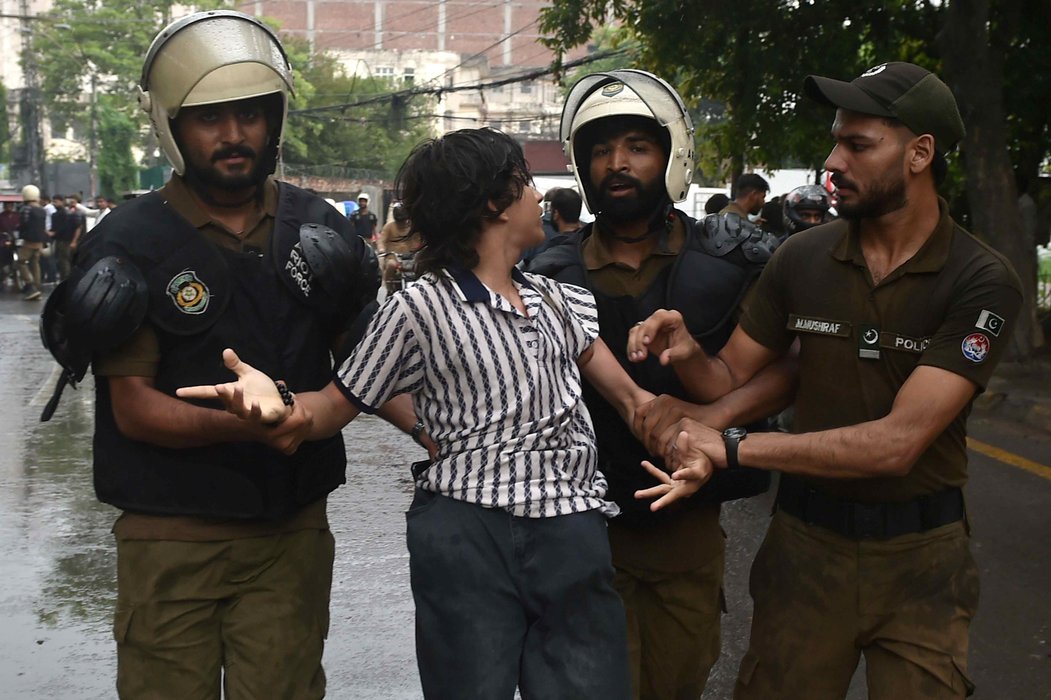
The state of civic space in Pakistan is rated as ‘repressed’ by the CIVICUS Monitor. Ongoing concerns include the repression against the opposition, the censorship of journalists and attacks on peaceful protests held by the opposition and human rights movements. Other ongoing concerns include the criminalisation, threats and harassment against human rights defenders and the failure to hold perpetrators to account. There have also been violations documented against ethnic Pashtun, Sindh and Baloch minorities and women’s rights activists.
In recent months, Baloch rights defenders were handed life sentences following a secret trial, the brother of a prominent human rights defender was forcibly disappeared and security forces raided the home of a woman human rights defender. Police detained Aurat March Karachi organisers, Punjab passed a law to allow ‘secret’ terrorism trials while a former police surgeon was arrested in Quetta on terrorism charges. There was a crackdown in Pakistan-Administered Kashmir on the Jammu and Kashmir Joint Awami Action Committee, including with arrests and designating them ‘terrorists’. The internet was blocked, and journalists restricted and detained around the crackdown in Kashmir.
Association
Baloch rights defenders handed life sentences following secret trial
Baloch Voice for Justice stands in solidarity with the leadership of the Baloch Yakjehti Committee. The imprisonment of Dr. Mahrang Baloch and Sibghatullah Shah Jee Baloch represents a serious attack on peaceful political activism, democratic rights, and the struggle for justice… pic.twitter.com/DqDwc7q07q
— Baloch Voice For Justice (@BalochV4Justice) June 24, 2026
On 22nd June 2026, Baloch activists Mahrang Baloch and Sibghat Ullah Shah Jee were convicted and sentenced under section 302 (murder) of the Pakistan Penal Code and section 7 of the Anti-Terrorism Act, 1997 for the alleged killing of a law enforcement officer from the Frontier Corps (FC) during the Baloch Raji Machi (Baloch National Gathering) in July 2024.
According to Amnesty International, the judgment implicates Mahrang for participating in the assembly and allegedly delivering an inciting speech and referring to state officials as “occupiers”, without demonstrating whether mere speech meets the threshold for a murder or terrorism offence. Shah Jee was implicated for being part of a crowd that charged at the FC officer.
Mahrang and Shah Jee boycotted the trial proceedings due to the persistent denial of their right to a fair trial and the alleged bias of the judge. A state-appointed defence counsel represented them in the later stages of the trial, but did not consult with them. In the later stages of the trial, Mahrang and Shah Jee were only given the option to join via video link.
Mahrang Baloch and Sibghat Ullah Shah Jee are members of the Baloch Yakjehti Committee (BYC), a peaceful civil rights movement in Pakistan advocating for an end to enforced disappearances, extrajudicial murder and economic injustice in Balochistan province. They have been under unlawful detention since March 2025.
UN experts said they were ‘gravely alarmed by the unjustified sentencing’ which was a ‘travesty of justice’, following an unfair trial and the misuse of counter-terrorism laws and murder charges to suppress peaceful protest and freedoms of association and expression.
The experts are concerned about Dr. Mahrang Baloch’s health and poor conditions of detention, including inadequate access to medical care, and allegations of pressure on her family.
Brother of prominent human rights defender forcibly disappeared
Since 21 April 2026, I have been waiting for my brother, Dad Shah Baloch.
— Fozia Baloch Shashani (@FoziaBaloch10) May 16, 2026
Every day feels longer than the last, filled with pain, uncertainty, and unanswered questions.
I sit holding his picture, hoping for the moment he returns home safely.
No sister should have to live with… pic.twitter.com/Wz0J9U5ETH
Dad Shah, brother of well-known woman human rights defender Fozia Baloch, was forcibly disappeared from his home in Karachi, Sindh, on 21st April 2026 by state officials allegedly belonging to the Counter Terrorism Department.
According to Amnesty International, despite the presence of multiple eyewitnesses when he was taken, the police have failed to adequately investigate the case, and his family members have since been harassed and arbitrarily detained by law enforcement for raising the issue of his disappearance.
Dad Shah, a 38-year-old man of Baloch ethnicity residing in Karachi, Sindh province, worked with his brother at a family-owned shop. Dad Shah has a keen interest in poetry and translating literary works into Balochi language and often shared his work on social media. His sister, Fozia Baloch, is a well-known woman human rights defender from Balochistan affiliated with the Baloch Yakjehti Committee (BYC). She actively campaigns for the rights of families searching for their disappeared loved ones and has supported families demanding justice for victims of extrajudicial executions.
After Shah was forcibly disappeared, his family approached the local police station to file a complaint regarding his abduction, but the police refused to file a First Information Report (FIR). Eventually, when the report was registered four days later, it was against “unknown persons” despite the family’s insistence that state personnel be named.
His sister, Fozia Baloch, and his mother were blocked from holding a press conference at the Karachi Press Club, and on their way back home they were stopped by the police, subjected to ill-treatment, arrested, and booked in a criminal case.
Security forces raided the home of woman human rights defender
📍PAKISTAN
— Front Line Defenders (@FrontLineHRD) June 30, 2026
🚨Pakistan security forces raided the home of WHRD Sammi Deen Baloch in Karachi.
FLD strongly condemns the targeting of the defender and believes the raid is a direct reprisal for her peaceful human rights work.
🔗 https://t.co/cUx5Oc5ZQ6 pic.twitter.com/QU4vey6DGy
On 28th June 2026 Pakistan security forces raided the home of woman human rights defender Sammi Deen Baloch in Karachi, Pakistan. Sammi Deen Baloch and her family were not home when the raid happened. The raid occurred as the family commemorated the 17th anniversary of the enforced disappearance of her father.
Sammi Deen Baloch is a Baloch women’s human rights defender from Mashkai, Awaran District of Balochistan province, Pakistan. She is the General Secretary of the Voice for Baloch Missing Persons (VBMP), a non-governmental organisation that represents and supports victims and relatives of enforced disappearances in Balochistan.
Police detain Aurat March Karachi organisers
Veiled police officers detain a Pakistani artist and human rights activist Sheema Kirmani, an organiser of the "Aurat March" or "Women's March", outside Karachi Press Club, where she was scheduled to address a press conference, in Karachi, May 5, 2026. REUTERS/Akhtar Soomro pic.twitter.com/ruF4ggkVhW
— Ariba Shahid (@AribaShahid) May 5, 2026
In May 2026, police detained seven Aurat March activists near the Karachi Press Club (KPC), following orders from Sindh Home Minister Ziaul Hasan Lanjar.
The activists were detained after they gathered at the club for a press conference to demand a no-objection certificate (NOC) for their upcoming annual march in Karachi planned on Mother’s Day (10 May). Among those detained were 75-year-old human rights activist Sheema Kermani. They were released later that day.
The Human Rights Commission of Pakistan (HRCP) and other activists strongly condemned the detentions of Aurat March activists noting that the incident was not an “isolated overreach but rather part of a broader and deeply troubling pattern: the systematic denial of public space to citizens seeking to articulate their rights”.
Aurat March (Women’s March) events have been held by women in towns and cities across Pakistan since 2018 to reclaim their space in society, speak up for their rights and demand justice from the system that has failed them because of patriarchal structures. The protests have taken the form of marches, public art displays and performances highlighting the challenges faced by women.
Court yet to hear appeal of human rights lawyers
PAKISTAN:
— Agnes Callamard (@AgnesCallamard) September 8, 2026
Human rights lawyers Imaan Mazari-Hazir and Hadi Ali Chattha remain behind bars for more than seven months while their appeals languish in Pakistan's courts. Meanwhile, there are concerns about Imaan's worsening health and access to adequate medical care.
No one… pic.twitter.com/W3Mqd5FHTc
More than eight months after human rights lawyers Imaan Mazari-Hazir and Hadi Ali Chatta were arbitrary arrested and sentenced, their appeal against their sentence and conviction has yet to be heard.
As previously documented, the two human rights lawyers were sentenced to 17 years’ imprisonment under the Prevention of Electronic Crimes Act (PECA) under sections 9 (glorification of an offence), 10 (cyber terrorism), and 26-A (false and fake information). The case was based on tweets published between 2021-2025 which highlighted human rights violations in Pakistan. Human rights groups found the trial to be flawed and were systematically denied their due-process rights including the right to mount an effective defence.
According to Amnesty International, since their imprisonment, Imaan and Hadi have filed applications appealing their conviction and for suspension of their imprisonment. These applications have not been heard by the courts through delaying tactics such as refusing to list the case. On 2nd March, the Islamabad High Court dissolved the bench due to hear their appeal. After appealing to the Supreme Court, the court directed the Islamabad High Court on 12th May to pass a verdict on the sentence suspension pleas within two weeks. Despite these orders, no substantial hearing of the appeal has taken place.
The human rights group said that Imaan Mazari-Hazir has experienced serious health concerns in detention for which she needed urgent healthcare and to which the authorities repeatedly denied her access.
Punjab allows ‘secret’ terrorism trials
On 31st August 2026, politicians in Punjab province passed a law allowing terrorism trials to be held in near-total secrecy, with the judge, prosecutor and witnesses permitted to remain anonymous.
Under the Anti-Terrorism (Punjab Amendment) Bill 2026, a person facing the country’s most serious criminal charge could be convicted without learning who heard the case against them, who prosecuted it or who testified.
The law lets the government appoint a senior bureaucrat as a “designated authority” tasked with deciding what cases are to be heard under the special provisions earmarked in the legislation. The official’s identity is kept confidential, known only to the chief justice of the Lahore High Court. The official can declare any terrorism case, or even a whole category of them, a “special security case” if they conclude that the people involved need special “protection”.
The law does not clearly define the parameters that need to be met, and the accused cannot contest being placed under this category. Once the official requests it, the chief justice assigns the case to a sitting anti-terrorism court judge. A panel of five public prosecutors is drawn up, and the official picks one.
From there, the identities of the judge, prosecutor, police officers, witnesses and defence lawyers cannot be disclosed under any circumstances. Official titles are used instead of names, and court orders are signed without revealing who signed them.
Opposition politicians argued the law violates the constitutional right to a fair trial and hands judicial-style powers to an unelected official with no oversight.
The Human Rights Commission of Pakistan (HRCP) also raised the alarm. They said that the secrecy they impose is inconsistent with the Constitution and the International Covenant on Civil and Political Rights (ICCPR), which the government has ratified. The Bill also reflects a broader pattern of invoking security justifications to expand state power at the expense of fundamental rights.
Dr Ayesha Faiz arrested on terrorism charges after Quetta press conference
On 7th September 2026, the Counter-Terrorism Department (CTD) arrested former police surgeon Dr Ayesha Faiz for her comments during a press conference at the Quetta Press Club the week before.
An Anti-Terrorism Court (ATC) then remanded her for three days. Officials confirmed that multiple cases have been registered against the former police surgeon with both the CTD and the National Commission for Child Rights (NCCI).
She was accused of “speaking in favour of leaders” of banned terrorist organisations and praising their anti-state actions. She is being investigated under sections 11F(4) and (6) (membership, support and meetings relating to a proscribed organisation), Section 11X(3) (responsibility for creating civil commotion), 11W (giving projection to any person convicted for a terrorist act or any proscribed organisation or anyone concerned in terrorism), and 27B (conviction on the basis of electronic or forensic evidence etc) of the Anti-Terrorism Act, 1997.
Balochistan Home Minister Mir Ziaullah Lango said that the police action was taken due to her alleged statements against the state and state institutions.
Peaceful Assembly
Women’s march held in Karachi despite restrictions
A well written and comprehensive account by Hamza Azeem putting the event in perspective.
— beena sarwar (@beenasarwar) May 11, 2026
Despite restrictions and uncertainty, Aurat March marches on in Karachi https://t.co/2faBVUN26o#AuratMarch #Karachi #WomensRights #Pakistan #MaritalRape #JusticeForShanti
In May 2026, women rights activists held an Aurat March despite restrictions imposed by Pakistan’s Sindh administration.
The provincial government issued a conditional no-objection certificate for Aurat March Karachi, allowing the annual women’s rights march to take place on 10th May 2026 while imposing 28 conditions on participants. The restrictions included a ban on promoting LGBTQ content, a prohibition on “objectionable clothing,” and limits on anti-state and anti-religious slogans, banners, speeches, and other material. The organisers had rejected some of the conditions.
The permit came after a confrontation outside the Karachi Press Club, where police prevented Aurat March organisers from holding a press conference about the planned march and detained several activists. (see above)
Aurat March events have been held since 2018 in major Pakistani cities, including Karachi, Lahore, and Islamabad, to mark International Women’s Day. This year, organisers did not hold the Karachi event on its usual 8th March date because it fell during the holy month of Ramadan. They later announced that the march would be held on 10th May, which this year coincided with Mother’s Day in Pakistan.
Movement designated as ‘terrorists’ in Jammu and Kashmir
On 5th June 2026, the region’s authorities issued a notification designating the Jammu and Kashmir Joint Awami Action Committee (JKJAAC) as a “proscribed organisation” under the first schedule of the Azad Jammu and Kashmir Anti-Terrorism Act, 2014.
The JKJAAC is a grassroots movement advocating for the economic and political rights of the people of Pakistan-administered Jammu and Kashmir.
On 5th June, Pakistan’s government announced that elections would be held in Pakistan-administered Jammu and Kashmir on 27th July. On the same day, it suspended all internet and mobile network signals in the region until 12th June, ahead of a protest planned by the JKJAAC for 9th June after negotiations with the government over the make-up of the region’s legislature broke down.
According to Amnesty International, since 5th June, the authorities have carried out a brutal crackdown against JKJAAC leaders and members. According to media reports, police arrested more than 100 people associated with the JKJAAC on 6th and 7th June 2026 and raided and sealed the organisation’s central office in Muzaffarabad city on 7th June.
JKJAAC activist Shahzeb Habib was shot during an encounter with police on the night of 5th June. He was reportedly travelling in a car with JKJAAC member Umar Nazir Kashmiri when their vehicle was stopped.
On 7th June 2026, people gathered outside the Combined Military Hospital (CMH) in Rawalakot where Shahzeb’s body had been brought for a post-mortem. At least eight protesters and four police officers were killed during ensuing clashes.
UN raises concerns on crackdown in Pakistan-Administered Kashmir
PAKISTAN: In the past 50 days, people in Pakistan-administered Jammu and Kashmir have lived through internet blackouts, mass arbitrary arrests and restrictions on movement amid a crackdown on dissent.
— Amnesty International South Asia, Regional Office (@amnestysasia) July 25, 2026
These measures raise serious concerns about the rights to freedom of… pic.twitter.com/z3mROULgHS
In July 2026 UN Human Rights Chief Volker Türk highlighted the unrest in Pakistan-Administered Kashmir ahead of regional elections at the end of the month.
He noted that dozens of people, mostly protesters but also law enforcement personnel, have reportedly been killed since June ahead of the vote for the Legislative Assembly on 27th July.
The High Commissioner called for prompt, thorough and impartial investigations into all deaths that have occurred due to the unrest.
The UN chief also said that some leaders of the banned Joint Awami Action Committee (JAAC) have been arrested and that the criminalisation of a civil society organisation and the imposition of strict limitations on gatherings raise serious concerns about infringements on the rights to freedom of expression, peaceful assembly and association. He added that detained JAAC leaders must have access to legal representation and their families, and their rights to due process and fair trial must be fully guaranteed.
Reports highlight restrictions and attacks on civic space in Azad Jammu and Kashmir
REPORT LAUNCH
— Human Rights Commission of Pakistan (@HRCP87) August 31, 2026
Our latest fact-finding report has traced the recent unrest in Azad Jammu and Kashmir (AJK) to institutional distrust, extensive restrictions on freedom of expression and connectivity, and an increasingly confrontational state response, including the… pic.twitter.com/t6KCee7Ut4
The Human Rights Commission of Pakistan (HRCP) conducted a fact-finding and election observation mission from 8th to 10th August 2026 and published a report.
It was particularly concerned by allegations of lethal and excessive use of force against protesters. It received multiple accounts alleging that protesters had been killed or seriously injured by security forces.
HRCP was also concerned by reports of arbitrary or inadequately documented arrests and detention of political activists, journalists and others associated with the protests. The placement of at least 147 JAAC activists on the Fourth Schedule, with additional names reportedly added later, and the use of anti-terrorism legislation against persons engaged in political dissent, raise serious questions regarding necessity and proportionality.
The report also noted that restrictions on journalism and access to information further constrained civic space. Arrests and legal action against journalists, restrictions on access to affected areas, special security requirements and the prolonged communications shutdown severely limited independent reporting.
Expression
Internet blocked, journalist restricted and detained around crackdown in Kashmir
Following the sweeping crackdown in Azad Jammu and Kashmir there have also been restrictions on the flow of information.
According to Reporters Beyond Borders (RSF), the authorities restricted the internet and stepped up measures to restrict media coverage of the region.
Internet access was suspended in the region on 5th June 2026 and has only been partially restored.
On 2nd August 2026, the Ministry of Information and Broadcasting blocked access to the Al Jazeera website, accusing the media outlet of sensationalised news coverage of the region.
On 4th August 2026, the Ministry of Information and Broadcasting then imposed new draconian guidelines: under the new 'Foreign Media Facilitation Guidelines 2026', foreign correspondents – including Pakistani journalists working for international media outlets – are required to obtain a No Objection Certificate (NOC) to cover news outside the cities of Islamabad, Lahore, and Karachi. The guidelines also stipulate that media professionals may have their accreditation revoked for vague reasons such as “acts contrary to Pakistan’s ideology, sovereignty, security, or public order".
#Pakistan: CPJ calls on Pakistani authorities to immediately release journalist Sohrab Barkat who was arrested on June 5 at his home in Islamabad over reports on his YouTube channel about protests in Pakistan-administered Kashmir.
— CPJ Asia (@CPJAsia) June 12, 2026
Pakistani authorities previously detained…
Journalist Sohrab Barkat was arrested on 5th June 2026 at his home in Islamabad over reports on his YouTube channel about the protests in Pakistan-administered Kashmir. The National Cyber Crime Investigation Agency (NCCIA) filed a First Information Report against Barkat alleging he had violated Pakistan’s Prevention of Electronic Crimes Act (PECA), which makes the dissemination of “fake or false” information a criminal offence punishable by up to three years in prison. He was remanded in custody for three days.
#Pakistan: CPJ is deeply concerned about the deteriorating health of Times of Kashmir journalist Syed Farhad Ali Shah, who has been detained since June 20 under the Maintenance of Public Order Ordinance after covering protests in Pakistan-administered Kashmir.
— CPJ Asia (@CPJAsia) July 29, 2026
Held for more than…
Journalist Syed Farhad Ali Shah, who reports for the social media-focused outlet Times of Kashmir, was detained by police in July 2026 after covering the Kashmir demonstrations. He was detained under the Maintenance of Public Order Ordinance, a colonial-era law that allows detention without charge for up to six months. He was released after nearly 75 days in administrative detention.
The crackdown also targeted journalists Razi Tahir and Muhammad Saif. These two independent journalists, who work for the YouTube channel The Independent Lens, were detained in Islamabad on 1st August 2026, after covering a demonstration in the capital in support of the protest movement in Kashmir. The journalists had also reported on the unrest in Pakistan-administered Kashmir.
Pakistan ranks 153rd out of 180 countries in RSF’s 2026 World Press Freedom Index.
Court remands journalist in PECA case
A judicial magistrate in Islamabad on Monday granted the National Cyber Crime Investigation Agency (NCCIA) three-day physical remand of journalist Bilal Ghauri in a case registered under the Prevention of Electronic Crimes Act (PECA).
— The Current (@TheCurrentPK) September 7, 2026
Details: https://t.co/pXGuRX2nn1
On 7th September 2026, an Islamabad court granted the National Cyber Crime Investigation Agency a three-day physical remand of senior journalist, columnist, and anchor Bilal Ghauri in a case concerning his online commentary about the appointment of the National Counter Terrorism Authority's national coordinator.
The case invokes Sections 20 and 26-A of the Prevention of Electronic Crimes Act (PECA), which concern offences against the dignity of a person and the dissemination of false or fake information.
The FIR alleges that Ghauri uploaded a post on X and a 16-minute YouTube vlog on 5th September concerning the appointment of Maj Gen Faisal Naseer as NACTA's national coordinator and had intentionally created and circulated a false and misleading narrative about the circumstances surrounding the appointment.
PECA is a draconian law that contains broad and vague provisions and disproportionate penalties to criminalise online defamation. It has been used to target activists, journalists and online critics.