Introduction
Denmark is rated “open” by the CIVICUS Monitor. According to the 2026 Civic Space Report on Denmark, published by the European Civic Forum and the Danish civil society organisation Nyt Europa, Danish civil society faced pressure in 2025 stemming from political discourse and administrative practices rather than formal legal restrictions.
Despite the country’s “open” rating, the report identified a number of challenges, including public discourse portraying civil society organisations (CSOs), particularly those working on minority rights, climate activism and Palestine solidarity, as illegitimate or “anti-democratic”.
It also raised concerns about the policing of demonstrations deemed “politically sensitive”, citing several incidents of excessive force and mass detentions.
The report highlighted unstable funding as a major challenge, noting that some organisations critical of the government had faced threats of defunding. In addition, online harassment and smear campaigns targeted activists working on climate, gender and Palestine-related issues, contributing to a more hostile public climate.
Freedom of association
NGOs challenging arms exports to Israel face political pressure and threats to funding; Supreme Court bars them from pursuing the case
On 18th March 2026, Denmark’s Supreme Court ruled that Amnesty International Denmark, Mellemfolkeligt Samvirke and Oxfam Denmark cannot bring a legal challenge against Danish arms exports to Israel. The ruling followed an April 2025 decision by the Eastern High Court that the organisations lacked legal standing to pursue the case.
The organisations sued the Danish state in 2024 over permits allowing Danish companies to export components for F-35 fighter jets used by Israel in Gaza. They argued that the exports violated international arms trade regulations and that the authorities had failed to assess the risk that the equipment could contribute to violations of international humanitarian law, including war crimes.
The organisations said they were disappointed, arguing that the decision prevented Danish courts from examining the legality of the exports. They called on politicians to ensure that Denmark complies with its international obligations, including under the UN Arms Trade Treaty and EU arms export rules.
The lawsuit drew political criticism, pressure and threats of defunding. Previously, in October 2025, Helle Bonnesen, a member of parliament for the Conservative People’s Party, called for the organisations’ public funding to be cut. She said that “an NGO should not be able to drag the state into court with one hand while receiving public funding with the other”. Bonnesen and her party later walked back the comments.
On 28th October 2025, a citizens’ initiative was launched online calling on parliament to withdraw state funding from Mellemfolkeligt Samvirke, but it failed to secure the necessary support. While initiatives must gather 50,000 signatures within 180 days to be considered by parliament, this one gathered only around 1,600 within the deadline.
Political attacks on civil society funding continued in 2026. In June 2026, Liberal Alliance political spokesperson Mads Strange claimed on social media that Mellemfolkeligt Samvirke had wasted taxpayers’ money on political advertisements campaigning for more Danish citizenships. Berlingske later reported that the claim was false, saying the advertisements were privately financed and not paid for with public funds.
Freedom of peaceful assembly
Court upholds detention of climate protesters
On 14th July 2025, the Eastern High Court (Østre Landsret) ruled that Copenhagen Police had acted lawfully in administratively detaining five climate activists from the Nødbremsen (Emergency Brake) movement during a road-blocking protest in June 2024.
The activists had blocked a major intersection on Vejlands Allé in Copenhagen during the morning rush hour as part of a demonstration against the government’s climate policies. They were held for several hours and later sought compensation, arguing that the detention was unlawful.
The High Court upheld earlier judgments of the Copenhagen City Court, finding that the blockade constituted a “significant disturbance of public order” under section 8(1) of the Danish Police Act. It accepted the police assessment that less intrusive measures would not have been sufficient to restore traffic and public order. The court also found no evidence that the protesters had been held for longer than necessary or subjected to unlawful treatment in custody. The compensation claims were therefore dismissed.
Jyllands-Posten journalists strike over planned job cuts
On 11th November 2025, editorial employees at Jyllands-Posten decided to strike after negotiations with management over planned redundancies and budget cuts broke down. The walkout followed weeks of talks over the newspaper’s plan to cut costs by DKK 16.9 million (around EUR 2.2 million) in 2026. Employees accused management of negotiating in bad faith and failing to make genuine efforts to avoid redundancies. The strike was also intended as a show of solidarity with colleagues due to receive redundancy notices the following morning.
According to the employee association, management presented new austerity demands at the final stage of negotiations that it said conflicted with the collective agreement and extended into 2027. Management rejected the allegations, saying it had held numerous meetings with union representatives, explored several alternatives to reduce the number of layoffs and identified additional non-salary savings. The newspaper described the strike as a breach of the collective agreement’s peace obligation and confirmed that the redundancies would go ahead.
Thousands protest in Denmark and Greenland against Trump’s annexation threat
On 17th January 2026, thousands of people protested in Denmark and Greenland against US President Donald Trump’s demand that Greenland be ceded to the United States, calling for the territory’s right to self-determination.
In Copenhagen, demonstrators marched to the US embassy carrying Greenlandic flags and banners reading “Greenland is not for sale” and “Hands off Greenland”. Organisers estimated that more than 20,000 people attended, although police did not provide an official figure.
In Nuuk, Greenland’s capital, thousands marched towards the US consulate, led by Prime Minister Jens-Frederik Nielsen. Protesters chanted the territory’s name in Greenlandic and displayed similar slogans.
The demonstrations followed repeated threats by Trump to take control of Greenland, including his refusal to rule out military force, which have caused diplomatic tensions between the US and Denmark. Greenland, a semi-autonomous territory of Denmark, has increasingly asserted its right to determine its own future.
Four Danish students face trial over pro-Palestinian university blockade
In June 2026, four University of Copenhagen students went on trial on trespassing charges over a pro-Palestinian protest in September 2024. They were among six people, including climate activist Greta Thunberg, arrested during an attempt by the group Students Against the Occupation to blockade the university’s administration building and pressure the institution to adopt an academic boycott of Israeli universities.
The four students deny taking part in the initial forced entry and say they arrived later. The university subsequently issued them with written warnings for violating its code of conduct.
The students argue that the prosecution threatens freedom of expression and the right to engage in campus activism, and have warned that a guilty verdict could criminalise student blockades. The case follows a series of university disciplinary measures and police interventions targeting pro-Palestinian student protests.
The trial is scheduled to continue for two and a half court days in September and October 2026.
Danish police use batons and detain pro-Palestinian protesters outside Maersk headquarters
On 13th May 2026, Danish police violently detained around 20 activists protesting outside the Copenhagen headquarters of shipping company Maersk. The demonstration was organised as part of the “Mask off Maersk” campaign, which accuses the company of transporting weapons and other goods linked to Israel during the war in Gaza, which the campaigners describe as genocide.
The protesters attempted to blockade the entrances to the headquarters, demanding that Maersk end business ties that they say contribute to Israel’s military operations. They carried banners reading “Maersk serves genocide” and chanted slogans including “Denmark, say no to genocide”.
According to Arbejderen, the outlet of Denmark’s Communist Party, around 100 police officers were deployed to disperse the protesters. Video footage showed officers using batons, deploying unmuzzled police dogs and dragging activists away before detaining around 20 people and removing them from the site.
Copenhagen Police later confirmed that some protesters had also been charged under Section 119 of the Danish Criminal Code with “violence against a public official”. The 20 people had initially been charged with trespassing, and police did not specify how many faced the additional charge.
The demonstration took place amid wider efforts by pro-Palestinian groups across Europe to pressure companies accused of maintaining commercial or logistical links with Israel during the war.
Eastern High Court rules in favour of 248 protesters over 2019 police checkpoint
In July 2025, the Eastern High Court ruled in favour of 248 protesters who had challenged Copenhagen Police’s refusal to bring their case over alleged unlawful deprivation of liberty before the district court. The case stems from a Workers’ Day demonstration on 1st May 2019, when police set up a checkpoint on Queen Louise’s Bridge as protesters marched from Israels Plads towards Fælledparken.
Police sought to register and search demonstrators following reports that some had violated a ban on face coverings and that fireworks had been set off. The protesters argued that they had been unlawfully deprived of their liberty, while police maintained that they had been detained only temporarily for inspection.
The court ruled that the police’s refusal to refer the case was unjustified, upholding an earlier ruling by the Copenhagen City Court.
Over 100 pro-Palestinian protesters detained at protest against arms manufacturer Terma
On 10th August 2026, Danish police forcibly dispersed pro-Palestinian activists demonstrating outside the headquarters of defence company Terma in Lystrup, near Aarhus, and detained more than 100 people. The activists opposed the company’s alleged involvement in supplying weapons used by Israel in Gaza. They poured red paint over windows and signs and walked onto the road, disrupting traffic.
According to Arbejderen, police used excessive force against the demonstrators, beating them with batons after the action even though activists were reportedly not resisting. The outlet said one activist was struck in the face and several sustained broken bones. Some were held for up to six hours before being released and told they faced charges for walking on the road in violation of traffic regulations and for failing to follow police instructions.
East Jutland Police reported that 141 people were detained and charged under the Traffic Act and for disobeying police orders. It said 40 people who refused to identify themselves were taken to a police station, and two remained in custody pending identification.
Six Greenpeace activists charged over banner protest at Danish agriculture ministry
On 27th August 2026, six Greenpeace activists were charged with violating public order and disturbing the peace after hanging a banner on the Copenhagen building that houses Denmark’s Ministry of Agriculture and Food. The banner, which read “Here the dead fjords begin”, was part of a protest against water pollution and oxygen depletion in Danish fjords and coastal waters.
According to Greenpeace, ten activists took part in the action, with several climbing onto the roof and raising a red flag, warning of dangerous conditions for marine life. Police received a report at 7:12 a.m. and concluded their operation shortly after noon, when all six protesters had voluntarily come down. Copenhagen Police said the activists had not been detained and that the incident had ended peacefully. The six face charges of allegedly failing to comply with police orders and disturbing the peace.
Two arrested as right-wing march and anti-fascist counter-protest clash in Copenhagen
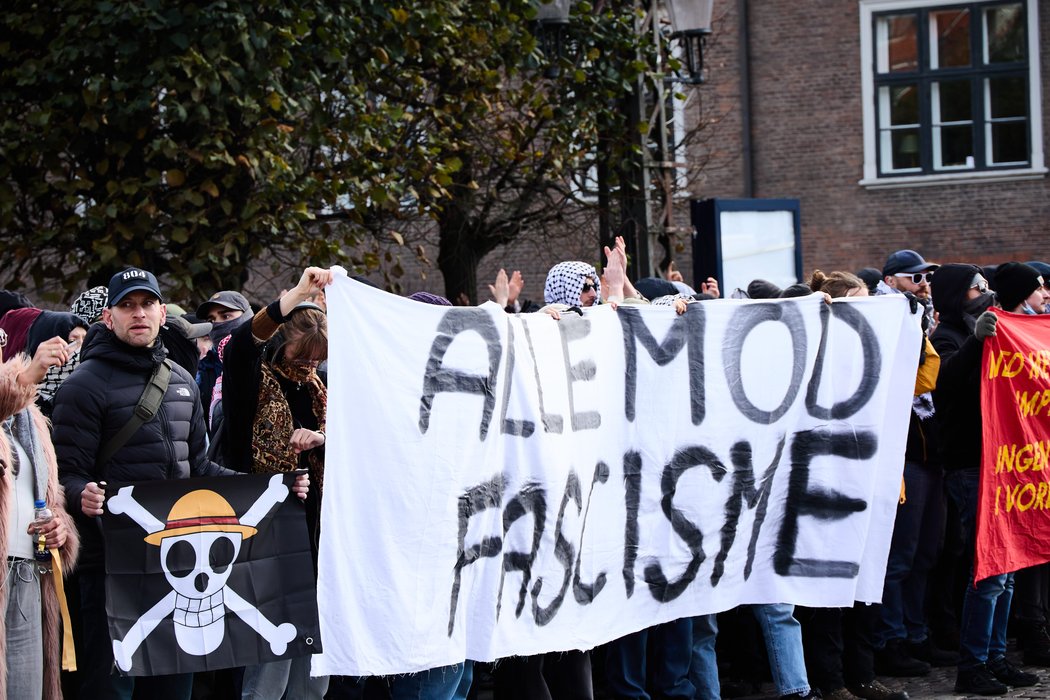
On 5th September 2026, a right-wing demonstration and an anti-fascist counter-protest took place in Copenhagen on Denmark’s Flag Day, which honours Danes deployed in service abroad.
The right-wing organisation Det Danske Folk organised a procession dubbed the “March for Denmark” under the slogan “for Denmark, for freedom, security, Danish culture and national unity”. The group described the event as a peaceful and non-partisan procession supporting what it calls a “fair and realistic remigration” policy. It also said Denmark should remain “culturally cohesive” and that immigration policy should be based on Danish law and interests. Far-right activists use the term “remigration” to refer to the mass deportation of non-white immigrants, regardless of their citizenship status.
Det Danske Folk publicly rejects racism and political extremism. However, the anti-fascist research collective Redox reported before the march that people with previous links to Danish neo-Nazi and far-right groups planned to attend. During the demonstration, Redox also documented black-clad participants and people displaying Nazi symbols and gestures.
The Joint Initiative Against Racism and Discrimination and other groups organised a counter-demonstration opposing racism and promoting equality. Organisers estimated that more than 1,000 people attended the right-wing march and more than 2,000 joined the counter-protest.
Police used batons and formed a barricade to prevent counter-demonstrators from approaching the march. When the groups crossed paths near the US embassy, participants shouted slogans and insults, fired cannon shots and threw Roman candles towards the counter-demonstrators. Police intervened to keep the groups apart. Two people were arrested in connection with the demonstrations: a counter-protester who police said disobeyed orders, and another person arrested over pyrotechnics.
Eight arrested at Copenhagen “remigration” march and counter-protests
On 17th October 2026, eight people were arrested during another demonstration organised by the right-wing Det Danske Folk movement and counter-protests in central Copenhagen. Anti-racist counter-protesters gathered at several points along the march route under the slogan “No to remigration - no to racism”.
The march began at Kongens Nytorv at 2 p.m. and proceeded towards Christiansborg Palace Square, ending at Højbro Plads. According to Copenhagen Police Deputy Inspector Jakob Hansen, two participants from opposing demonstrations who had got into an altercation were arrested before the march, and one person was arrested for refusing to identify themselves. Five others were detained at around 5 p.m. as the demonstration dispersed. Hansen said smaller groups began putting on masks and confronting others, prompting clashes with police. Officers used police dogs and batons against demonstrators. Police did not disclose the reasons for the five later arrests or say what charges, if any, the eight detainees might face.
Two press photographers were attacked by riot police while covering the demonstrations. Anthon Unger of Ekstra Bladet said a plainclothes officer hit him on the arm despite his clearly visible press badge. Video footage published by the newspaper showed the officer striking him with a baton and reaching towards his camera. Thomas Borberg of Politiken said he was struck repeatedly and that his camera was damaged. He reportedly required hospital treatment.
The editors of both newspapers said they planned to file formal complaints with Copenhagen Police and the Independent Police Complaints Authority (DUP). Politiken editor-in-chief Christian Jensen described the incident as an unacceptable attack on press freedom.
Freedom of expression
Journalist threatened after reporting on Hizb ut-Tahrir
On 9th July 2025, Danish journalist Claes Kirkeby Theilgaard received multiple threats and intimidating messages shortly after publishing an article in B.T. about alleged members of Hizb ut-Tahrir, a transnational Islamist organisation.
After the article was shared on B.T.’s Facebook page, a user posted a comment directed at Theilgaard, claiming to have collected personal information about him and suggesting it would be shared with others. Theilgaard reported the threat to police and said the incident was part of a longer pattern of harassment linked to his reporting on the group. He had previously received abusive messages and online accusations, including being labelled “Islamophobic” and an “Israeli agent”. In May 2024, a person who threatened the lives of Theilgaard and his family received a 50-day detention sentence and probation.
The European Federation of Journalists and Media Freedom Rapid Response highlighted the case as an example of growing pressure and intimidation targeting reporters. The threats raised concerns among press freedom organisations about the safety of journalists covering sensitive political and religious topics.
Press groups oppose plan for state-funded media ombudsperson
On 10th September 2025, organisations representing media outlets and journalists across the Nordic region raised concerns about the Danish government’s proposal to establish a publicly funded Media Ombudsperson. Under the proposal, the new institution would be able to initiate criminal proceedings against media organisations in cases involving defamation and privacy, take part in civil litigation, and seek legal aid on behalf of complainants.
The plan has met strong opposition from media and journalist associations, including the Danish Union of Journalists – Media & Communication (DJ), the European Federation of Journalists and Media Freedom Rapid Response. They argue that giving such extensive powers to a state-funded body could significantly affect press freedom and journalistic independence in Denmark. Critics have also warned that the mechanism could facilitate state-supported Strategic Lawsuits Against Public Participation (SLAPPs).
The recommendation originated from the Media Liability Committee, which was set up to review the ethical and legal framework governing the media sector. Media and journalist organisations have urged the government to reject it, although the Minister of Culture and several members of parliament have publicly endorsed the proposal.
Venstre spokesperson blames public broadcaster for party’s poor election results
On 25th March 2026, Christian Friis Bach, spokesperson for Denmark’s centre-right Venstre party, blamed public broadcaster DR for the party’s historically poor election result. Speaking on the podcast Borgerlig Tabloid, Friis Bach accused DR of “campaign journalism”, saying its coverage had overshadowed more important issues. He criticised the focus on groundwater and pig farming and said the media were responsible for the party’s performance.
Kirsten Marie Svendsen, acting news director at DR News, rejected the accusations. She said the broadcaster did not engage in campaign journalism and described its coverage as nuanced, reflective and fact-based. She added that DR aimed to provide objective and fair reporting on issues relevant to voters during the campaign.
AI-generated Facebook post spreads false claims about husband of Danish TV host
On 6th July 2026, Danish outlet Journalisten reported that an AI-generated fake news story had falsely claimed that Per Faber, husband of TV 2 host Janni Pedersen, was dying of amyotrophic lateral sclerosis (ALS). The story was published by the Facebook page “Dagens Verden”, reportedly managed by an individual based in Armenia. It also used a photograph from the weekly magazine Billed-Bladet without permission, falsely associating the publication with the claim. Faber has Parkinson’s disease, which the couple had previously disclosed in an interview with the magazine.
Pedersen repeatedly reported the post through Facebook’s official channels, but it remained online for around five months. Meta removed it only after Journalisten contacted the company directly, raising concerns about the platform’s handling of reported disinformation.
Outgoing Kolding mayor says media are “a pest sometimes”
On 18th November 2025, Knud Erik Langhoff, outgoing mayor of Kolding and a candidate in the municipal elections, criticised the press after regional newspaper JydskeVestkysten described him as an “invisible mayor”. The newspaper’s election coverage argued that Langhoff had been largely invisible during his four-year term, constrained by a political alliance that sought to keep the Liberal Party out of the mayor’s office.
Langhoff told JydskeVestkysten and broadcaster TV Syd that repeated references to him as an “invisible mayor” risked shaping public perceptions. He also criticised the media and social media, saying “the media in general are a pest sometimes” and “the press must behave properly”.
Former mayor threatens local newspaper with loss of municipal advertising and subscriptions
On 28th April 2026, former mayor and city councillor Holger Schou Rasmussen threatened to propose withdrawing municipal subscriptions and advertising from the local newspaper Folketidende after it published critical reporting on the municipal administration. The newspaper had reported that several current and former councillors believed the administration, including municipal director Thomas Knudsen, was overstepping its authority. It said it had cross-checked statements and carried out extensive fact-checking while protecting the politicians’ identities.
In a Facebook post, Rasmussen accused the newspaper of promoting rumours, hidden agendas and personal attacks, and said there should be consequences for its reporting. Asked by Journalisten.dk whether politicians should boycott media outlets over unfavourable coverage, he agreed and repeated his criticism of the paper. The proposal to withdraw public funding in the form of subscriptions and advertising raised concerns about political pressure on local media over critical reporting.
DR cancels interview with music journalist over support for Gaza
On 16th September 2026, Danish public broadcaster DR’s morning programme P1 Morgen cancelled a planned interview with music journalist Kjartan F. Stolberg shortly before broadcast. Stolberg was due to comment on Danish musician Lukas Graham’s withdrawal from British musician Ed Sheeran’s tour, which followed the removal of a rapper from the tour over pro-Palestinian statements.
According to Journalisten, the decision was linked to a statement supporting Gaza that Stolberg had signed in 2025 alongside around 1,000 people from Denmark’s music industry.
Michael Alsen, editor-in-chief of P1 Morgen, acknowledged that cancelling the interview was a mistake. He said the programme should have told listeners about Stolberg’s signature rather than excluding him as a source. The programme later contacted Stolberg to apologise.