The state of civic space in New Zealand is rated as ‘open’ by the CIVICUS Monitor. Civil society groups are able to form and operate without restrictions, freedom of expression is respected and protected and there are rarely restrictions on protests. However, there have been some incidents of arrest and prosecution of protesters.
In recent months, climate protesters have been arrested for boarding a fishing vessel or occupying a coal bucket. Anti-militarisation protesters were also arrested and ill-treated for a protest outside an aerospace summit. There are concerns about a new bill that has been proposed that could restrict protests outside residential homes.
These actions appear inconsistent with New Zealand's human rights obligations under the International Covenant on Civil and Political Rights (ICCPR), including concerns about arbitrary arrest and ill-treatment by the police as well as restrictions on the right to peaceful assembly. They also seem to contravene the New Zealand Bill of Rights Act 1990.
Peaceful Assembly
Greenpeace protesters arrested after boarding fishing vessel in Nelson
PRESS RELEASE: Greenpeace activists arrested in Nelson after occupying bottom trawling vessel #nzpol #ProtectTheOceans https://t.co/uu8kJZSdE7
— Greenpeace Aotearoa (@GreenpeaceNZ) August 22, 2025
On 23rd August 2025, three Greenpeace protesters were arrested after boarding a fishing boat at Nelson's port, stopping it from leaving. Police were called to the port at about 8am after two protesters boarded Talley's Amaltal Columbia vessel and refused to leave. One of the demonstrators holding a banner attached themselves to the vessel.
Greenpeace activists occupied the Amaltal Columbia in protest at Talley’s industrial fishing practices. The organisation has labelled Talley’s an ‘ocean killer’ over the destruction caused to the sea floor by bottom trawling. The group said that bottom trawling is a highly destructive fishing practice that wreaks havoc on ocean life.
All three activists have been charged with illegally being in an enclosed area.
Mine protesters arrested after spending three weeks in coal bucket
Two environmental activists were arrested and charged in August 2025 after spending three weeks in a coal bucket at the Stockton Mine on the West Coast. The two protesters, Rach Andrews and Tāmati Taptiklis, face charges of trespass.
They had been protesting against mining at the Denniston Plateau, about 30 minutes from Westport.
Protester Rach Andrews told 1News: “We can't keep destroying our wild places. You know, the Denniston Plateau is a unique, beautiful landscape where, you know, a massive array of flora and fauna have adapted to really thrive.”
Suspended over the ground for three weeks, the two protesters captured their efforts on camera, while living in the buckets used to transport coal from the Stockton Mine.
350 Aotearoa movement support manager Adam Currie said today's arrests were "about silencing community opposition to this terrible mine".
Arrests, ill-treatment as protesters target Christchurch aerospace summit
We condemn police brutality against Peace Action Ōtautahi members and supporters who engaged in peaceful direct action to oppose NZ arms and aerospace companies' collaboration with the American military industrial complex and the Israeli genocide in Gaza. https://t.co/nxTd3BWKOq
— People Against Prisons Aotearoa (@againstprisons) October 8, 2025
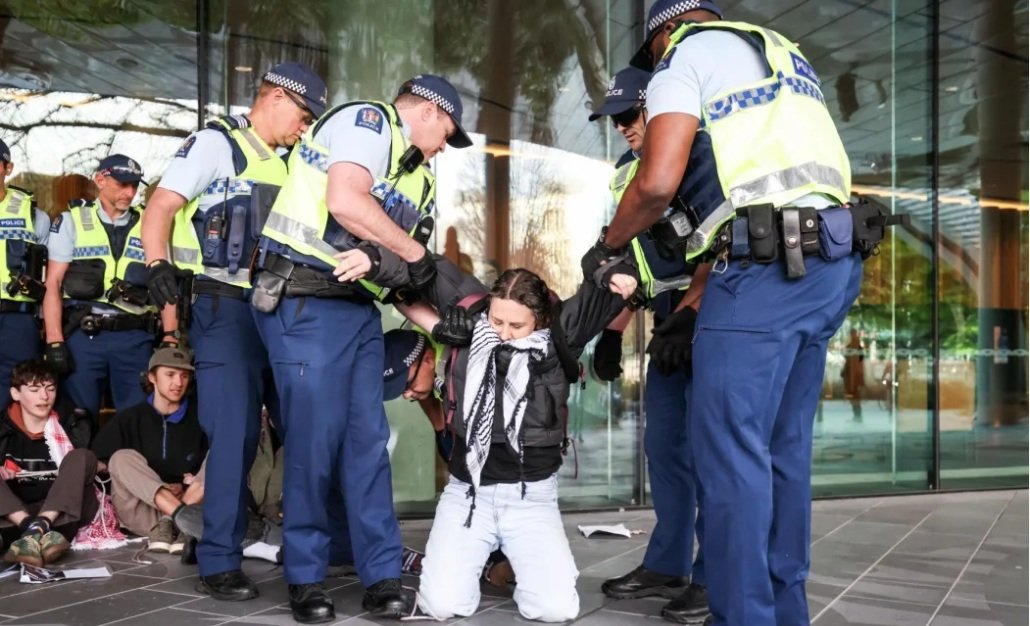
Thirty people were arrested at a demonstration outside an aerospace summit in Christchurch on 8th October 2025.
More than 100 protesters held signs reading “Peter Beck makes NZ a target” and “Keep Space for Peace” outside Christchurch’s Te Pae Convention centre, attempting to stop attendees from entering the New Zealand Aerospace Summit. Two dozen people chained themselves outside the doors, before many were forcibly carried away by police, while supporters further out chanted “Rocket Lab is supporting genocide”.
Superintendent Lane Todd said the police had made 30 arrests for trespassing and obstruction.
Joseph Bray, a spokesperson for Peace Action Ōtautahi, said the police had been using unnecessary force. “We unfortunately had people being dragged by their neck, someone was punched in the back of the head by a police officer and kicked as they were being moved on.”
One activist said he moved in towards the convention centre to try and block an entrance, but a police officer grabbed him and started kicking him repeatedly to push him back. He was then thrown backwards by a cop over a barrier between the convention centre into a garden where he saw another person lying face down while a cop had one of their arms pinned behind them and kneeling on him.
Peace Action Ōtautahi said they were protesting the aerospace industry's ties with the United States and Israeli defence forces. They alleged that Defence Minister and Minister for Space Judith Collins had overseen the "intense militarisation" of the aerospace industry, bringing it closer to the US military. Activists had accused the government of being complicit in genocide and had labelled some members of the coalition as war criminals.
Greens MP Teanau Tuiono, who is the party's spokesperson for Defence and Space, spoke to protesters and voiced his support for the demonstrations.
Concerns about bill that could restrict demonstrations outside residential homes
In August 2025, it was reported that the government was introducing a new offence for engaging in disruptive demonstrations outside private homes.
According to Justice Minister Paul Goldsmith, the reason for the new offence - The Summary Offences (Demonstrations Near Residential Premises) Amendment Bill - was that in recent times, there has been increased reports of demonstrations targeting private residences, especially of public persons, such as MPs, judges, and other public officials.
He said: “The new law will be tightly targeted. It will only apply to demonstrations directed at a person in their home. It will prohibit unreasonable disruptions for residents, and will consider factors like the time of day, duration, the actions of demonstrators, noise levels and distance to the premises.”
The Bill includes a maximum penalty of three months in jail or a fine of up to NZD 2,000 (USD 1,120).
However, concerns have been raised that the bill is too vague and that there are existing laws sufficient to cover such offences. Further, such a bill may be inconsistent with the New Zealand Bill of Rights Act 1990 which protects fundamental freedoms.
The New Zealand Council for Civil Liberties in a submission said they had serious concerns about the purpose of the bill. The need for the bill is unclear with no evidence or justification given. The details of the bill are often vague and too much discretion is given to the police officers who will be enforcing it. The bill could be used to stop protests outside “an embassy including an ambassador’s residence” or even at parliament grounds, which are “near” apartments occupied by politicians. According to Amnesty International, the bill contains serious human rights concerns and will capture legitimate protest that should not be criminalised. An overarching concern is the vagueness of the bill, especially the definition of what could be considered an unreasonable disruption. Further, the proposed penalties are harsh.
The bill is currently being considered by a Parliamentary Select Committee, which is due to report in late February 2026.