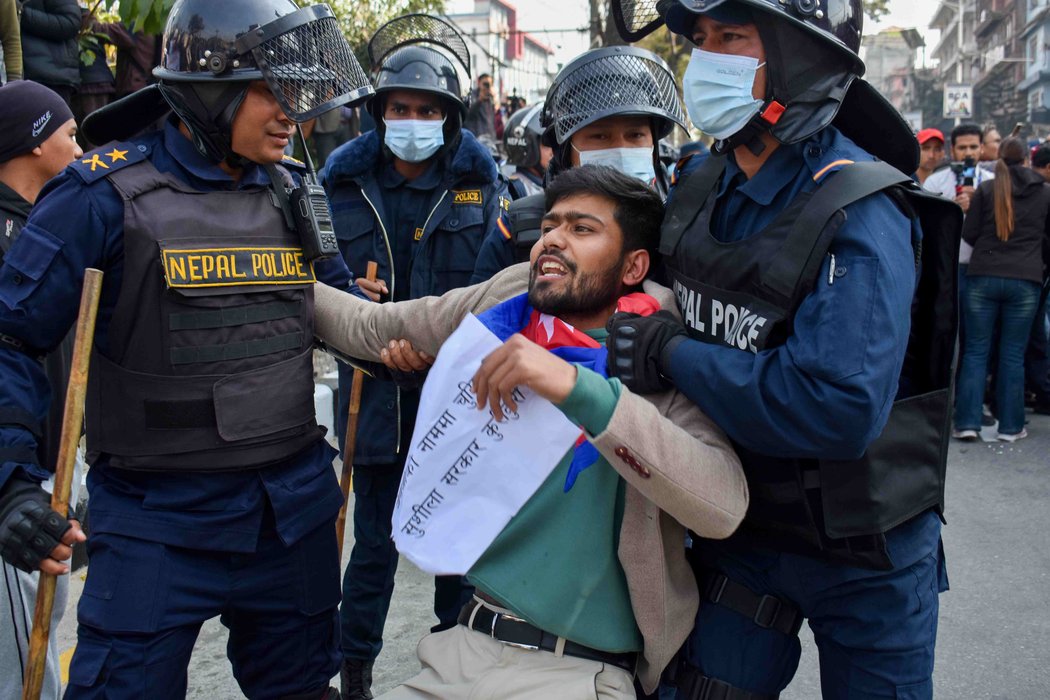
The state of civic space in Nepal is rated as ‘obstructed’ by the CIVICUS Monitor. Documented violations of fundamental freedoms include arbitrary arrests and the use of excessive force with impunity during protests, as well as the ongoing targeting of journalists, including through harassment, attacks and criminalisation.
On 21st January 2026, Nepal’s human rights record was reviewed at the UN Human Rights Council where recommendations were made by states. Among others they include calls to promote a safe and enabling environment to exercise freedom of opinion and expression, both online and offline. They were also recommended to ensure the constitutional right to peaceful assembly, refrain from excessive use of force by security agencies, and conduct impartial investigations into protest-related violence, ensuring accountability for perpetrators. States also urged the government to revise the Social Media and Media Council bills to align with International Covenant on Civil and Political Rights standards.
On 4th February 2026, Human Rights Watch issued its annual report and highlighted that in 2025 they documented police use of excessive and lethal force during protests and that proposed legislation and government actions under existing laws threatened Nepal’s relatively free and open public discourse. Further, progress on justice for human rights violations committed during the 1996-2006 conflict stalled after victims’ groups rejected the commissioners appointed to the transitional justice bodies, saying they were unqualified and lacked political independence.
Nepal will be holding elections on 5th March 2026 following the anti-corruption protests in September 2025 that toppled the previous government. The elections were called after an interim government was formed by former chief justice Sushila Karki to serve as interim prime minister until the vote. The elections will determine the makeup of the 275-seat House of Representatives, the lower chamber of parliament, with 165 members chosen in a direct vote and 110 through party lists.
Some 68 political parties have registered for the election - with some emerging after the September 2025 uprising - marking the highest number of parties to participate in an election since the country’s democracy was restored in 2006.
In recent months, human rights groups have documented violations by security forces during the September 2025 protests and have demanded justice and accountability. An investigation panel around protests has yet to make its report public. Since then, there have been ongoing disruptions of protests and detentions of protesters. Journalists remain at risk of harassment and intimidation for their reporting.
Peaceful Assembly
Human rights groups document violations by security forces during September 2025 protest
Nepal: Unlawful Use of Force During ‘Gen Z’ Protest https://t.co/tXGazUdIaS
— Human Rights Watch (@hrw) November 20, 2025
Human rights groups have documented human rights violations by the security forces around the September 2025 protests.
In November 2025, Human Rights Watch (HRW) reported that security forces in Nepal used disproportionate force against youth-led protests in September 2025. HRW found that on 8th September 2025, police indiscriminately fired on protesters multiple times over three hours - shooting people in the head, chest, and abdomen - killing 17 people in Kathmandu who had been demonstrating against corruption in politics and a sweeping social media ban imposed four days earlier at a “Gen Z” protest in the capital, Kathmandu. Dozens were also detained and some were beaten and threatened.
Police entered the grounds of a hospital on 8th September 2025 and charged staff and patients with batons, injuring a staff member, a hospital official said. Protestors attacked ambulances on both days. Journalists were injured by kinetic impact projectiles fired by police.
This sparked a second day of violence on 9th September 2025, but security forces appeared to fail to act when groups of people, some apparently not linked to the Gen Z protest, set fire to prominent government buildings; assaulted politicians, journalists, and others; and attacked schools, businesses, and media companies. Witnesses and analysts interviewed by HRW or quoted in the media said they suspected that the violence may have been influenced by “infiltrators” affiliated with various political movements.
New Amnesty report finds that Nepal’s law enforcement agencies committed unlawful killings and caused severe injuries during September’s youth-led “Gen-Z” protests.https://t.co/aOMeIx4jsC
— Amnesty International USA (@amnestyusa) December 8, 2025
In another report, published in December 2025, Amnesty International said there were widespread failings by Nepal’s law enforcement agencies in policing September’s protest that resulted in unlawful killings, unnecessary and excessive use of force, and severe injuries.
The briefing documents how security forces used mounting and ultimately lethal force – including live ammunition – against largely peaceful protesters during the assembly in Kathmandu on 8th September, at which at least 19 people were killed and more than 300 injured. Across the country, the two-day protests and six days of subsequent unrest left 76 people dead and more than 2,000 injured.
Videos from 8th September 2025 show the moment protesters toppled a police barricade less than 500m from the parliament building and were hit with water jets at close range in a manner that raises serious concerns over the principles of necessity and proportionality under international human rights standards. The use of force quickly escalated over the course of the next few hours, with witnesses describing panic and chaos as security forces intensified their response.
According to witnesses, tear gas grenades were launched from elevated positions, an extremely dangerous practice that violates the UN Guidance on less lethal weapons. Some were discharged in and around hospital premises, and disrupted emergency medical services.
Kinetic impact projectiles, including rubber bullets and rubber-coated metal bullets, were fired directly into dense crowds without warning and without meaningful attempts at de-escalation, hitting those as young as 14.
Videos showed Nepali police officers equipped with rifles and shotguns, and firing at head level. Security forces fired into crowds – including protesters, children, bystanders and journalists – striking people in the head, neck and chest.
Investigation panel around protests yet to make report public
The Karki government created a judicial commission of inquiry in September 2025 - chaired by former justice Gauri Bahadur Karki - tasked with investigating the deaths of at least 76 people nationwide in the two days of violence, around 47 of them in Kathmandu, including three policemen.
However, on 22nd January 2025 the Cabinet extended the commission’s term by 20 days. On 9th February 2025 its deadline was extended for another 25 days beyond election day, for fear that its findings could be opposed by security forces or political actors and cause “friction” in the election environment.
Human rights groups have raised concerns that the report will be buried like previous judge-led inquiry reports on human rights violations and abuses and have called for it to be made public to ‘dismantle the culture of impunity’.
On 13th February 2026, Human Rights Watch, Amnesty International and the International Commission of Jurists called Nepal’s interim government led by Prime Minister Sushila Karki to release the Commission of Inquiry report into deadly violence during the protests of September 2025 and for all political parties participating in the parliamentary election to commit to end impunity for rights abuses and corruption by upholding the rule of law.
Ongoing disruption of protests and detention of protesters
On 10th October 2025, protesters were detained in Nepal for demanding the arrest of the ousted leader. Nepal’s police arrested 18 members of the "Gen Z" movement, including Dr Nicholous Bhusal, after they staged a demonstration at Maitighar, Kathmandu, demanding the arrest of deposed prime minister KP Sharma Oli and former home minister Ramesh Lekhak,
Police swarmed Maitighar hours before the march began. Bhusal and fellow activist Surendra Gharti were among those arrested by police as chants of "Arrest Oli!" and "Justice for Gen Z!" echoed across the street. Demonstrators accused the government of "pretending to investigate" while protecting those in power.
"The government has failed to meet even a single demand of Gen Z despite the change in leadership," protesters shouted, accusing caretaker Prime Minister Sushila Karki of turning a blind eye.
Police disperse Gen Z activists at Singha Durbar
— The Kathmandu Post (@kathmandupost) November 25, 2025
Group seeks meeting with Prime Minister Karki amid growing protests over alleged nepotism.https://t.co/yL39HtxxKR
On 19th November 2025, Durga Prasain, a medical entrepreneur and political activist, was arrested from his Bhaktapur residence for the fifth time in the past several months, just days before his group’s planned nationwide protests. The Kathmandu District Police said he was detained over concerns for public safety and national security amid his group’s plans for nationwide protests starting on 23rd November 2025.
His arrest has sparked strong reactions from his supporters, who submitted a 24-hour ultimatum to the District Administration Office, Kathmandu,l demanding his unconditional release. The police reportedly also took nine people into custody who went to the Kathmandu District Police Office to meet Prasain. Kathmandu District Police Range spokesperson Bhattarai said that they were taken into custody for questioning.
Police disperse Gen Z activists at Singha Durbar
— The Kathmandu Post (@kathmandupost) November 25, 2025
Group seeks meeting with Prime Minister Karki amid growing protests over alleged nepotism.https://t.co/yL39HtxxKR
On 25th November 2025, police dispersed a group of Gen Z activists at Singha Durbar, who staged a brief demonstration demanding a meeting with the Prime Minister Sushila Karki. The group, led by Miraj Dhungana, reached the main gate of the administrative complex in the afternoon. Police said the area is restricted and barred them from entering.
There has been a clash between police and protesters led by Miraj Dhungana and Rabi Kiran Hamal in Maitighar, Kathmandu. The protest was called by Dhungana against the interim government. pic.twitter.com/Xq4NsajHuq
— No Next Question (@NoNext_Question) December 22, 2025
In December 2025, police took Rabi Kiran Hamal and five individuals into custody for a short period after participating in a demonstration at Maitighar Mandala. The protest was organised by youths including Miraj Dhungana, demanding the formation of an all-party government. They carried placards reading, “Gen Z’s demand is not elections, but good governance.”
Expression
Journalists face harassment and intimidation
Journalists remain at risk for undertaking their work in Nepal. According to the monitoring conducted by the Federation of Nepali Journalists, 139 incidents of press freedom violations were recorded in 2025, directly affecting 218 journalists and media personnel and 31 media houses.
Incidents of harassment and intimidation were reported in recent months, according to monitoring by Freedom Forum Nepal.
Senior correspondent to Nepalpress.com Keshab Bhul received numerous threats for covering news of a political party that was published on the news portal with his byline on 27th September 2025. After Bhul shared the news on his social media page, people affiliated to the party flooded the post with abusive comments. The leaders of the party also wrote threatening comments.
Journalist at 4CAST TV, Parbatraj Ghimire received a death threat on 7th October over his reporting on the online television channel about Kathmandu Metropolitan Mayor Balen Shah’s residence. Shah called the journalist and verbally abused him. He further threatened to break Ghimire’s hands and legs and kill him.
In the same month, Communist Party of Nepal (Unified Marxist–Leninist) leader and former Industry Minister Mahesh Basnet issued a death threat to senior journalist and Janastha Weekly editor Kishor Shrestha. The threat, made publicly via social media on 29th October, 2025 followed a news story published the same day in Janastha Weekly and its online edition.
In November 2025, Kishor Singh Rathore, Deputy General Secretary of the Nepali Congress, verbally abused and attempted to assault journalist Prakash Bam of Kantipur Television after being questioned about the proposals discussed at the party’s Central Committee meeting.
Security forces detained Laligurans Media reporter Hem Raj Bhatta while he was covering a protest on 13th December in Kirtipur, Bagmati Province. Bhatta said he was forcefully taken into a police van while reporting on a protest staged by youths outside the cricket stadium. The protesters were demonstrating against fraud in the distribution of tickets. Bhatta added that he showed his press identity card, but they did not stop. He was taken to the Police Circle, Kirtipur where his mobile phone was seized.
Editor at Bhaktapurtimes.com Harisundar Chhunka was verbally abused and threatened by unknown persons on a motorbike on 16th December in Bhaktapur, Bagmati Province. He had been actively covering news on soil excavation and exploitation at various locations in Bhaktapur.
In January 2026, a political cadre from the student wing of the Nepali Congress abused Kantipur Publications reporter Binay Azad on his social media account. Azad is a reporter based in Siraha, Madhesh Province who had reported on the misuse of a government vehicle during a picnic programme organised by the Nepali Congress in Siraha.
Editor-in-Chief at Hamropaila.com, Ganesh Pokhrel was abused on social media over his reporting on 5th January 2026. The news portal operates from Kapilvastu, Lumbini Province. He had reported on an internal dispute within the Rastriya Swatantra Party (RSP) that was published on the portal along with an audio clip of a conversation between leaders. Following the publication, two persons wrote abusive posts on social media along with Pokhrel's photograph.