Myanmar’s civic space is rated ‘closed’ by the CIVICUS Monitor. Since the 2021 coup, thousands of activists and protesters have been detained on fabricated charges including terrorism, incitement and sedition. Many have been convicted by secret military tribunals in unfair trials and given harsh sentences, including the death penalty. Some have been tortured or killed. There has also been an unrelenting crackdown on the media. Many independent civil society groups have had to shut down, operate underground or outside the country.
In March 2026, the UN Human Rights Council issued a resolution where it expressed serious concern at the unilateral convening by the Myanmar military of elections that excluded much of the country’s geographical territory and many political parties, at a time when it is clear that there can be no meaningful participation of all political parties and groups, and that they were neither free nor fair.
Tom Andrews, the former UN Special Rapporteur on the situation of human rights in Myanmar released his final report in April 2026. He called on the international community to step up efforts for accountability in Myanmar, saying that decades of impunity have led the country to a human rights catastrophe. While cases before international tribunals and judicial authorities in other countries offer a glimmer of hope to victims and the people of Myanmar, they are narrow in scope and insufficient to break the system of impunity that shields the military from accountability.
In June 2026, during the UN Human Rights Council session, the High Commissioner for Human Rights presented his report on the overall situation of human rights in Myanmar. In the report he stated that, since the coup, 30,508 individuals had been arrested on political grounds, and 22,799 remained in detention. Individuals were prosecuted ahead of elections, including for minor online criticism, with disproportionate punishment. Access to information remained precarious, with widespread Internet shutdowns.
Investigations by the Independent Investigative Mechanism for Myanmar (IIMM) released in August 2026 show a pattern of deliberate aerial attacks targeting homes, schools, medical facilities, religious buildings and camps for internally displaced persons, causing deaths, injuries and destruction. The IIMM also collected and analysed extensive evidence of arbitrary detention, torture and sexual violence in military-run detention facilities, including cases linked to the 2025 law criminalising criticism of the elections. Numerous individuals have been arrested under the law and face up to 20 years’ imprisonment and the death penalty for activities such as posting critical comments on social media.
Also in August 2026, a UN Human Rights report found that the human rights situation in Myanmar, in particular that of minority communities, has plummeted to a new low, from the ever-worsening brutal abuse of the Rohingya population to the devastating impact of illicit economies, notably illegal mining for rare earths.
On 7th September 2026, UN High Commissioner for Human Rights Volker Türk said that efforts to normalise relations without any sign whatsoever that the military are complying with fundamental obligations under international law will only fuel even greater violence and violations against civilians, in Myanmar and beyond. He urged member states to refer the full situation in Myanmar to the International Criminal Court through the Security Council, and to end transfers to Myanmar of arms, ammunition, jet fuel and dual-use items, where there is a clear risk they could facilitate violations of international human rights and humanitarian law.
Since March 2026, there have been reports on the digital repression of human rights defenders (HRDs), challenges for HRDs in Kachin and Northern Shan states and risks, criminalisation, and attacks against environmental HRDs. Torture and ill-treatment of political prisoners and other detainees were reported including in Insein prison. The forced conscription of young people persisted. There has been surveillance of mobile phones and challenges in accessing the Starlink internet. There were reports that independent media outlets were blocked during elections and access to them dropped due to a firewall and surveillance. The licences of three news outlets were revoked, and a journalist was denied medical care. A move to restart the controversial Myitsone dam sparked protests while a court sentenced activists to 37 years over an election protest.
Association
Digital repression of human rights defenders
While many human rights defenders have been detained and jailed for their activism, others remain at risk due to digital repression.
A study published in April 2026, conducted by the Myanmar Internet Project (MIP) in collaboration with and support from the Association for Progressive Communications (APC), found an alarming escalation in digital repression. The military junta has imposed internet shutdowns, deployed surveillance technologies and weaponised legal tools to silence dissent.
These tactics have disproportionately affected human rights defenders (HRDs), particularly women human rights defenders (WHRDs), who are subject to harassment and threats, both online and offline, and are persecuted through the criminalisation of free speech.
The study refers to an “ecosystem” of digital repression, where all of these strategies are interdependent and work symbiotically to silence online dissent. This ecosystem has a differential impact on WHRDs in Myanmar.
The research identified several forms of digital repression affecting them, including restrictions of free speech online, doxxing and sexual harassment through digital platforms such as Telegram. Internet shutdowns, meanwhile, have delayed vital support for women in need. The junta has also invaded the privacy of detained activists by downloading private photos off their phones and sharing them widely in an attempt to degrade and humiliate them.
Moreover, they found that WHRDs who exposed cases of gender-based violence within the pro-democracy movement have been accused of attempting to undermine or discredit the revolution.
Faced with constant surveillance, criminalisation and severe online harassment, many women defenders and activists are forced to withdraw from public and digital life to protect their safety and mental well-being. Many live in a constant state of uncertainty and fear, distrusting the digital technologies they rely on and that are necessary for their work.
Challenges for HRDs in Kachin and Northern Shan states
A report by Kachin Human Rights Watch (KHRW) in August 2026, found that since the 2021 coup, human rights defenders (HRDs) in Kachin and Northern Shan States have operated in an increasingly restrictive environment.
Movement and operational constraints have become some of the most pervasive threats facing human rights defenders (HRDs) in Myanmar. Checkpoints, surveillance, arbitrary inspections, forced recruitment, and restrictions on freedom of movement have increasingly constrained the ability of defenders and civil society actors to operate safely.
Expanding post-coup online surveillance, censorship measures, arrests linked to social media activity, and the growing use of technologies that enable authorities to monitor communications have significantly narrowed digital civic space.
Arbitrary arrest, detention, torture, and fear of re-arrest continue to shape how HRDs operate in Myanmar. Widespread arrests, deaths in custody, and the continued use of detention and ill-treatment against perceived opponents have made imprisonment a central tool of repression.
Women’s rights organisations have documented how women defenders are exposed not only to surveillance, arrest, and insecurity, but also to gender-based stigma, reputational attacks, and family pressures that are less commonly experienced by their male counterparts.
Risks, criminalisation, and attacks against environmental HRDs
In August 2026, Human Rights Myanmar made a submission to the UN Special Rapporteur’s report on the right to a healthy environment on the experiences of environmental human rights defenders (EHRDs) in Myanmar. EHRDs include indigenous peoples, local communities, journalists and civil society actors defending land, water, forests and livelihoods.
In the Dawei Special Economic Zone, military operations in 2026 intended to secure or advance the project resulted in the killing of EHRDs and other community members, arbitrary arrests, arson, and mass displacement.
In 2026, villagers in Lashio Township protested against gold mining and the seizure of agricultural land, which residents said had proceeded without meaningful consultation, consent or compensation. The Myanmar National Democratic Alliance Army - an armed group in the Kokang region - reportedly detained 36 villagers. Detainees were allegedly beaten and subjected to coercive questioning intended to identify organisers.
Torture and ill-treatment of political prisoners and other detainees
In July 2026, the Independent Investigative Mechanism for Myanmar published a report. It found that there were specific detention locations where serious international crimes were allegedly committed by the Myanmar security forces, including by the Myanmar military and intelligence forces.
At Yay Kyi Ai, Shwepyithar and the Nay Pyi Taw Command Headquarters compound, detainees were interrogated over several days, during which they were subjected to physical torture, sexualised torture, and threats of death, including death of their family members. Women, men, boys and girls were subjected to sexualised torture at these detention facilities.
Detainees were usually kept blindfolded and handcuffed throughout long periods of interrogation. Before being transferred to either the Shwepyithar Yay Kyi Ai or Nay Pyi Taw interrogation centre, victims have described being first subjected to torture at township police stations such as Myawaddy police station, Yankin police station, Kamayut Township police station, Hlaing Township police station, Bahan Township police station and Nay Pyi Taw police station.
30 political prisoners beaten in Insein prison
Myanmar's Insein Prison: 30 political prisoners brutally beaten by an officer with a rubber baton after a football match, struck in vital areas. #Myanmar #InseinPrison #HumanRights https://t.co/stqJ8Z04sv pic.twitter.com/sbtjjXNV4s
— Burma News International (@bnionline1) July 9, 2026
In July 2026, it was reported that approximately 30 political prisoners returning from an officially sanctioned football match inside Yangon's notorious Insein Prison were arbitrarily and violently beaten by a prison official.
The incident, which took place on the evening of 5th July 2026, involved political prisoners held in Ward 1 who had been permitted to attend the sports event.
The assailant, identified as Prison Officer Aung Kyaw Sint allegedly utilised a heavy rubber baton to deliberately strike the detainees in vital areas, including their faces, heads, and necks.
The source noted that the unprovoked assault targeted both the political prisoners who played in the match and those who attended as spectators.
The Political Prisoners Network of Myanmar (PPNM), a prominent local advocacy group, confirmed that the “inhumane treatment” resulted in severe trauma to the prisoners’ faces and heads. The network reported that several victims remain in critical condition and are completely immobilised in their cells.
In a formal statement, PPNM strongly condemned the acts of torture and systemic violence, reiterating its unwavering commitment to fighting for the fundamental rights of political detainees in Myanmar.
Forced conscription of youths
In September 2026, the UN High Commissioner for Human Rights reported that forced conscription was among the key drivers of the worsening of the human rights crisis. Since activating the process in 2024, the military has reported recruiting 25 batches of forced conscripts, each comprising as many as 5,000 young people, which granted the military a significant numerical advantage on the battlefield, factoring into territorial gains.
As a result of arbitrary military conscription practices, fear has permeated every aspect of life among young people and their family members. Thousands of young people reportedly fled abroad, depriving the economy of the workforce.
Former leader moved to house arrest
Former Myanmar leader Aung San Suu Kyi, who had been held in detention since a military coup in 2021, was moved to house arrest.
Since her arrest she had been charged with a raft of criminal offences, including corruption. She denies all of the accusations, and rights groups have condemned the series of secret trials as a sham. She was found guilty and sentenced to a total of 33 years in jail, which since then has been reduced several times.
On 30th April 2026, the military showed an undated picture of her on TV and said it would be moving her out of jail and putting her under house arrest.
Expression
Surveillance of mobile phones
In March 2026 the NGO Athan reported that control over the telecommunications sector was increased by requiring the registration of mobile phones and SIM cards through the CEIR (Central Equipment Identity Register) system. The CEIR registration system registers, verifies, and controls mobile devices in a database using each device’s IMEI (International Mobile Equipment Identity) number for use on telecom networks. When a mobile phone connects to the network, the IMEI number can be checked against the CEIR database to allow or block network access.
When this system is combined with SIM card registration and other user data, it becomes a digital surveillance infrastructure capable of monitoring and controlling citizens’ communication activities.
By linking SIM cards and IMEIs, there is an attempt to track mobile phone network users, the types of phones they use, and their locations precisely.
Challenges in accessing the Starlink internet
In July 2026, significant challenges were encountered in accessing the internet via Starlink, which has become a primary reliance in Myanmar’s conflict zones
According to the NGO Athan, starting around June 2026, Starlink devices in Myanmar began experiencing region-restricted and country-restricted errors, leading to consecutive service outages. These restrictions and service failures were predominantly reported in Karen, Karenni, Rakhine, Shan, Sagaing, Mandalay, Magway, and several other resistance-controlled areas.
Following the 2021 military coup, phone lines and mobile internet services in conflict areas were cut off by the military, prompting the adoption of Starlink as an alternative means of communication starting in late 2023. In numerous conflict regions, Starlink serves as a critical communication channel in these areas.
Because Starlink is the primary communication channel for conflict zones, disruptions directly impact the daily lives of local populations. In particular, it affects access to emergency information regarding airstrikes and military movements, emergency healthcare, humanitarian response efforts, education, freedom of information, and communication among family members. Furthermore, the inability to access mobile banking and online money transfer services poses severe difficulties for remitting funds and purchasing food and medicine.
Blocking of independent media during elections
In March 2026, Human Rights Myanmar and The Independent Press Council Myanmar (IPCM) published a report on how the military intensified internet blocking of independent media, social media platforms, and VPNs during the elections.
Among the key findings was that the military significantly increased its website blocking during the elections, obstructing 93 percent of public attempts to access the large independent media websites. The blocks increased according to each outlet’s criticism of the military, with those most critical facing over 90 percent obstruction.
To stop people evading the blocks, the military increased blocks on encryption and circumvention tools while simultaneously unblocking unencrypted platforms in an attempt to funnel the public into a more heavily surveilled digital space.
The military tried to gaslight the public, classifying blocks as State secrets, threatening telecommunications companies (telcos) with severe imprisonment for leaks, and concealing 98 percent of the blocks as technical failures.
They also accused all telcos of failing in their responsibility to respect human rights and becoming active enforcers of the military’s blocking regime, including State-owned telcos MPT and Mytel, which led to the crackdown on the media.
News media access drops due to firewall and surveillance
In June 2026, Human Rights Myanmar reported that the primary cause of the decline in news audience reach in Myanmar is likely the military’s technical campaign to block the public from accessing news. Following the coup, the military started building a “Great Firewall” by ordering internet shutdowns and blocking access to Facebook and independent media websites.
The firewall was escalated during the 2025-26 election period. When the public turned to Virtual Private Networks (VPNs) to circumvent the firewall, the military responded by effectively banning these tools. They criminalised people for trying to avoid the firewall.
Another likely cause of the decline in media reach is the military’s use of surveillance technologies and device searches, followed by the criminalisation of internet use. The understandable concerns of being monitored online, exposed while responding to independent news, or caught at a checkpoint with a VPN app have led people to change whether and how they interact with information online.
Licences of three news outlets revoked
In April 2026, the licences of three local news agencies - the Khonumthung Media Group, Chin World, and Myatmaukkhit News Agency - were revoked.
According to the Committee to Protect Journalists, the military bans, effective on 9th April 2026 and formally announced on 24th April 2026, were issued for violations of Section 8(b) of the Printing and Publishing Enterprise Law, with authorities claiming the outlets published content harmful to national security, the rule of law, and public peace, according to news reports.
The bans, imposed coincident with the declaration of a state of emergency and martial law across 60 townships, including in Chin state, prohibit the news outlets from publishing or broadcasting on any media platform or technology. Several journalists associated with the three banned outlets have gone into hiding to avoid possible arrest or harassment.
Myanmar’s junta has revoked the licences of several independent news outlets since seizing power and suspending democracy in a 2021 coup. According to Athan, from 2021 to April 2026, 18 news agencies had their licences revoked. The crackdown has driven many media groups to move their news operations into exile while relying on underground reporters, who have been targeted for harassment and imprisonment.
Journalist denied medical care
The Committee to Protect Journalists has called on Myanmar’s regime to provide urgent surgery for jailed Myanmar Now journalist Sai Zaw Thaike. He was sentenced to 20 years with hard labor for covering Cyclone Mocha in 2023 and is being denied surgery for his worsening kidney… pic.twitter.com/fmZkQspovd
— The Irrawaddy (Eng) (@IrrawaddyNews) April 27, 2026
In April 2026, CPJ reported that journalist Sai Zaw Thaike, who is detained at Insein Prison in the country’s largest city Yangon, was denied access to adequate medical care.
Sai Zaw Thaike, a photojournalist with the independent Myanmar Now, who is serving a 20-year prison sentence for treason, is suffering from severe kidney disease and haemorrhoids and requires urgent major surgery.
Prison authorities have refused to allow him access to either the prison hospital or an external medical facility, and are treating him only with oral medication.
Sai Zaw Thaike was arrested by the military in Sittwe in May 2023 while covering the destruction caused by Cyclone Mocha in Rakhine state. He was sentenced to 20 years in prison with hard labour later that year. In January 2025, Sai Zaw Thaike was subjected to “daily physical abuse” and “retaliatory torture.”
Journalists remain at risk
According to Human Rights in Myanmar in June 2026, since the coup at least 221 journalists from over 100 media outlets have been detained. At least 175 of them were formally charged under nine different laws, mainly “incitement”, “false news” and weaponised counter-terrorism provisions. At least 88 journalists have been sentenced to a combined 497 years in prison, with 23 percent receiving extreme sentences of 10–27 years, in military-controlled courts that disregard basic due-process guarantees. As of early 2026, over 30 journalists remained imprisoned.
Pro-military social media channels and allied online networks publish women journalists’ home addresses, national registration numbers, intimate or manipulated images, and details of family members, often alongside explicit calls for arrest, assault or execution. Security forces monitor these channels, cross-reference doxed information with facial-recognition systems and checkpoint searches and use it to locate and arrest targeted women. Detained women journalists face heightened risks of torture, sexual violence and threats against relatives. Detention data indicate that women journalists and media workers face higher charge and conviction rates under the military’s lawfare system.
Peaceful Assembly
According to the UN High Commissioner for Human Rights in May 2026, between 1st August 2025 and 31st January 2026, over 250 peaceful protests occurred nationwide, approximately 100 of them ahead of voting.
Most demonstrations were held in areas outside military control, with the highest number, at 132 protests, recorded in Yinmarbin township, Sagaing. Few of the reported protests took place in urban areas, such as Yangon and Mandalay, particularly around voting days.
Move to restart controversial dam sparks protests
Students and activists in Kachin State’s Myitkyina staged a protest Monday to demand the termination of the Myitsone Dam project, located at the confluence of two rivers that form the source of the Irrawaddy River. (Photo: KHRW) #WhatsHappeningInMyanmar pic.twitter.com/phFf10UGcg
— The Irrawaddy (Eng) (@IrrawaddyNews) May 26, 2026
In April and May 2026, there were reports of a protest opposing the Myitsone Dam project on the Irrawaddy River in Kachin State in northern Myanmar.
Civil society groups and local communities have opposed the controversial dam on one of Myanmar’s major rivers following an alleged move to resume construction 15 years after it was suspended.
On 6th May 2026, a coalition of 49 civil society organisations and activists from all over the country issued a joint statement to oppose the planned restarting of the Myitsone Dam. The statement slammed the government of military chief-turned-president Min Aung Hlaing for being apathetic to possible damages to livelihood and environment if the dam project moves ahead.
The dam was originally agreed upon between the then-military government and China before the 2010 democratic transition. However, in 2011, just one year after a quasi-civilian government took power, President Thein Sein himself suspended the project.
The statement highlighted that the project focuses exclusively on economic profit, operating entirely without public consent.
Court sentences activists to 37 years over election protest
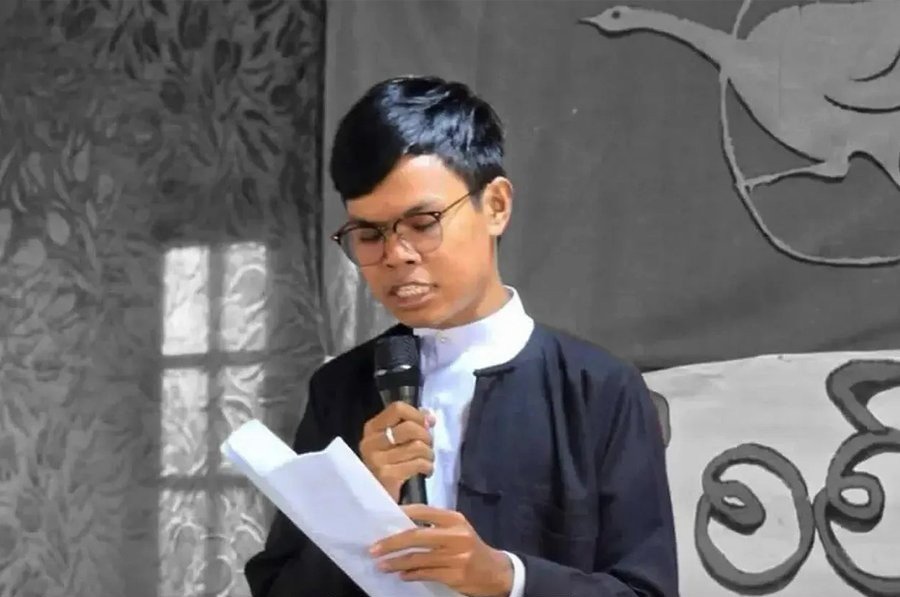
In July 2026, a regime-controlled court in Mandalay sentenced prominent student leader Htet Myat Aung (pictured above) and seven other pro-democracy activists to 37 years in prison following their involvement in anti-election demonstrations.
The tribunal handed down a 30-year sentence under the regime’s Election Protection Law alongside a seven-year sentence under the Counter-Terrorism Law.
On 3rd December 2025, Htet Myat Aung joined nine other prominent activists in staging a flash-mob rally in Mandalay’s Chanmyathazi Township. The protest called on the public to boycott the regime’s 2025–26 elections. The 24-year-old Htet Myat Aung was violently arrested by regime security forces in Mandalay Region on 14th December 2026.
The ASEAN Parliamentarians for Human Rights (APHR) - a regional network of current and former lawmakers - issued an urgent appeal demanding the immediate and unconditional release of Htet Myat Aung and his fellow organisers.