Civic space in Mongolia is rated as 'obstructed' by the CIVICUS Monitor. Ongoing concerns raised by civil society include reports of harassment, intimidation and reprisals against human rights defenders, especially those working to defend economic, social and cultural rights. Further, provisions of the Criminal Code related to ‘cooperation with foreign intelligence agencies’ and ‘sabotage’ have been used to prosecute human rights defenders for legitimate activities. There are also concerns about press freedom and the criminalisation of journalists.
Civil society groups have made submissions to the UN Human Rights Council ahead of its Universal Periodic Review (UPR) in November 2025. CIVICUS together with FORUM-ASIA and the Asia Democracy Network made a submission on civic space highlighting concerns about draft NGO laws that are inconsistent with international law and standards, and the harassment and criminalisation of HRDs and journalists. The report also documented restrictions on freedom of expression, including proposed laws to control the internet, and restrictions against peaceful protests, including arrests and excessive use of force.
On 13th June 2025 Mongolian lawmakers confirmed G. Zandanshatar as the country’s new prime minister, after his predecessor resigned following weeks of anti-corruption protests. Zandanshatar – also from the ruling Mongolian People’s Party (MPP) – was elected with 108 out of 117 present voting in favour.
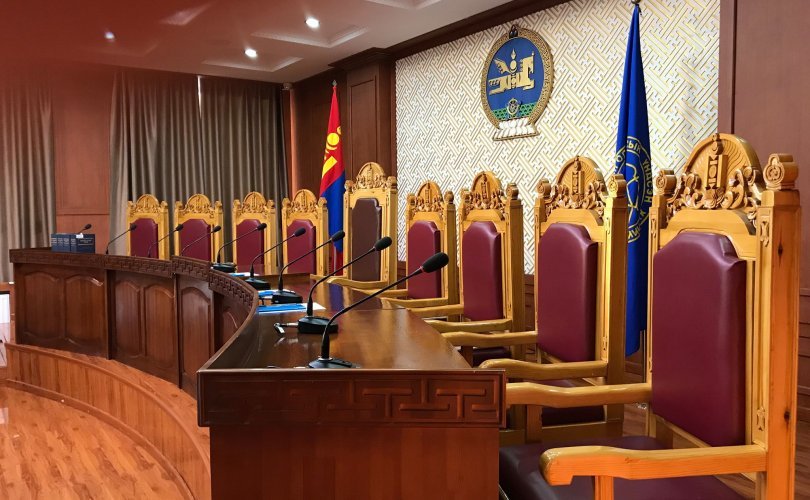
In recent months, a human rights group has made a submission to the Constitutional Court to repeal a provision in the Criminal Code criminalising the dissemination of “false information”. NGOs continue to face challenges, while implementation of a law on human rights defenders is lacking. Thousands of teachers have protested for a salary increase and more funding.
Expression
Human rights group makes submission to Constitutional Court to repeal provision criminalising the dissemination of “false information”
In August 2025, Amnesty International submitted an amicus curiae brief pursuant to a request received by Amnesty International Mongolia on 6th June 2025, No.2/346 from the Constitutional Court (Tsets) of Mongolia.
The Court requested written submissions relating to Article 13.14 of the Criminal Code of Mongolia that stipulates that the dissemination of “false information” that, among other things, harms a person’s or a corporation’s honour or reputation is punishable by a fine of 450,000 to 1,300,000 MNT (USD 125 to 361), 240 to 720 hours of community service, or restriction of the right to travel for one to three months.
In the submission, Amnesty International stated that laws that restrict the right to freedom of expression based on ill-defined notions such as “blatantly false information” are incompatible with the principle of legality and hence international human rights law.
The organisation also submits that imposing a general prohibition with the sole purpose of tackling false or misleading information extends beyond the legitimate aims allowed under international human rights law. Moreover, the use of criminal defamation laws, even when intended to protect the honour and reputation of others, can have the effect of inhibiting legitimate expressions in the public interest. The criminalisation of defamation in these instances, although pursuing a legitimate aim, is likely to amount to a disproportionate restriction of the right to freedom of expression.
Finally, Amnesty International stated that there is a clear trend under international human rights law to avoid the use of criminal law to address the challenges posed by the spread of false and misleading information, including when it is intended to tarnish the honour or reputation of others. International human rights mechanisms have demonstrated that States have at their disposal less restrictive means to achieve the desired aim and should therefore repeal laws that criminalise the spread of false or misleading information.
Amnesty International has reported that Article 13.14 of the Criminal Code has been used to file investigations and claims against journalists and citizens who criticised authorities. The National Police Agency confirmed that as of 25th December 2024, the police had received a total of 697 complaints based on “spreading of false information”. Sixteen of these were related to journalists; four cases were forwarded to the prosecutor to initiate a criminal case.
As previously documented, in July 2024, prominent journalist Naran Unurtsetseg was sentenced to four years and nine months in prison. In a closed-door trial, the court convicted her on five charges including spreading false information (Criminal Code article 13.14).
Association
Challenges faced by NGOs and to ensure human rights defenders protection
Ahead of the UPR review of Mongolia, civil society groups raised concerns about freedom of association and of human rights defenders.
According to the Mongolian Youth Council (MYC) - a national non-governmental umbrella organisation of civil society youth, comprised of 18 active member organisations with diverse representation - the government has made working conditions more difficult for NGOs through laws and regulations.
For example, the Law on State Registration can liquidate inactive organisations without prior notice if they fail to submit activity and tax reports. An expert from the General State Registration Department reported in December 2024 that about 7,000 NGOs had been liquidated. Additionally, NGOs face a heavy tax burden, with those working for NGOs paying a 34 percent tax on their income, compared to 24 percent for civil servants.
MYC also said while Mongolia was the first country in Asia to adopt a law on human rights defenders in 2021, its implementation is lacking. There are still shortcomings in identifying human rights defenders and providing emergency responses. The public is largely unaware of this law and their ability to file complaints with the Human Rights Defenders Committee.
Peaceful Assembly
Thousands of educators protest to demand salary increase and funding
Mongolia faces a budget crisis as teachers threaten a strike and pensioners protest, testing the government’s fiscal and political limits.https://t.co/wXIy8qKbl9#mongolia #budget #teacherstrike #pensionprotest #mongoliaeconomy
— Mongolia Weekly (@MongoliaWeekly) September 24, 2025
On 24th September 2025, in Ulaanbaatar’s main square, thousands of teachers and education support personnel staged a peaceful demonstration in front of the Parliament building.
Protests were also reported in other cities, with more than 9,000 union members and teachers participating in the peaceful rallies. The demonstrations drew support from the public and prominent political figures.
Their core demand was to raise the basic salary of teachers to 3.5 million tugrik (USD 970) and allocate adequate funding for the education sector. Currently, teachers earn between 1.2 – 1.4 million tugriks (USD 333 - 389), and education support personnel below 1 million tugriks (USD 278), a figure many argue is insufficient amid rising living costs.
A young teacher, capturing the deep concern shared across the profession, said: “There is a real threat to education. Many qualified teachers are changing their profession and joining other highly paid sectors. The future of Mongolia’s education is at risk. We must act!”
This mobilisation coincided with the government’s deliberations of the 2026 national budget and informed by Federation of Mongolian Education and Science Unions (FMESU) broader “Go Public! Fund Education” campaign.
Beyond the capital, workplace sit-ins and press conferences were held in Bayan-Ulgii, Bulgan, Darkhan-Uul, Dornogovi, Dundgovi, Zavkhan, Sukhbaatar, Tuv, Khovd, and Khentii aimags. Over 30,000 citizens and workers have signed a petition supporting the increase in salaries and allocating adequate funding to the education sector. The petition also includes the signatures of more than 3,000 teachers that have been submitted to Parliament and the government.
On 5th October 2025, to coincide with World Teachers’ Day, FMESU organised a peaceful sit-in at the main square in front of the Parliament building, drawing 800 educators. This symbolic act reinforced the union’s commitment to defending teachers’ rights and strengthening public education.