Civic space in Mongolia is rated as 'obstructed' by the CIVICUS Monitor. Ongoing concerns raised by civil society include reports of harassment, intimidation and reprisals against human rights defenders, especially those working to defend economic, social and cultural rights. Further, provisions of the Criminal Code related to ‘cooperation with foreign intelligence agencies’ and ‘sabotage’ have been used to prosecute human rights defenders for legitimate activities. There are also concerns about press freedom and the criminalisation of journalists.
On 17th October 2025, Mongolian Prime Minister Gombojav Zandanshatar stepped down after only four months following a crushing vote of no confidence from the 126-seat national parliament citing constitutional violations and concerns about governance. However, the Constitutional Court of Mongolia overturned this vote on procedural grounds several days later, leaving Zandanshatar in office.
In November 2025, Mongolia’s human rights record was reviewed by the UN Human Rights Council. There were recommendations to protect journalists, media workers and human rights defenders and to guarantee freedom of peaceful assembly. There were also calls to review laws used against journalists and activists, including Article 13.14 of the Criminal Code criminalising ‘false information’, Article 19.11 that pertains to the illegal access to state secret information and Article 17.6. on ‘threatening to disseminate information that might cause serious damage’.
In recent months, the courts struck down a provision that has been used to criminalise journalists. There are continued calls for the release of activist Munkhbayar Chuluundorj who is serving a 10-year jail sentence. A strike by an educators’ union was successful in raising wages for teachers.
Expression
Court strikes down restrictive article criminalising ‘false information’
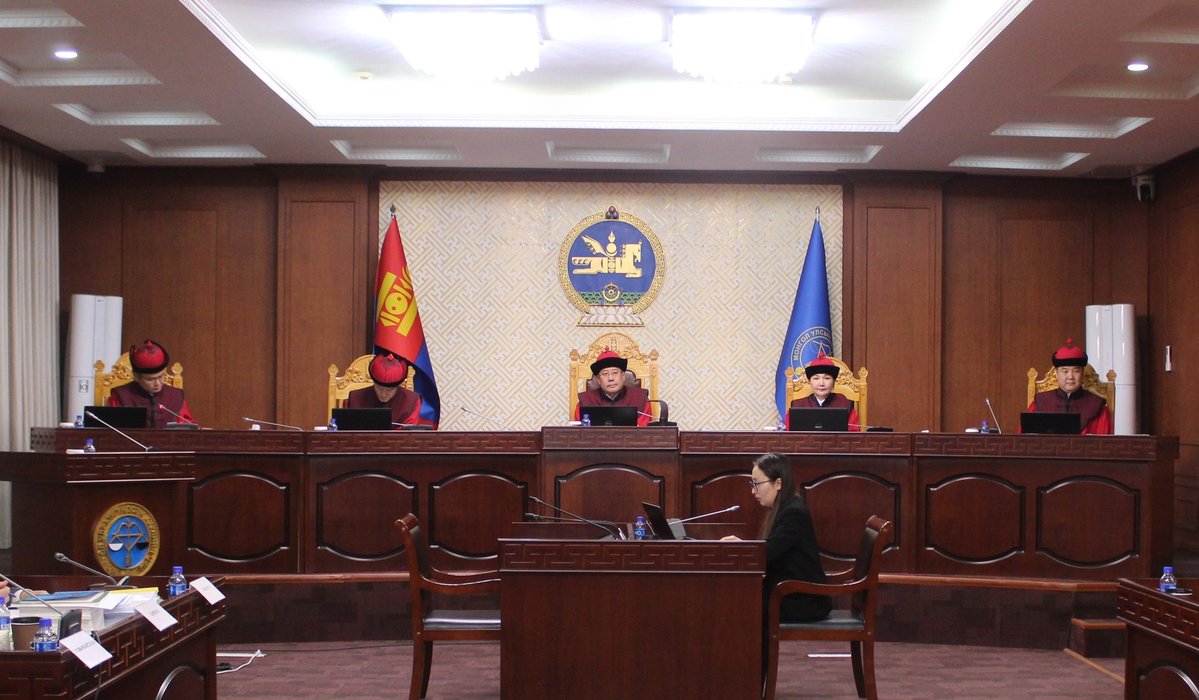
In a landmark decision, Mongolia’s Constitutional Court ruled on 25th November 2025 that a controversial provision on ‘false information’ in the country’s Criminal Code violated its constitution.
According to the International Federation of Journalists (IFJ), the critical press freedom case followed multiple complaints filed between mid-2024 and March 2025 by five journalists and two citizens relating to the controversial Article 13.14 in Mongolia’s Criminal Code. This subsequently triggered an eight-month judicial process, with heavy lobbying by the country’s journalists and media workers.
As previously documented, in August 2025, Amnesty International submitted an amicus curiae brief stating that the provisions restrict the right to freedom of expression.
Following Constitutional Court hearings from 24-25th November 2025, the Court determined to suspend the provision for breaching constitutional clauses related to the rule of law, guarantees for freedom of opinion, speech, and publication, the right to information and constitutional authority.
According to Globe International Centre, between 2020 and 2024, Mongolian authorities opened 2,260 cases under Article 13.14, resulting in just five convictions - a pattern that advocates said demonstrated its use as an intimidation tool rather than a legitimate legal safeguard.
Among those targeted under the law was prominent journalist Naran Unurtsetseg, the editor-in-chief of the news site Zarig. She is well-known in Mongolia for her critical coverage, exposing the corruption and money laundering of high-ranking Mongolian officials.
IFJ said that since its introduction in 2020, the provision has been criticised for enabling police and prosecutors to open investigations without establishing the falsehood of reported information. International and local press freedom groups also warned that the vaguely defined offence could be used to intimidate reporters investigating corruption and political misconduct. The provision imposed fines of up to MNT 1,300,000 (USD 365), up to 720 hours of community service, or travel restrictions for up to three months for disseminating ‘clearly false information’ that damages the reputation of individuals or legal entities.
The landmark court decision now awaits approval by Mongolia’s parliament, with civil society organisations, anti-corruption activists, and journalists, including the CMJ, lobbying MPs to formally adopt the ruling.
Association
Call for the immediate release of jailed activist
Munkhbayar Chuluundorj is an award-winning Mongolian journalist, poet, and human rights activist. He was sentenced to 10 years in prison on June 28, 2022.
— Kym Staton (@StatonKymJ) August 21, 2024
A founding member of the World Mongols Poetry Association, Chuluundorj is a well-known blogger, poet, and human rights… pic.twitter.com/cDA3ZcsOgX
On International Human Rights Day, 10th December 2025, the Southern Mongolia Congress issued a formal statement calling for the immediate and unconditional release of activist Munkhbayar Chuluundorj, a Mongolian citizen and vice president of the organisation, who is currently serving a 10-year prison sentence.
The statement expresses deep concern that the charges against Munkhbayar were closely linked to his long-standing work documenting human rights violations in Southern Mongolia - including cultural suppression, erosion of language rights, and violations in the education system.
The statement urged the Mongolian government to ensure transparent judicial review and called on the international community to strengthen oversight against cross-border repression.
As previously documented, the prominent activist was arrested in Mongolia in February 2022, on politically motivated charges of cooperation with foreign intelligence agencies (article 19.4), related to his public criticism of the Mongolian government’s close ties with China. A founding member of the World Mongols Poetry Association, Munkhbayar Chuluundorj is a well-known blogger, poet and human rights activist known for defending the linguistic, cultural and historical identities of ethnic Mongolians in China’s Inner Mongolia.
Major union victory after persistent mobilisation and strike
✊🏽✊🏾✊🏻 When we fight, we win!
— Education International (@eduint) November 4, 2025
Huge congratulations to our colleagues at the Federation of Mongolian Education and Science Unions! Their persistent mobilisation and widely supported strike secured a 50% raise for teachers.
➡️ https://t.co/w0MIUIq8a2#GoPublic #FundEducation pic.twitter.com/VAgzr6Eojp
In November 2025, it was reported that after more than 13 weeks of strike and nine rounds of negotiations, the teachers’ strike in Mongolia was called off following a favourable agreement between the Federation of Mongolian Education and Science Unions (FMESU) and Mongolia’s Ministry of Education. Teachers’ basic salaries will increase by 50 percent.
As of January 2026, teachers’ basic salaries will be raised to 2.8 million Mongolian tughriks (around USD 780), marking a 50 percent increase, and by 26 percent from 1st November 2026.
The salary increase marked a major victory for Mongolian educators after a massive mobilisation that saw over 40,000 teachers and education support personnel from 720 educational institutions taking part in the nationwide strike. Teachers and education support personnel (ESP) went on strike across the country from 16th October 2025.