Malaysia’s civic space continues to be rated as ‘obstructed’ by the CIVICUS Monitor. Among ongoing concerns are the array of restrictive laws, especially the Communication and Multimedia Act 1998 (CMA) and the Sedition Act, that have been used to silence online dissent and to harass human rights defenders. Critical news websites and blogs have been blocked. Peaceful protesters continue to be hauled in by the police for questioning under the Peaceful Assembly Act. Malaysia has also yet to ratify the International Covenant on Civil and Political Rights (ICCPR).
In April 2025, human rights group SUARAM published their annual report which documented a five-year high in charges under the Sedition Act (SA) and continued targeting of journalists and activists under the SA and Section 233 of the Communications and Multimedia Act (CMA). Restrictions to exercise freedom of assembly persist. Out of 79 assemblies in 2024, nearly 40 percent were investigated.
In May 2025, Amnesty International said that in 2024, the government expanded laws unreasonably restricting freedom of expression and that the authorities continued to use the Peaceful Assembly Act (PAA), the Penal Code and the Minor Offences Act to restrict peaceful protests. Organisers and participants were subjected to unnecessary investigations, detention and use of force.
In early July 2025, the Bar Council raised concerns about judicial independence. They include vacancies in the judiciary, the judicial appointment process and continuity in judicial leadership.
Since January 2025, the authorities have seized a laptop from a new outlet and used restrictive laws to investigate and prosecute peaceful expression. There was also police intimidation around literary events, books were banned by the Home Ministry and a student activist was questioned for objecting to the state governor’s appointment. There was police harassment and intimidation around protests and a forum blocked a at a university. Sabah state denied entry to an activist, while police launched an investigation into an LGBTQ+ event. On a positive note, a Media Council bill was passed and the courts made a ruling that would strengthen peaceful assembly and in favour of a women’s rights group facing a fatwa.
Expression
Laptop seized from media outlet for their reporting
Journalists, media groups slam seizure of @malaysiakini laptophttps://t.co/c24N3qwEDP pic.twitter.com/jKigm7PmsG
— Daily Express Malaysia (@DailyExpress_MY) January 28, 2025
The Malaysian police confiscated a laptop from the online media outlet Malaysiakini on 27th January 2025 as part of their ongoing investigation into former Health Minister Khairy Jamaluddin.
The investigation concerned the former minister’s comments regarding a purported royal addendum that could allow former Prime Minister Najib Tun Razak to serve his prison sentence under house arrest. Before the laptop was confiscated, the Bukit Aman Criminal Investigation Department (CID)’s Special Investigation Unit interrogated Malaysiakini’s executive editor RK Anand over an article on the outlet quoting Khairy’s comments in his podcast.
ARTICLE 19 said it was deeply concerned that this action constitutes unnecessary harassment of independent media and poses a direct threat to press freedom and freedom of expression Malaysiakini, a long-standing independent media outlet, has faced numerous legal challenges and harassment in the past for its critical reporting.
Use of restrictive laws to investigate and prosecute peaceful expression
The government has continued to use restrictive laws such as the Sedition Act and the Communications and Multimedia Act to investigate and prosecute individuals, including activists and politicians, for their comments.
In February 2025, opposition leader, Muhyiddin Yassin maintained his “not guilty” plea in a sedition case brought against him in the High Court. The former prime minister is facing one charge of making seditious statements during the Nenggiri by-election campaign in Gua Musang, in 2024.
April 23 hearing for Papagomo's sedition case https://t.co/EeiD2ZSfVs
— malaysiakini.com (@malaysiakini) April 8, 2025
In April 2025, the prosecution said it would proceed with the case involving blogger Papagomo, whose real name is Wan Muhammad Azri Wan Deris, for posting seditious publications against the King of Malaysia on his X account in May 2024. The charge, framed under Section 4(1)(c) of the Sedition Act 1948, provides a maximum fine of RM5,000 (USD 1,179) or imprisonment for up to three years or both upon conviction.
A man was detained in April 2025 by police after uploading a video on TikTok that insulted Prime Minister Anwar Ibrahim. According to the police, the video contained offensive language and inappropriate nicknames for the prime minister. It also accused Anwar of deceiving the public at the event. The case was investigated under Section 504 of the Penal Code (intentional insult), Section 233 of the Communications and Multimedia Act (improper use of network facilities), and Section 14 of the Minor Offences Act 1955 (insulting behaviour).
Cops seize Perak exco man’s phone over caricature of PAS man #FMTNews #FMTEng https://t.co/kPWW2oCH34
— Free Malaysia Today (@fmtoday) June 2, 2025
In June 2025, Woo Kah Leong, a Perak executive councillor, had his phone and SIM card confiscated by police in connection with a probe into an allegedly offensive caricature of state opposition leader Razman Zakaria of the Pan-Malaysian Islamic Party (PAS.) He is being investigated for improper use of network facilities under Section 233 of the Communications and Multimedia Act 1998, and criminal defamation under Section 500 of the Penal Code (defamation).
Intimidation around literary events and banning of books
There were reports that government monitored literary events and banned books under the draconian Printing Presses and Publications Act 1984 (PPPA).
Yes, draconian authority is always challenged by books. Today, two armed police came to monitor the 100th anniversary gathering of Pramoedya Ananta Toer. Why treat the bookshop like a place of crime? https://t.co/XS2rw3uhTf pic.twitter.com/xaiHIsHM6k
— Gerakbudaya #IlmuIalahKuasa (@GerakBudaya) February 15, 2025
On 17th February 2025, it was reported that police patrols were seen outside events organised by book publisher Gerakbudaya in Selangor. This was after the publisher posted pictures of police outside the book shop during a gathering to commemorate the 100th anniversary of left-leaning Indonesian writer Pramoedya Ananta Toer. The shop is well known for selling leftist books.
In March 2025, the Home Ministry said it had seized 20,000 publication materials in 2024 for violating the Printing Presses and Publications Act 1984 (PPPA). They were part of inspections that were carried out under the Printing Presses and Publications Act to address ‘undesirable publications’.
In April 2025, the Ministry of Home Affairs (KDN) enforced a publication ban effective from 10th March 2025 under the Printing Presses and Publications Act 1984 (Act 301) against two publications deemed harmful to public order and interest. In a statement the ministry confirmed that the two banned titles are The Goal of The Wise: The Gospel of The Riser of The Family of Mohammed by Abdullah Hashem and Suka Duka Perjalanan Dhul-Qarnain / Cyrus The Great dan Iskandar Agung.
Youths decry 'intimidation' after authorities shut down reading eventhttps://t.co/rtLPinFci1
— Nizam Bashir | نظام بسهير (@nizambashir) May 12, 2025
Things have not changed.
On 12th May 2025, a youth group faced intimidation after authorities allegedly disrupted their book reading and discussion event at Dataran Merdeka in Kuala Lumpur. The National Youth Federation (NYF) said nearly a dozen police officers and Kuala Lumpur City Hall (DBKL) personnel had approached them, demanding they get police permission to hold such activities in public. The group claimed that most of the officers were in plainclothes.
On 27th May 2025, the Home Ministry banned seven books which it says violated conditions under the Printing Presses and Publications Act 1984. In a statement the Ministry said this was to prevent the spread of beliefs, ideologies or movements that could compromise security, public order and social harmony.
ARTICLE 19 said that “the continued use of the PPPA to dictate what Malaysians can or cannot read based on overly broad concepts is deeply troubling and undermines the fundamental need for open discourse essential to any democratic society.” It has repeatedly warned that the PPPA is incompatible with international human rights law and standards relating to freedom of expression. Section 7(1) gives sweeping discretion to the Minister of Home Affairs to ban publications, opening the door to arbitrary and discriminatory application. Moreover, the possible justifications for a ban are extensive and broadly defined. Again, this power is granted without judicial oversight and risks arbitrary interference with freedom of expression".
Student activist questioned for objecting to state governor’s appointment
Police quiz Sabah student leader for objecting Musa Aman appointment https://t.co/SCa2VHCGw6
— malaysiakini.com (@malaysiakini) May 23, 2025
In May 2025, police questioned the leader of a Sabah student movement, purportedly over the group’s objection to Musa Aman’s appointment as the state governor.
According to Fadhil Kasim, who leads the Suara Mahasiswa UMS group, he was summoned to the Kota Kinabalu district police headquarters after a private secretary to Musa lodged a police report against him and the group.
This followed the movement’s press conference, where they announced a plan to hold a two-day protest in Kota Kinabalu and listed a series of objections and demands.
In response to the police questions, the activist said he had used his right under Section 112 of the Criminal Procedure Code to decline to answer, except saying he would only answer in court.
Media Council bill passed but concerns remain
In a positive move, parliament passed the Malaysian Media Council Bill 2024 in February 2025. The establishment of the Malaysian Media Council (MMC) marks a significant step towards fostering an independent, multi-stakeholder regulatory and accountable media ecosystem.
However, civil society continues to have concerns about the law and press freedom. They maintained a fundamental objection to having government representatives in the Board of the MMC as it undermines the object and purpose of an independent self-regulatory body.
Further, the government has yet to repeal oppressive laws such as the Printing Presses and Publications Act (PPPA) 1984, Sedition Act 1948, Official Secrets Act 1972, Section 211 and Section 233 of the Communications and Multimedia Act (CMA) 1998, Section 114A of the Evidence Act 1950, and Section 203A, Section 499 and Section 500 of the Penal Code (criminal defamation) as well as to amend other laws like the Whistleblower Protection Act 2010. According to the groups, without simultaneous and immediate legal reforms, the effectiveness of the MMC will be undermined.
Peaceful assembly
Harassment and intimidation around anti-corruption protest
HIMPUNAN RAKYAT BENCI RASUAH 2.0
— Mandiri - Pusat Pembangunan Rakyat (@MandiriMY) June 29, 2025
Wakil-wakil dari pelbagai NGO tampil ke depan, menyampaikan puisi dan ucapan tentang kebobrokan sistem yang dicengkam rasuah. pic.twitter.com/dLYRD5sWTJ
Organisers of a protest against corruption (Himpunan Rakyat Benci Rasuah) that was held on 29th January 2025, faced restrictions and barriers ahead of the protest. Four days before the demonstration, the police and Home Ministers said that the organisers had to obtain permission from Kuala Lumpur City Hall (DBKL) to gather outside the Sogo department store and Dataran Merdeka (Independence Square) according to the Peaceful Assembly Act 2012 (PAA). The police also urged the public not to attend “any gathering that contravenes legal provisions”.
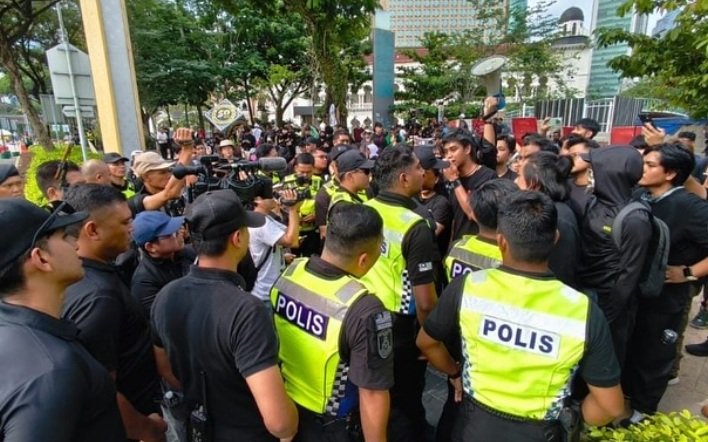
Despite these challenges the protest went ahead with around 200 people participating. A student activist was allegedly manhandled and arrested without clear justification. Following the protest, ten university students involved in the gathering were called in for police questioning. The organisers criticised the police, calling it a form of intimidation.
Cops probing rally against security law outside prison
YB Tuan Ramkarpal has now entered the Sungai Buloh prison to visit the SOSMA detainees whose family members are outside. pic.twitter.com/7sYcH3cH1G
— Suara Rakyat Malaysia (@SUARAMtweets) August 2, 2023
In February 2025, police said they were opening an investigation paper against a gathering outside Sungai Buloh prison that called for the abolition of the Security Offences (Special Measures) Act (SOSMA) 2012.
The protest started at around 8.10am on 8th February 2025 with around 50 participants, including family members of 32 SOSMA detainees suspected of gang-related crimes. Family members launched a hunger strike in front of the Sungai Buloh Prisons Complex. Their demands include that the government and prison authorities allow them to visit and check on the detainees.
SOSMA allows for detention without trial and has been used to justify abuses against detainees under the guise of national security. Under SOSMA, certain offences under the Penal Code are categorised as ‘security offences’ for which different rules of evidence and trial procedure apply. Many of these provisions violate international human rights standards on the right to a fair trial.
Sungai Buloh district police chief Hafiz says the case being investigated under Section 9(5) of the Peaceful Assembly Act 2012.
Additional fine by court for activist over 2019 protest
The High Court here today increased to RM10,000, from the RM5,000 fine imposed by a Magistrate against a former president of Universiti Malaya Association of New Youth(Umany) for insulting the university’s vice-chancellor by staging a protest during a convocation ceremony in 2019 pic.twitter.com/5hPmAKWN2l
— Vibrant Malaysia News (@VMalaysiaNews) April 15, 2025
The High Court in April 2025 increased to RM10,000 (USD 2,350) the RM5,000 fine (USD 1,175) imposed by a Magistrate against Wong Yan Ke, a former president of Universiti Malaya Association of New Youth (Umany), for insulting the university’s vice-chancellor by staging a protest during a convocation ceremony in 2019.
In 2019, Wong Yan Ke staged a solo protest during the University of Malaya’s (UM) graduation ceremony against the Vice-Chancellor Datuk Abdul Rahim Hashim for his speech during the Malay Dignity Congress. He was charged under Section 504 of the Penal Code, which defines the offence of provocation with the intention of disturbing public peace. In October 2023, the Kuala Lumpur magistrates’ court found Wong guilty. In July 2025, the Court of Appeal allowed an application for leave to appeal against his conviction.
Police attempt to disrupt protest and arrest protesters in Sabah
Student led protest Gempur Rasuah Sabah 2.0 begins in downtown KK https://t.co/ZfKoQUM7d7
— The Long Tweet (@tanjooilong) June 21, 2025
On 21st June 2025, students held a protest in Kota Kinabalu, the capital of the state of Sabah, aimed at pressuring the Prime Minister to act against corrupt politicians, which saw the participation of over 100 protesters. The protesters also urged legal action against the Sabah Water Department over water issues at the Sabah university and called for full autonomy for the national corruption agency or MACC.
The protest ended with the burning of a large banner bearing a caricature of Prime Minister Anwar Ibrahim. Fadhil, who was the group’s spokesperson, said the banner symbolised a scathing critique of Anwar’s administration, which the group claimed had failed to uphold promises of institutional reforms.
Ahead of the protest, police warned the public not to participate in the demonstration. Three student activists - Fadhil Kasim, Aliff Danial Badrul Akmal Hisham and Sabir Syarafuddin - were arrested at the Sabah police headquarters under the Sedition Act,
Student groups slam university for blocking forum on peaceful assembly
In June 2025, student groups claim Universiti Malaya (UM) blocked a forum on peaceful assembly that was supposed to take place on campus. The forum, featuring artist-activist Fahmi Reza and lawyer Rajsurian Pillai, was organised by a movement called Liga Mahasiswa.
However, according to the organiser, they were informed by UM auxiliary police that the forum was not allowed to take place inside its compound, allegedly by order of the UM deputy vice-chancellor in charge of student affairs.
Liga Mahasiswa criticised the action and urges the UM deputy vice-chancellor of student affairs to explain the decision.
Federal Court rules punishment for protest organisers is unconstitutional
A Federal Court’s decision on 1st July 2025 found that Section 9(5) of the Peaceful Assembly Act (PAA) 2012 is unconstitutional and invalid. The court found that Section 9(5) of the PAA imposes a punishment that exceeds the limits permitted under Article 10(1)(b) of the Federal Constitution. The section was described as ‘a disproportionate intervention’ that amounted to a prohibition, rather than a restriction on guaranteed rights.
The question before the court was whether it is constitutional to criminalise an organiser for failing to notify the police five days in advance of holding a peaceful assembly. The court ruled that it is unconstitutional to impose such a criminal penalty on an organiser.
Former Malaysian United Democratic Alliance (MUDA) Secretary General, Amir Hariri Abdul Hadi, brought the constitutional case before the court after he was charged under Section 9(5) of the PAA for failing to give notice under Section 9(1) in connection with a protest gathering that was held on 14th August 2022, on the littoral combat ship (LCS) linked to a corruption scandal.
Association
Sabah state denies entry to activist
Fahmi Reza posts Sabah photo after travel ban - but is he there? https://t.co/uNZDZbqVBM
— malaysiakini.com (@malaysiakini) June 20, 2025
On 29th May 2025, graphic artist and activist Fahmi Reza was denied entry into the state of Sabah after arriving at Kota Kinabalu International Airport and was sent back to Kuala Lumpur.
Fahmi — known for his satirical artworks that often criticise political figures — shared a notice that appeared to be issued by the Sabah Immigration Department on his Instagram page. The notice stated that the refusal was made under Section 65(1)(a) of the Immigration Act 1959/63, which allows Sabah’s authorities to bar entry at their discretion.
Earlier in 2025, Fahmi was investigated under three laws, including the Sedition Act, following the release of an illustration that labelled newly appointed Sabah governor Tun Musa Aman as the state’s “number one corruptor”. The probe is being conducted under Section 4(1) of the Sedition Act, Section 233 of the Communications and Multimedia Act (CMA), and Section 504 of the Penal Code.
Fahmi is also taking action against the government after being prevented from boarding an international flight in June 2025. He was initially told that he was on a travel blacklist at the immigration checkpoint, which the police later denied.
Police launch investigation into LGBTQ+ event
On 4th June 2025, police called in two members of the youth wing of the Malaysian Socialist Party, Pemuda Sosialis for questioning in relation to the ‘PRIDECARE: Queer Stories and Sexual Health Awareness’ workshop they had organised in conjunction with Pride in June 2025.
The police carried out an investigation under Section 298A of the Penal Code for alleged blasphemy, Section 505(c) of the Penal Code for purportedly inciting a crime, and Section 233 of the Communications and Multimedia Act (CMA), which criminalises improper use of network facilities. The police also confiscated the mobile phone of one of the youth wing members after taking their statement.
ARTICLE 19 said “this investigation highlights the repressive environment that LGBTQI communities continue to live in and the relentless discrimination they face for merely exercising their basic freedoms to expression and assembly.”
Court rules in favour of women’s rights group
On 19th June 2025, the court ruled that a 2014 fatwa (religious edict) against the women’s rights group Sisters in Islam (SIS) cannot be enforced on organisations or institutions such as Sisters in Islam since the Federal Court deemed the fatwa’s applicability only relevant to individuals professing the religion of Islam. A fatwa is an interpretation of points from the Sharia law issued by the State Fatwa Councils in Malaysia.
The fatwa was issued by the Selangor Islamic Religious Council, the primary religious authority in Selangor. It stated that the Sisters in Islam had deviated from Islamic teachings by subscribing to ‘liberalism and religious pluralism’ and that any publication with liberalism and religious pluralism elements should be banned and can be seized. The fatwa also called on the Malaysian Communications and Multimedia Commission (MCMC) to block social sites that go against Islamic teachings and Islamic law and any individual who holds on to 'liberalism and religious pluralism' beliefs should repent and return to Islam.
Since its issuance, the fatwa has significantly impacted SIS’ work and their ability to speak freely on issues related to Muslim women’s rights. Most recently, the Selangor Islamic Religious Department (JAIS) urged the public to congregate in all mosques in the state to pray over the case – reflecting the ongoing pressure and harassment that SIS has faced due to the fatwa.