Malaysia’s civic space continues to be rated as ‘obstructed’ by the CIVICUS Monitor. Among ongoing concerns are the array of restrictive laws, especially the Communication and Multimedia Act 1998 (CMA) and the Sedition Act, that have been used to silence online dissent and to harass human rights defenders. Critical news websites and blogs have been blocked. Peaceful protesters continue to be hauled in by the police for questioning under the Peaceful Assembly Act. Malaysia has also yet to ratify the International Covenant on Civil and Political Rights (ICCPR).
In recent months, peaceful protests have been blocked, and activists have faced arrest or ill-treatment for their involvement in protests. Activists and critics have also been arrested and charged, using restrictive laws to silence their online expression and criticism of the authorities. The government also blocked Telegram channels and a video from an online news outlet. A journalist was arrested in Thailand for his criticism of a government body while books continue to be banned. The courts have made positive rulings around protests, the use of the Communication and Multimedia Act 1998 (CMA) and around enforced disappearances. Activists were arrested around a forced eviction.
Peaceful Assembly
Police block march to parliament demanding reform of laws
"Instead of taking steps to protect this right, it is disappointing to see the police resorting to heavy-handed actions. They should not obstruct peaceful protesters, particularly in public places such as Parliament."https://t.co/6Hr9VYhTIJ
— ARTICLE 19 (Malaysia) (@Article19Msia) July 23, 2025
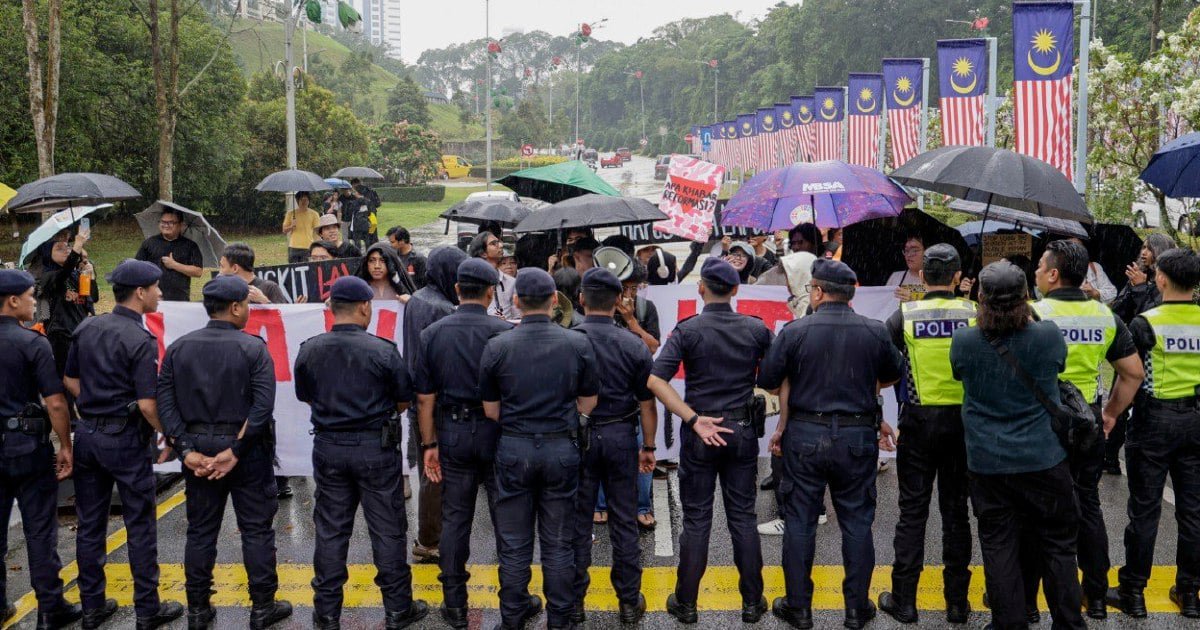
On 22nd July 2025 at least 50 people, including human rights defenders and civil society groups, marched to Parliament, where the lower house (Dewan Rakyat) was in session, to demand meaningful change to the Peaceful Assembly Act (PAA) 2012 and the repeal of the Sedition Act 1948.
When the group arrived at Parliament, police and the Light Strike Force (LSF), a riot control unit, obstructed them and prevented them from handing over their memorandum for lawmakers. As the group marched closer to Parliament, they were met by police enforcement officers, who had formed a human barricade just outside the gates of the legislature’s grounds, preventing protesters from advancing further.
Nalini Elumalai from ARTICLE 19 said: “Peaceful assemblies are crucial in bringing to light topics of legitimate public interest. Yet, those who call for accountability, including the reform of archaic laws that are not in line with international standards, are often repressed or silenced.”
Cops arrest opposition politician at his home following rally
On 28th July 2025, opposition politician and activist Badrul Hisham Shaharin, better known as Chegubard, was arrested by police after reports were lodged against him following the ‘Turun Anwar’ rally on 26th July 2025 calling for the Prime Minister to step down.
Chegubard is being probed under Section 4(1) of the Sedition Act 1948 for doing or attempting to do any act with a seditious tendency, Section 233 of the Communications and Multimedia Act 1998 for improper use of network facilities, and Section 504 of the Penal Code for intentional insult with intent to provoke a breach of the peace. He said he is also being investigated under Section 14 of the Minor Offences Act 1955 for using indecent, threatening, abusive or insulting words or behaviour that could lead to a breach of the peace.
Blocking of plantation workers’ protest and harassment of activist
🧵1/ Today, human rights defender @arul_psm was arrested, just days after leading plantation workers in a peaceful march to Parliament.
— Amnesty International Malaysia (@AmnestyMy) August 20, 2025
👉 @PDRMsia calling him in to surrender himself is nothing short of harassment. pic.twitter.com/YbQHYPXcAC
On 13th August 2025, hundreds of plantation workers gathered at the National Monument, before marching to Parliament to submit a memorandum urging the government to enact legislation requiring alternative housing for plantation workers if their current estates are repurposed for development projects.
According to ARTICLE 19, although they were eventually able to hand over the memorandum to Members of Parliament from the opposition and the government, the peaceful protesters were first met with a police blockade. Authorities attempted to physically block protesters from advancing closer to the Parliament gates, causing a scuffle, and resulting in one activist, Arutchelvan, Deputy Chairperson of the Socialist Party of Malaysia (PSM), to fall to the ground.
Following the protest, the police contacted Arutchelvan, citing a report lodged against him for an alleged scuffle during the march. Hel later gave his statement at Dang Wangi District Police Headquarters on 14th August, where he was investigated under Section 353 of the Penal Code (criminal force or assault to deter a public servant from performing their duties).
Arutchelvan was then required to surrender himself for arrest at Dang Wangi District Police Headquarters, which he did on 20th August 2025. He was detained for about six hours and released on police bail at midnight.
Arrests and excessive force at pro-Palestine rally
On 2nd October 2025, two protesters were arrested during a peaceful protest held outside the US Embassy in response to Israel’s interception of the Global Sumud Flotilla and the detention of hundreds of activists, including 23 Malaysians.
According to civil society groups, the two were arrested around noon for allegedly obstructing civil servants from performing their duties (Section 186 of the Penal Code). Instead of enabling safe use of the pedestrian walkway outside the U.S. Embassy, officers blocked access and displaced protesters onto the roadway, manufacturing the very disruption later cited. Police were seen provoking a scuffle when a plainclothes Special Branch officer feigned being pushed by one of the arrestees while blocking him from rejoining fellow protesters. A second protester who was attempting to de-escalate was also arrested.
Both protesters were dragged and restrained by multiple police officers, held by both arms and around the neck, before being handcuffed. Other protesters who were attempting to defuse the situation were also manhandled without warning.
For four hours after the arrests, the authorities did not disclose where the two protesters were held. They were released the same night.
Activist acquitted following landmark court ruling
🎉 Good news: @amirxabdhadi acquitted!
— Amnesty International Malaysia (@AmnestyMy) August 8, 2025
We welcome the court’s decision to acquit activist Amir Hadi of charges under Section 9(5) of the Peaceful Assembly Act.
An important win for freedom of assembly in Malaysia!
Picture by: @MandiriMY #ProtectTheProtest pic.twitter.com/J4q8c8FriD
On 8th August 2025, activist and Mandiri executive director Amir Hariri Abd Hadi was acquitted of a charge under Section 9(5) of the Peaceful Assembly Act 2012 (PAA) for allegedly failing to notify authorities before organising the “#ManaKapalLCS” anti-corruption rally on 14th August 2022. The court granted the acquittal after the prosecution confirmed it had no intention to re-charge Amir.
The acquittal followed the Federal Court’s July 2025 decision declaring Section 9(5) unconstitutional for criminalising peaceful assembly organisers who fail to give five days’ notice to the police. The Court found the provision inconsistent with the constitutional right to peaceful assembly under Article 10(2)(b) of the Federal Constitution (FC) read together with Article 8(1) of the FC. In striking down Section 9(5) as unconstitutional, the Federal Court found the provision to be disproportionate, discriminatory, and tantamount to a prohibition rather than a restriction.
Expression
Student activist arrested under Sedition Act over comment on Governor
On 21st August 2025, Universiti Malaysia Sabah (UMS) student Abdul Qayyum was arrested at his home by police who arrived in two cars and one motorcycle. He was taken alone to the Kota Kinabalu district police headquarters without legal counsel present. Police confiscated his mobile phone and SIM card, informing him that his statement would be recorded but not clarifying his detention status.
Qayyum was investigated under Section 4(1) of the Sedition Act over a comment he posted on Sabah Governor Musa Aman’s Facebook page. The comment, made under a post on Musa’s page about an award ceremony and later deleted, criticised the governor over perceived inaction regarding the death of student Zara Qairina. He was detained for close to five hours and questioned, with the investigating officer initially indicating a possible court remand the next day. However, Qayyum was released without charge later that night.
Opposition activist and blogger arrested
Badrul Hisham Shaharin, better known as Chegubard, was arrested on 6th September 2025 in connection with a viral TikTok video allegedly containing seditious remarks and baseless claims relating to the royal institution. The case is being investigated under Section 4(1) of the Sedition Act 1948, Section 505(b) of the Penal Code, and Section 233 of the Communications and Multimedia Act 1998.
Blogger Wan Muhammad Azri Wan Deris, widely known as Papagomo, was arrested by police on 26th October 2025 in connection with an investigation under the Sedition Act 1948.
The arrest follows an earlier court ruling on 24th September 2025, when the Sessions Court ordered Wan Azri to enter his defence on a charge of making seditious statements allegedly inciting hatred against the King of Malaysia.
Online critics nabbed from their homes
Police arrested two individuals from their homes on 30th September 2025 for uploading online content critical of Prime Minister Anwar Ibrahim. Aidil Qayyum, who is part of the opposition party Bersatu Youth's new media section, was arrested at his home at 1am, believed to be over his comments critical of the government's subsidy scheme for petrol.
He is being investigated under the Sedition Act, Section 233 of the Communications and Multimedia Act, and Section 505(b) of the Penal Code related to causing "fear or alarm to the public".
Meanwhile, TikToker Muhammad Kamil Puteh, who has been actively criticising the government, was arrested at his home at 3.30am over his cynical comments on a recent statement by the Malaysian Anti-Corruption Commission (MACC) absolving Anwar of claims.
Both Kamil and Aidil were brought to the Dang Wangi police station for remand. However, the magistrate denied the application to remand them for four days and ordered their release after 24 hours.
Court issues injunction against Telegram channels
On 11th September 2025, the High Court issued a prohibitory injunction preventing Telegram from disseminating content alleged to undermine public institutions and threaten social order. Judge Mahazan Mat Taib granted the government's application, filed through the Malaysian Communications and Multimedia Commission (MCMC), ordering the removal of 33 specific posts from the Telegram channels Edisi Siasat and Edisi Khas. Both channels are known for sharing whistleblower-style revelations, frequently focusing on public institutions and enforcement agencies.
ARTICLE 19 and the Centre for Independent Journalism expressed deep concern over the Court’s injunction against Telegram, blocking Edisi Siasat and Edisi Khas from publishing so-called “harmful” content under the Communications and Multimedia Act 1998 (CMA). They urged the court to reverse the decision and call for a review of the CMA in line with international human rights law.
Seven individuals arrested for online posts targeting political leaders
On 6th October 2025, Malaysian police announced the arrest of seven individuals for allegedly posting “seditious and threatening” content targeting political leaders on TikTok and Facebook.
The arrests, carried out by the police, followed investigations into videos and posts shared on TikTok and Facebook between 17th September and 5th October 2025. The cases involve users allegedly posting content ranging from comments insulting the government and national leaders, to threats and statements “capable of causing public alarm”.
Amnesty International Malaysia said: “Using Malaysia’s digital laws to go after people for what they say online is not the mark of a government encouraging free speech, it is intimidation and control extended to online spaces. These arrests send the message that even light criticism or satire can land you in a police cell in Malaysia.”
MalaysiaNow news outlet video taken down
In July 2025, the government asked Facebook to block a video uploaded by MalaysiaNow news outlet containing audio recordings showing acts of corruption.
The six-minute video shows a meeting chaired by Sabah Chief Minister Hajiji Noor in 2024 in which a company linked to politician Farhash Wafa Salvador was granted the exclusive right to explore minerals on 70,000 hectares of forest reserves. The video was blocked for Facebook users in Malaysia.
A notice from Facebook stated that “because of a legal request from MCMC, we have to restrict access to your video”, referring to the Malaysian Communications and Multimedia Commission (MCMC), the agency under the communications ministry.
The latest blocking by Facebook is not the first instance of MalaysiaNow being subjected to online censorship by the MCMC. As previously documented, in June 2023 the news portal MalaysiaNow was inaccessible to some users and was likely being blocked by certain internet service providers (ISPs).
Journalist arrested in Thailand at Malaysia’s request
#AsiaPacific 🌏 Retired academic Murray Hunter warned about the dangers of transnational repression and how his case could set an alarming precedent, especially since Thailand is a regional hub for exiled journalists, scholars, and dissidents. @Advoxhttps://t.co/tUyV29mf3S pic.twitter.com/2rE8JB2N5h
— IFEX (@IFEX) October 20, 2025
On 29th September 2025, Australian journalist Murray Hunter was arrested by Thai police on criminal defamation charges, reportedly at Malaysia’s request, sparking concerns about transnational repression of free speech in ASEAN. Thailand, a hub for critical regional reporting, has faced criticism for cooperating with neighbouring governments in similar cases.
Hunter was released on bail after 48 hours in custody and now faces charges linked to the Malaysian Communications and Multimedia Commission (MCMC). In April 2024, Hunter accused MCMC of political bias, which the commission denied, labelling his claims slanderous. The charges reference four of his Substack articles under Thailand’s Criminal Code Section 328.
On 17th October, a Malaysian court found Hunter liable for defamation in a civil suit by the MCMC. According to MCMC, Hunter published a series of articles between April and November 2024 deemed to be false and defamatory of the country’s internet regulator.
Hunter believes he is the target of a SLAPP action and a victim of transnational repression. Strategic Lawsuits Against Public Participation (SLAPPs) are a tactic used to weaponise the courts against those who stand up or speak out on public interest issues.
Landmark decision on digital law
In August 2025, the courts made a landmark decision around a provision in the Communications and Multimedia Act (CMA) that has been systematically used to criminalise online expression.
On 19th August 2025, the Court of Appeal found in the case of Heidy Quah v Government of Malaysia, that the words ‘offensive’ and ‘annoy’ in Section 233 of the Communications and Multimedia Act (CMA) 1998 are unconstitutional, as they breach two articles of the Federal Constitution: Article 8, which guarantees the right to equality, and Article 10, which guarantees the right to freedom of speech and expression.
The ruling set a precedent affirming that critical discourse and calls for accountability are vital to democracy. The Centre for Independent Journalism (CIJ) and ARTICLE 19 welcomed the decision and reiterated their call to repeal Section 233 of the CMA. They further urged the Ministry of Communications and Parliament to amend Section 233(1) accordingly and impose a moratorium on its enforcement until the amendments take effect.
The challenge to Section 233 was brought by Refuge for Refugees co-founder Heidy Quah after being charged on 27th July 2021 for a Facebook post she uploaded on 5th June 2020. Heidy’s post recounts a mother’s description of horrific conditions she and her child faced in an immigration detention centre. In April 2022, the Sessions Court granted the human rights activist a discharge not amounting to an acquittal (DNAA) because the charge under Section 233(1)(a) was deemed defective.
Banning of books continues
The government has continued to use the draconian Printing Presses and Publications Act (PPPA) 1984 to ban books.
On 29th July 2025, it was reported that the Home Ministry had banned two publications, effective from 1st July 2025, due to their content allegedly being “detrimental to public morals”. The books, “Chase Me” by American author Tessa Bailey, and “Ammar Zahrain: The Obsessive Husband” by local author Nssignature, were banned under Subsection 7(1) of the Printing Presses and Publications Act (PPPA). The ministry also invoked Subsections 8(1) and 8(2) to justify the measure.
Under Subsection 8(1) of the Act, any individual in possession of restricted material can be prosecuted and fined no more than RM5,000 (USD 1,204). Under Subsection 8(2) of the law, any parties involved in the printing, importing, production, publication, distribution, etc. of any prohibited content can be prosecuted and imprisoned for no more than three years or fined no more than RM20,000 (USD 4,818), or both.
Media council established and holds inaugural meeting
The Malaysian Media Council (MMC), an independent self-regulatory body to uphold journalistic standards and media accountability, was formally established in July 2025.
The council said it is tasked with promoting ethical and responsible journalism, maintaining a code of conduct for the media, mediating public complaints, and facilitating communication between the media, government, and the public.
It will also play a role in supporting legal and policy reforms that advance press freedom, facilitating training and professional development for journalists, and maintaining a centralised information database on the media landscape. These functions are aimed at strengthening the independence, accountability and sustainability of the media sector in Malaysia.
On 7th November 2025, twelve people were elected to the MMC board at its inaugural annual general meeting, representing media companies, journalists, and the public.
Association
Civil society calls for accountability for enforced disappearances following court ruling
Two men disappeared — and for years, their families demanded answers.
— malaysiakini.com (@malaysiakini) November 13, 2025
On Nov 5, the KL High Court finally declared what many had long feared: the government bears responsibility.
But as the Attorney-General appeals the ruling, the question remains — will justice ever be served?… pic.twitter.com/Kz0aQzKREm
On 5th November 2025, the High Court ruled that the government and police were responsible for the enforced disappearances of Pastor Raymond Koh and Amri Che Mat, citing involvement by the Special Branch of the police.
Amri Che Mat was abducted in 2016, while Pastor Raymond Koh was abducted in 2017. The court awarded Raymond Koh’s family over RM 37 million (USD 8,845,331) and Amri Che Mat’s family RM 3.6 million (USD 860,626) in damages and ordered the police to reopen investigations, with regular progress reports to the Attorney General’s Chambers. Despite the ruling, the government announced plans to appeal the entire court decision in both cases.
Amnesty International said: “This welcome landmark ruling is the first judicial recognition of enforced disappearance at the hands of the Malaysian authorities. The government must now ensure this decision marks the beginning of real accountability, not another cycle of delay and denial through drawn-out appeals.”
On 13th November it was reported that the police have established a special investigative team to review the disappearances. Home Minister Datuk Seri Saifuddin Nasution Ismail said the team, led by an assistant commissioner of police, has already begun reviewing all initial investigation papers, the Human Rights Commission of Malaysia (Suhakam) and findings from the previous special task force.
Activists arrested around forced eviction
Several leaders and activists of PSM, along with residents of Kampung Papan, were arrested by security forces on Wednesday and Thursday, after they resisted the illegal demolition of houses in the area.
— Peoples Dispatch (@peoplesdispatch) November 15, 2025
Read more ⬇ https://t.co/IEd2RXngH5
Activists were arrested together with residents attempting to prevent the demolition of houses as part of a forced eviction in the state of Selangor.
On 12th November 2025, Deputy Chairperson of PSM, Arutchelvan Subramaniam, also known as Arul, activist M. Mythreyar, and M. Logesvaran, a representative for the residents affected by the demolition, were arrested under Section 186 of the Penal Code for allegedly obstructing public servants from discharging their duties – a clause that carries a penalty of up to two years’ imprisonment and/or a maximum fine of RM10,000 (approximately USD 2,410).
The following day, 10 people were arrested, also under Section 186 of the Penal Code: PSM Secretary-General Sivaranjani Manickam, PSM National Treasurer Soh Sook Hwa, PSM activist Aein Aneera Anuar, PSM activist Ramasamy Karupan, PSM activist Tan Ka Wei, PSM activist Hridhay Praveen, activist Wong Kueng Hui from the non-governmental organisation Mandiri, local resident Tang Bing Ai, and activist Fakrurrazzi Khairur Rijal from the advocacy group Himpunan Advokasi Rakyat Malaysia.
On 14th November, two human rights defenders - Yee Shan from Parti Sosialis Malaysia (PSM) and Jernell Tan - and seven local residents were arrested.
Nalini Elumalai, Senior Malaysia Programme Officer at ARTICLE 19 said: “This is a blatant attack against human rights defenders who dare speak out on behalf of local communities living in a climate where forced evictions and development pressures are being used to displace long-time residents. The arbitrary arrests of the activists highlight the risks faced by human rights defenders advocating housing rights.”