INTRODUCTION
Istanbul Mayor İmamoğlu Detained after Announcing Presidential Bid
On 27th February 2025, Istanbul Metropolitan Municipality Mayor Ekrem İmamoğlu, widely seen as President Erdoğan’s main challenger in the 2028 presidential elections, officially declared his candidacy. His announcement was quickly followed by escalating political and legal pressures. Weeks later, on 18th March, the Istanbul University Board announced the cancellation of diplomas for 28 individuals, including İmamoğlu. The university invoked “gross procedural errors”, alleging that İmamoğlu had been irregularly admitted to its English programme at the Faculty of Business Administration after transferring from a private university in 1990 –- rendering his degree invalid and making him ineligible to run for president under constitutional provisions requiring a university degree.
The situation escalated dramatically the next day, on 19th March, when İmamoğlu was taken into custody along with more than 100 individuals, including several senior municipal officials and the mayors of Istanbul’s Şişli and Beylikdüzü districts. He faces a range of serious charges, including forming and leading a criminal organisation, engaging in bribery and corruption, manipulating public tenders, and illegally recording personal data.
In addition, İmamoğlu was accused of aiding the Kurdistan Workers’ Party (PKK), an armed militant group classified as terrorist by the Turkish state, allegedly through his involvement in a political strategy known as “urban reconciliation.” This term refers to a strategy adopted by the pro-Kurdish People’s Equality and Democracy (DEM) Party, the third largest in the Turkish Parliament, during the March 2024 local elections, in which the DEM Party withdrew candidates in key cities to support Republican People’s Party (CHP) candidates such as İmamoğlu. The Istanbul Chief Prosecutor’s Office has now framed this electoral tactic as a coordinated attempt by the PKK to increase its political influence in urban centres.
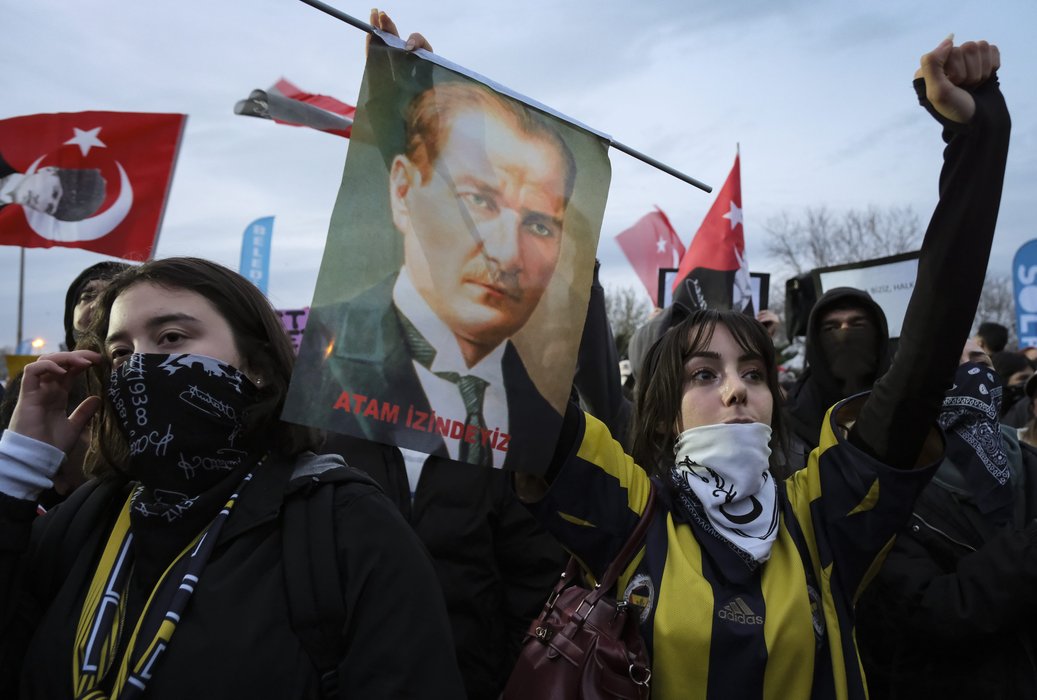
The arrest of İmamoğlu, a popular opposition figure, sent shockwaves through Turkish politics. His 2019 mayoral win, followed by a landslide victory in the rerun election, had made him a key symbol of resistance to Erdoğan’s rule. Mass demonstrations erupted on the day of İmamoğlu’s detention, spreading rapidly from Istanbul to 55 of Turkey's 81 provinces. The youth-led movement, driven largely by university students, quickly grew beyond İmamoğlu and his party, drawing widespread support from opposition groups, civil society and participants from diverse political backgrounds and resulting in the outbreak of the largest protests since the 2013 Gezi Park movement, with crowd estimates reaching up to two million people.
This is Istanbul mayor Imamoglu shortly before his detention this morning. He calls the investigation against him “a coup against the people’s will” and vows not to back down. Imamoglu runs a city of 16 million people. Expect a big public reaction. https://t.co/AdxcM1zyWj
— Julia Hahn (@juliahahntv) March 19, 2025
Legal Pressure on the Opposition
Based on an amendment to the Law on Municipalities introduced after the July 2016 failed military coup, the Interior Ministry can remove elected mayors, deputy mayors and council members for alleged terrorism links. Although the law requires a council member to act as interim mayor, the government has often appointed the most senior public official in the area (such as the governor or district governor) as a permanent “trustee”. In many cases, trustees have dissolved local councils or blocked them from convening, assuming full control of municipalities and sidelining elected representatives. This practice, primarily targeting Kurdish municipalities, has been repeatedly condemned by watchdogs, including the Council of Europe and Human Rights Watch. By November 2024, ANKA news agency reported, trustees had been installed in 149 municipalities since 2016.
In the most recent crackdown, this tactic has been turned towards the CHP. In the 2024 local elections, the party won 35 of 81 provincial municipalities in a historic result. Since İmamoğlu’s arrest, President Erdoğan’s government has begun sweeping detentions of CHP officials on vague allegations of corruption, organised crime and terrorism, paving the way for their removal and replacement with trustees.
On 23rd March, judicial proceedings began under tight security outside Istanbul’s Çağlayan Courthouse. Ninety-one people, including İmamoğlu, were referred to court with arrest requests. He was arrested on corruption charges but released in the parallel terrorism case. In total, 48 people were arrested. Some, including İmamoğlu, were arrested on corruption charges, and three others –- Şişli Mayor Resul Emrah Şahan, Istanbul Municipality Deputy Secretary General Mahir Polat and human rights advocate Mehmet Ali Çalışkan — on terrorism charges. Forty-one others were placed under judicial control. That day, the Interior Ministry suspended İmamoğlu and the mayors of Şişli and Beylikdüzü under Article 47 of the Municipalities Law. As İmamoğlu’s arrest was unrelated to terrorism, the court ruled a trustee could not be appointed.
After Şişli’s mayor was removed, District Governor Cevdet Ertürkmen was appointed as trustee. His first act was to hang a portrait of Erdoğan in the mayor’s office and post the image online, sparking daily protests.
The crackdown soon extended to Ankara. On 24th March, the Governor’s Office launched an investigation into 33 concerts organised by the CHP-led Ankara Metropolitan Municipality, citing alleged financial misconduct, another move widely seen as politically motivated. Amid speculation that the government could appoint a trustee to the CHP itself, party leader Özgür Özel called an Extraordinary Congress for 6th April, following two investigations into alleged vote-buying and irregularities in past congresses.
Crackdown Sparks Major Public Mobilisation
Despite İmamoğlu’s arrest, the CHP held its presidential primary the same day. Originally limited to party members, the vote transformed into a nationwide act of protest. More than 14 million people, including non-members and diaspora voters, cast their ballots; over 90% were in favour of İmamoğlu.
That evening, according to CHP estimates, nearly a million people gathered in Istanbul’s Saraçhane district in one of the country’s largest protests in years. Özgür Özel addressed the crowd, denouncing pro-government media and calling for a boycott of affiliated brands, stating no company should profit while “serving the palace.”
On 24th March, demonstrators gathered again in Saraçhane, turning towards Silivri Prison, where İmamoğlu was reportedly watching live coverage. Recordings show them chanting a famous protest song together and raising their voices in a powerful moment of solidarity with the imprisoned mayor.
Thousands of people protested in Turkey against the arrest of Istanbul's mayor Ekrem İmamoğlu.
— DW News (@dwnews) March 20, 2025
In Ankara, Istanbul, and other cities, demonstrators called for President Recep Tayyip Erdogan to resign, accusing him of trying to eliminate his biggest rival through the arrest. pic.twitter.com/uXBQ0LTbhO
FREEDOM OF ASSOCIATION
Expansive Powers Under Turkey’s New Cybersecurity Law
The new Cybersecurity Law introduced in March 2025, which creates a centralised administrative framework and designates the Cybersecurity Presidency as the main regulatory authority, has raised concerns among civil society due to its far-reaching surveillance powers. The law authorises access, search, copying and seizure of digital data from public and private entities with judicial or prosecutorial approval. However, in urgent cases, some actions may proceed before approval is granted, provided post-search authorisation is obtained—creating a risk of abuse in monitoring civil society actors. It also imposes penalties for non-compliance, mandates licensing of cybersecurity services and enables broad data collection, posing serious threats to activists’ privacy, freedom of association and the confidentiality of organisational work.
Ongoing Repression of Kurdish Language and Culture
A report by Kurdish Monitoring published in April 2025 documents 24 incidents of Kurdish language and cultural repression in Turkey during the first quarter of the year, pointing to a systematic crackdown. These restrictions affected public spaces, media outlets, cultural events and prisons. Notable examples include the blocking of Kurdish media platforms such as Mezopotamya Agency and JINNEWS, forced removal of Kurdish banners, bans on Kurdish concerts and punishment of artists, prohibitions on speaking or sending letters in Kurdish in prisons, and suspension of Kurdish-language social media accounts. Together, these measures reflect sustained state-backed efforts to limit Kurdish linguistic and cultural expression across public and institutional life in Turkey.
Pressure on Bar Associations and the Legal Profession
On 21st March 2025, the Istanbul 2nd Assize Court removed the elected leadership of the Istanbul Bar Association under Article 77/5 of the Attorneyship Law, dismissing the Bar’s president and executive board and ordering new elections. In February, Bar President İbrahim Kaboğlu and ten executive board members were charged with “making propaganda for a terrorist organisation through the press” and “publicly disseminating misleading information”, with prosecutors seeking up to 12 years’ imprisonment and political bans. The charges relate to a public statement issued after the deaths of two journalists in Syria in December 2024, which called for an independent investigation. Separately, Bar board member Fırat Epözdemir was detained on 23rd January 2025 after returning from an advocacy visit to the Council of Europe and charged with alleged “membership in a terrorist organisation” and “making propaganda for a terrorist organisation”.
The developments come amid wider pressure on legal professionals during mass protests that followed İmamoğlu’s arrest. A dozen lawyers were arrested in İzmir and Istanbul for supporting protesters, including former İzmir Bar Association Chair Özkan Yücel. Reports indicate that lawyers were in many cases denied timely access to clients, restricted in their ability to meet under confidential conditions, barred from entering courthouses during questioning, or prevented from confirming detainees’ whereabouts. These measures significantly impeded legal representation and restricted access to justice during the protests. On 28th March, Mehmet Pehlivan, the lawyer representing İmamoğlu, was detained on suspicion of money laundering, before being released under judicial supervision. In a post published on X/Twitter by his legal team, İmamoğlu dismissed the charges as fabricated.
FREEDOM OF PEACEFUL ASSEMBLY
Protests erupt following İmamoğlu’s detention
As outlined above, on 19th March 2025, Istanbul Mayor Ekrem İmamoğlu was arrested on politically charged corruption and terrorism-related allegations. A key opposition figure and leading challenger to President Erdoğan in the 2028 presidential election, he was widely seen as being targeted to obstruct his candidacy and weaken the opposition. His detention, alongside more than 100 others, triggered mass demonstrations across Turkey, including in Istanbul, Ankara and İzmir, with hundreds of thousands taking to the streets. The protests, fuelled by political repression and economic hardship, united a broad ideological spectrum and were marked by republican symbols and calls to defend democratic values.
Protests began at Saraçhane, outside the Istanbul Municipality Building, initially called by the CHP but quickly expanding into a grassroots movement led largely by Gen Z youth. University campuses became key protest hubs, with students breaking police barricades at Istanbul University’s Beyazıt Square and staging class boycotts. Demonstrations soon spread to other universities in Istanbul, Ankara and İzmir, despite official bans.
Heavy Crackdown and Rights Violations
Turkish authorities responded with a heavy-handed crackdown, deploying tear gas, water cannon and rubber bullets against largely peaceful protesters. Almost 2,000 people were detained or arrested, while journalists covering the events faced harassment, arrest and expulsion (see more under Freedom of Expression).
The İstanbul Bar Association (IBA) has documented extensive human rights violations during the protests that erupted from 19th to 29th March 2025. Their reports, based on field investigations and interviews, reveal systemic abuses including inadequate detention conditions, restriction of lawyers' access to clients, last-minute court appearances limiting defence preparation, and disproportionate use of pretrial detention. Thousands, including students and political activists, were detained under conditions violating constitutional protections. Women detainees reported widespread physical, psychological, and sexual abuse, including strip searches, neglect of hygiene and health needs, and routine sexist insults. The IBA stresses that these violations constitute a “state of lawlessness” rather than lawful crisis management, highlighting arbitrary practices throughout policing, judicial, and prison procedures.
İstanbul Üniversitesi'nde Ekrem İmamoğlu'na destek için toplanan öğrenciler polis barikatını yıkarak Beyazıt Meydanı'na ulaştı pic.twitter.com/Q1WYNegobq
— Kayhan AYHAN (@kayhanayhann) March 19, 2025
Protesters Subjected to Rushed, Mass Trials
In April 2025, mass trials began for hundreds of protesters, with charges including illegal assembly, incitement and disrupting public order. Critics said the proceedings lacked due process and were part of a broader effort to criminalise dissent. Notably, an Istanbul court later ordered the release of 102 young detainees, including CHP Party Assembly member Berkay Gezgin, creator of İmamoğlu’s campaign slogan, “Everything will be great again.” Nonetheless, the trials have become emblematic of Turkey’s democratic backsliding and shrinking civic space.
Digital Clampdown, Arrests and Disinformation
Within 24 hours of İmamoğlu’s detention, the Interior Ministry reported 18.6 million posts about him on the X platform. Authorities identified 261 accounts, including 62 abroad, accusing them of inciting hatred or crime, and arrested 37 individuals for sharing “provocative” content. Amid this, AFP fact-checkers debunked a viral 15-second video claiming to show petrol bombs thrown during the protests, tracing it to unrelated footage from a 2014 demonstration in Istanbul’s Okmeydanı district.
Arrests of People Calling for a Shopping Boycott
The crackdown extended beyond street demonstrations, with authorities increasingly criminalising other forms of protest and dissent. Police detained 11 people accused of promoting a one-day shopping boycott called for 2nd April. The action followed a call by main opposition leader Özgür Özel for a broader boycott of businesses perceived as tied to President Erdoğan’s government. The Istanbul Chief Public Prosecutor’s Office issued arrest warrants for 16 suspects on charges of “hatred and discrimination” and “inciting hatred and hostility,” according to state news agency Anadolu.
“Saturday Mothers” acquitted following years-long legal battle
An Istanbul court has acquitted 46 members of the Saturday Mothers group, ending a nearly seven-year legal ordeal that began after police violently dispersed their 700th weekly peaceful vigil in Galatasaray Square in August 2018. The demonstration, which has taken place every Saturday since 1995 and demands justice for enforced disappearances and political murders in Turkey, was banned by the governor of the Beyoğlu district on the grounds of late notification. Police used tear gas and water cannon, detaining 46 participants who were later charged in 2020 with “attending illegal meetings and marches without weapons and failing to disperse despite warnings”, offences carrying potential prison sentences.
The trial was closely followed by human rights organisations such as Amnesty International and Turkey’s Human Rights Association (İHD), as well as opposition political parties. Amnesty International described the prosecution as “baseless” and welcomed the verdict as recognition of the Saturday Mothers’ right to peaceful assembly, urging the lifting of all ongoing restrictions on their gatherings in Galatasaray Square.
Repression of International Workers’ Day protests continues
Turkish authorities have maintained a ban on May Day (International Workers’ Day) celebrations in Istanbul’s Taksim Square for over a decade, citing security and public order concerns. The ban, imposed after crackdowns on protests including the 2013 Gezi Park demonstrations, remains in force despite Constitutional Court and earlier European Court of Human Rights decisions affirming the right to peaceful assembly there. Ahead of 1st May 2025, the Istanbul governor’s office sealed off Taksim Square with metal barriers, deployed tens of thousands of police officers and detained dozens of people in advance for planning protests.
On 1st May 2025, police clashed with protesters attempting to defy the ban. Hundreds, including union members and civil society activists, tried to march towards Taksim but were blocked and pushed back by riot police, leading to scuffles in the Beşiktaş and Şişli districts. Authorities detained at least 384 people (some reports put the figure above 400) many of whom were forcibly loaded onto buses. The governor’s office implemented some of the tightest security measures to date, deploying more than 50,000 officers, shutting down metro, bus and ferry services, and sealing off major roads and areas including Kadıköy to prevent protesters reaching central Istanbul. The crackdown came amid a nationwide wave of unrest sparked by the March detention of Istanbul Mayor Ekrem İmamoğlu.
Turkish police detain demonstrators as they try to enter Taksim square during a May Day rally marking the international day of the worker in Istanbul, on May 1, 2025. #1M2025 #Taksim #1Mayıs2025 pic.twitter.com/PB76bKMfJT
— Bulent KILIC (@Kilicbil) May 1, 2025
In 2023, the Constitutional Court ruled that the longstanding ban on May Day celebrations at Taksim Square violated the constitutional right to assembly and demonstration under Article 34 of the Turkish Constitution. The decision concerned incidents in 2014 and 2015 when peaceful gatherings were dispersed with excessive force, including tear gas and rubber bullets, and protesters were prevented from assembling despite having notified authorities. The court found the restrictions lacked sufficient legal justification, were disproportionate and violated protesters’ rights.
Despite the ruling, which passed by a 10–5 majority, Turkish authorities have continued to enforce bans on large-scale assemblies in Taksim Square, citing security concerns and public order. The continued police crackdowns and pre-emptive detentions have been criticised by human rights groups as inconsistent with the Constitutional Court’s decision and international standards on freedom of peaceful assembly.
Polis gözaltına aldığı eylemcileri yerlerde sürüklüyor, Etkin Haber Ajansı muhabiri de gözaltına alınanlar arasında!#1MAYIS #1M2025Taksim pic.twitter.com/s2RUMqfiDp
— Furkan 🇯🇴 (@furkankayaciik) May 1, 2025
FREEDOM OF EXPRESSION
The 2025 World Press Freedom Index by Reporters Without Borders (RSF) ranks Turkey 159th out of 180 countries, its lowest position yet and a further decline from 158th in 2024. This marks the second consecutive year that Turkey remains in the Index’s bottom tier, reflecting a deeply repressive environment for journalists. Over 90% of national media is under state control, while politically motivated prosecutions, financial penalties targeting critical outlets, and sweeping censorship continue to stifle independent reporting.
Since 2002, when Turkey ranked 99th, the country has experienced a consistent erosion of press freedom. This decline stems from growing legal and economic constraints, hostile conditions for independent journalism, and diminishing media pluralism.
Amid the outbreak of nationwide protests in March 2025, Turkish authorities intensified their crackdown on freedom of expression and press freedom. This includes the arrest and physical assault of journalists reporting on the protests, the imposition of broadcast bans and fines on opposition-aligned media, and the detention or expulsion of foreign correspondents.
Journalists Arrested, Assaulted by Police While Covering Protests
In March 2025, following the arrest of Istanbul Mayor Ekrem İmamoğlu, Turkish police detained numerous journalists covering the ensuing protests. At least 11 reporters were detained during raids on their homes or while reporting from protest sites, with some, including AFP photojournalist Yasin Akgül, placed in pre-trial detention on charges of participating in illegal demonstrations. These actions were taken under Turkey’s restrictive Law No. 2911 on Meetings and Demonstrations, which criminalises unauthorised public assemblies and is frequently used to suppress dissent.
In addition to arrests, journalists faced violence and intimidation from police while reporting on the ground. Between 21st and 23rd March 2025, at least 12 journalists were physically assaulted in Istanbul’s Saraçhane district, according to the Council of Europe’s Platform for the Safety of Journalists. Despite clearly identifying themselves as press, they were deliberately targeted with pepper spray, rubber bullets and beatings while carrying out their professional duties.
On 21st March, victims included journalists from Nefes Gazetesi, Anadolu Agency, AFP, Reuters, Bianet, İlke TV, Özgür Gelecek, and several freelancers. Anadolu Agency reporter Hakan Akgün suffered a broken nose, while Reuters correspondent Dilara Şenkaya sustained head injuries. Nefes Gazetesi reporter Rıfat Kırcı reported being struck in the neck with a tear gas canister and beaten on the head by police.
On 22nd March, Egemen İsar of Nefes Gazetesi was shot with rubber bullets, leaving a visible wound above his right eye. The following day, BirGün reporters Ebru Çelik and Deniz Güngör were pepper-sprayed, kicked, and beaten by police who were attempting to disperse the demonstration. After kicking her to the ground, officers forcibly removed Çelik’s gas mask before pepper spraying her in the face.
Sanctions Against Media Outlets for Protest Coverage
Media critical of the government’s handling of the protests were fined and threatened with licence revocation or suspension, reflecting a broader effort to control and censor independent reporting.
Turkey’s broadcasting watchdog, the Radio and Television Supreme Council (RTÜK), imposed harsh penalties on several opposition-aligned TV channels for their live coverage of the mass protests. Sözcü TV received one of the harshest punishments: a 10-day broadcast suspension, during which it was ordered to display a black screen showing RTÜK’s ruling. One RTÜK member described the sanction as “one step before licence revocation.”
Halk TV and Tele 1 were also fined up to 5% of their monthly advertising revenue and received five-episode suspensions of specific programmes. The regulator accused these channels of “inciting hatred and hostility among the public”, particularly citing live broadcasts and commentary on demonstrations in Istanbul, Ankara and İzmir, as well as speeches by CHP leader Özgür Özel that criticised government officials and called for a boycott of pro-government media, which RTÜK claimed encouraged public division.
Tensions escalated further when RTÜK reportedly issued verbal instructions to TV outlets to stop live broadcasts of the protests—orders some channels refused to comply with in the absence of a written directive. In response, RTÜK President Ebubekir Şahin warned that licence revocations would be imposed on “broadcasting organisations that broadcast outside the law, incite the public to take to the streets, feature commentators who speak as if they were spokespersons for illegal organisations, engage in biased broadcasting activities that violate personal rights, and give place to expressions and broadcasts that insult or even threaten state officials, judicial authorities conducting investigations, police personnel, and law enforcement forces”, as stated in a post on Twitter/X. According to Deutsche Welle, following the RTÜK President's statement, many television channels cut off live broadcasts in busy areas and continued reporting from the studio.
Kamuoyuna ve Yayıncılarımıza Önemli Duyuru!
— Ebubekir Şahin (@ebekirsahin) March 19, 2025
Yaşanan gelişmeler ışığında, yayıncı kuruluşlarımızın haber içeriklerinde editoryal bağımsızlıklarını korurken, kamu yararını ve toplum huzurunu gözetmeleri gerektiğini bir kez daha vurgulamak isteriz.
Özellikle, İstanbul Cumhuriyet… pic.twitter.com/UqTOB2lcyt
In addition to punishing traditional broadcasters, RTÜK has expanded its crackdown to online media. In March, it ordered two YouTube channels—Flu TV and a channel owned by journalist Fatih Altaylı—to register with the government within 72 hours, or their accounts would be blocked. Fatih Altaylı, a prominent independent journalist, has nearly 1.5 million subscribers, which is significantly more than pro-government YouTube channels.
Foreign Journalists Detained, Expelled
Swedish journalist Joakim Medin was arrested in Turkey on 27th March, shortly after arriving in Istanbul to cover the protests. Turkish authorities charged him with “membership in an armed terrorist organisation” linked to the banned Kurdistan Workers’ Party (PKK) and “insulting the president”, relating partially to a 2023 protest in Stockholm where a puppet of President Erdoğan was hung by its feet—an event in which Medin and organisers denied his involvement. The Turkish government stated his detention was unrelated to his journalistic activities but rather based on these alleged prior actions. This arrest sparked protests in Sweden and raised alarm among media rights groups who condemned the Turkish government for criminalising journalism. They emphasised that Medin was performing his journalistic role, reporting on political developments in Turkey, and that such charges are part of a broader pattern of repression against journalists amid the crackdown on protests and dissent.
On the same day as Medin’s arrest, BBC correspondent Mark Lowen was detained for 17 hours in Istanbul before being deported. Turkish authorities justified the expulsion by labelling him a “threat to public order”.
Widespread Social Media Restrictions
Between 19th and 21st March, Turkish authorities imposed extensive bandwidth throttling across all major social media and messaging platforms. Services including YouTube, Instagram, X, TikTok, WhatsApp, Telegram, and Signal were slowed significantly, with some users reporting restrictions lasting up to 42 hours. The watchdog group NetBlocks confirmed the disruptions, which were implemented by all major mobile and broadband providers.
⚠️ Confirmed: Live metrics show #Turkey has restricted access to multiple social media platforms including X, YouTube, Instagram and TikTok; the incident comes as Istanbul mayor Ekrem Imamoglu and dozens of others are detained in events described by the opposition as a "coup" pic.twitter.com/5ldegqQCH3
— NetBlocks (@netblocks) March 19, 2025
No official justification was provided. Under a 2020 social media law, Turkey’s Information and Communication Technologies Authority (BTK) may unilaterally impose bandwidth limits for 24 hours without a court order; longer measures require judicial approval within 48 hours.
Authorities also ordered Twitter/X to block 700 accounts belonging to “news organisations, journalists, political figures, students, and others”, including the Turkish-language feed of independent outlet Bianet, citing a court order based on “national security and public order”.