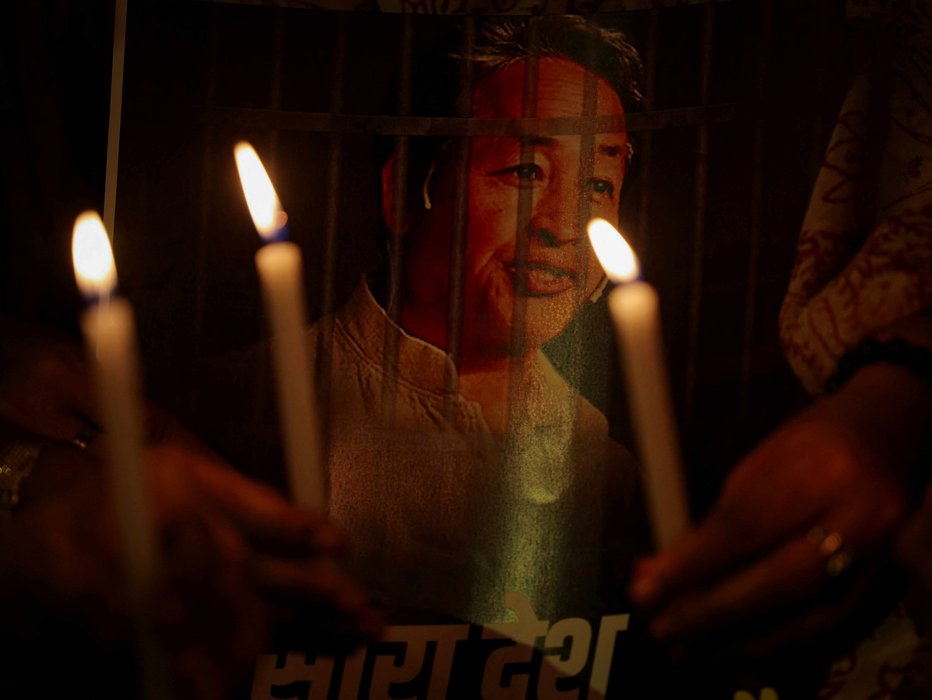
India’s civic space is still rated as ‘repressed’ by the CIVICUS Monitor. The authorities persist in targeting activists, journalists, students and civil society through the misuse of draconian laws, arbitrary detention, censorship and the criminalisation of dissent. Over the past year, the Unlawful Activities (Prevention) Act (UAPA), the Foreign Contribution (Regulation) Act (FCRA), counterterrorism provisions and public order regulations have been consistently deployed to silence government critics, restrict civil society, and deter peaceful protests.
Journalists across the country have faced growing intimidation through raids, surveillance, arrests, censorship and digital shutdowns. Media workers in Indian-administered Kashmir remain especially vulnerable to repeated police summons, raids, criminal cases and restrictions on movement. The right to peaceful assembly has also come under sustained assault. Student protests, workers’ mobilisations and solidarity demonstrations have been met with detentions and criminal charges.
In recent months, protesters have been targeted, including journalists, students, health workers and environmental activists. Police used lethal force during protests in Ladakh and detained an activist under a national security law. There have been reports of media restrictions, internet shutdowns, blocking of social media accounts and bans on VPNs in Jammu & Kashmir. There have been reports of killing of an RTI activist in Gujarat, counter-terrorism operations violating human rights in Jammu and Kashmir and the denial of bail to student activists. New orders issued in September 2025 grant sweeping powers to restrict freedoms while police raided the house of an environmental activist.
Peaceful Assembly
Journalists and activists gathered to protest media crackdown charged
Kerala Police File FIR Against Journalists, Activists Who Gathered to Protest Crackdown on Media@sukanyashantha✍️ https://t.co/Wc4oQmqb1Q
— The Wire (@thewire_in) September 16, 2025
On 13th September 2025, a group of journalists, activists and advocates gathered in Kochi, Kerala, to voice their concerns about the increasing crackdown on journalists and their arbitrary arrests. The meeting was organised as part of an ongoing campaign to demand the release of 26-year-old Kerala-based journalist Rejaz M. Sheeba Sydeek, who was arrested by the Maharashtra Anti-Terrorism Squad (ATS) in May 2025.
However, shortly after the meeting, the Kerala Police took the very actions the group had been protesting against, registering a case against the event’s organisers and speakers. Despite having proper permission to hold a public event, the Kochi Police booked them under several sections of the Bharatiya Nyaya Sanhita (BNS) and the Kerala Police Act for “unlawful assembly” and for “obstructing police from performing their duties”. They were also charged with “threatening, obstructing, or assaulting a police officer with the clear intention to prevent them from performing their duties” – a claim that the organisers have explicitly denied.
Those named in the FIR are journalists Siddique Kappan, Ambika, Baburaj Bhagavathy and Mrudula Bhavani; activists Niharika Pradaush, Dr. Hari, Shaneer, C.P. Rasheed, Sajid Khalid, V.M. Faisal; and advocate Pramod Puzhangara.
Police use lethal force during protests in Ladakh and detain activist
Authorities in India must immediately investigate use of lethal force against Leh protesters.
— Amnesty International (@amnesty) September 25, 2025
Read more 👇 https://t.co/PaaMQJdRai
Police fired on and killed four people and injured around 50 in Leh, the capital of India’s Himalayan region of Ladakh, on 24th September 2025, after protests over demands for statehood turned violent.
According to HRW, the authorities imposed a curfew and reportedly detained at least 50 people after protesters clashed with the police, setting fire to an office of the ruling Bharatiya Janata Party (BJP), the office of the chief executive councillor, and a police vehicle. Dozens of people, including police officials, were injured.
Ladakh was established as a union territory of India on 31st October 2019, following the passage of the Jammu and Kashmir Reorganisation Act. Prior to that, it was part of the Jammu and Kashmir state. The agitation in Ladakh has been ongoing since 2021, with protesters demanding statehood for the region and its inclusion in the Sixth Schedule of the Indian Constitution, which provides a system of autonomous self-governance for tribal areas.
The BJP-led central government blamed Sonam Wangchuk, an educator and climate activist from the region who has been spearheading the movement for statehood through peaceful marches and hunger strikes, for inciting the violence. Wangchuk denied the claims, appealing for calm and dialogue, saying it was a “Gen-Z revolution” incited by young people’s frustration over lack of jobs and a government that is unwilling to listen to their demands.
HRW reported that the Central Bureau of Investigation initiated an inquiry against an institution founded by Wangchuk on alleged violations of India’s foreign funding law, the Foreign Contribution Regulation Act (FCRA). Wangchuk denies the allegations, saying they are politically motivated. On 25 September 2025, the Home Ministry cancelled the FCRA licence for his NGO, Students’ Educational and Cultural Movement of Ladakh, which operates an alternative school widely hailed as a model for innovative education.
Following the protests, on 26th September, activist Sonam Wangchuk was arrested and charged under the National Security Act (NSA). He was kept in solidarity confinement and not allowed to meet with his family. He remains in detention. Under the NSA, individuals can be held without charge or trial in administrative detention for up to 12 months on grounds of national security and maintenance of public order. This preventive detention violates various due process rights, including the presumption of innocence.
Students beaten and detained for protest against sexual harassment in Pondicherry
Students’ Federation of India (SFI) cadres at Pondicherry University were attacked by campus security guards and arrested by the police on Thursday night during a protest demanding action against professors accused of sexual harassment and the reconstitution of the inactive… pic.twitter.com/2VUXz7n5qP
— Maktoob (@MaktoobMedia) October 10, 2025
On 9th October 2025, at least 24 students of Pondicherry University were violently lathi-charged, dragged and detained by university security personnel and later by the police while demanding the suspension of two professors accused of sexual misconduct at the university’s Karaikal campus.
The protest erupted after two audio recordings surfaced in which the accused faculty members were allegedly heard demanding nude photographs from a student and threatening serious academic consequences if she refused.
The student reportedly remained under sustained harassment for several months, leading to severe trauma, withdrawal from classes and the inability to appear for examinations. Protesting students accused the university administration of inaction despite repeated complaints, while the administration claimed that it had conducted an internal inquiry on 30th September and found “no prima facie validity” to the allegations against the faculty members.
Excessive force used against protesting health workers in Kerala
Kerala HC Closes PIL Seeking Increase In Honorarium Of ASHA Workers As State Informs Of ₹1000 Hikehttps://t.co/s9cIQXLFHj
— Live Law (@LiveLawIndia) November 4, 2025
In October 2025, after Kerala Chief Minister Pinarayi Vijayan publicly claimed that there was no poverty in the State, long-protesting Accredited Social Health Activist (ASHA) workers intensified their agitation, calling the statement a denial of their lived realities. The workers, who had been protesting for over eight months outside the State Secretariat, were demanding a substantial increase in their monthly honorarium and improved retirement benefits. Under the banner of the Kerala ASHA Health Workers’ Association (KAHWA), they announced a statewide day of protest and escalated their mobilisation by marching towards the Chief Minister’s official residence, Cliff House, in Thiruvananthapuram.
On 23rd October 2025, police used water cannon and physical force to block the ASHA workers’ march, forcibly dispersing the protesters as they attempted to cross barricades. Several ASHA workers were taken into custody, including leaders M.A. Bindu and S. Mini, after protesters climbed over barricades during the standoff. The workers were later released after police assured them that a meeting with the Chief Minister would be arranged. The police action was widely condemned as anti-democratic, with opposition leaders alleging excessive use of force, tearing of women’s clothing, and arbitrary detention, even as solidarity protesters were also arrested at the site.
Detention and arrests at air pollution protests in New Delhi
There have been protests in New Delhi calling for action as the Indian capital faces another winter engulfed in smog.
Arrest the pollution, not the people!@CMODelhi @gupta_rekha STOP targeting the citizens and students — START TACKLING POLLUTION!
— CPIML Liberation (@cpimlliberation) November 9, 2025
Immediately release all detained citizens and students who were peacefully protesting at India Gate against dangerous pollution levels in Delhi and… pic.twitter.com/W1OIjTQUbf
On 9th November 2025, demonstrators mounted a rally at the city’s India Gate monument to demand action over the lethal pollution that envelops the area each year. Crowds held up banners and chanted slogans while some disrupted traffic. Police officers detained some of the protesters by putting them on buses, and dispersed others. Newslaundry reporter Anmol Pritam and producer Tarun Sahu were also detained by Delhi Police while covering a citizens’ protest against air pollution near India Gate.
Delhi: A group of protesters holds a protest at India Gate over air pollution in Delhi-NCR. They were later removed from the spot by police personnel pic.twitter.com/VYT8wFo3yB
— Jist (@jist_news) November 23, 2025
On 23rd November 2025, 23 individuals, including 12 girls and a minor, were apprehended by the Delhi Police for a protest at the India Gate against the toxic air in the capital. It is alleged that the protesters blocked traffic at C-Hexagon, obstructed police from performing their duties, raised slogans in support of slain Maoist commander Madvi Hidma and that one of the accused caused simple injuries to a police constable by using pepper spray.
Lawyers representing the protesters said that police also assaulted the protesters and that there were visible marks on their bodies.
While 16 accused in the case were earlier granted bail by a Magistrate court in Patiala House, the bail of six others was only granted a month later.
Expression
Government orders removal of media items related to Adani
According to CPJ, a directive from the authorities was issued, ordering the removal of dozens of allegedly defamatory media items about Adani Enterprises. On 16th September 2025, the Ministry of Information and Broadcasting ordered the removal of 138 YouTube videos and 83 Instagram posts, including content from independent news outlets and commentators, citing a New Delhi court order that barred “unverified, unsubstantiated and ex-facie defamatory” reports about Adani, one of India’s largest conglomerates.
The government directive follows a 6th September 2025 ex-parte injunction issued by a civil court in New Delhi. Ex-parte orders are temporary and granted without hearing the opposing party, typically in urgent cases where immediate action is considered necessary to prevent serious or irreparable harm.
The order restrained 10 defendants, including independent journalists Paranjoy Guha Thakurta, Ravi Nair, Abir Dasgupta, Ayaskanta Das, and Ayush Joshi, from publishing allegedly defamatory content about Adani. Although not named by Adani in the defamation case, independent news outlets such as The Wire, Newslaundry, and The DeshBhakt, as well as several prominent commentators on YouTube, were ordered by the government to take down content. A copy of the ministry’s directive was sent to Meta and Google.
Journalist and family face threats
Forget police security, they didn’t even file an FIR despite threats to my life: Rana Ayyub - The Hindu https://t.co/fVwlBwd8HS
— Rana Ayyub (@RanaAyyub) November 9, 2025
The Committee to Protect Journalists (CPJ) reported in November 2025 that Washington Post columnist Rana Ayyub and her family had received multiple threats via her phone from someone who knew her home address.
Ayyub told CPJ that she received multiple video calls, phone calls, and messages via WhatsApp over a 20-minute period on 2nd November 2025, demanding that she write a column on the 1984 anti-Sikh riots, in which some 3,000 Sikhs were killed following the assassination of then-Prime Minister Indira Gandhi by her Sikh bodyguards.
The caller cited Ayyub’s home address and threatened to send people there to attack her and to kill her father, who lives with her, if she failed to publish the article. In her complaint, Ayyub noted that the profile image of the caller matched a photograph of Indian gangster Lawrence Bishnoi, who is currently in a prison in the Indian western state of Gujarat. Ayyub said police officers were sent to her residence as protection following the threats.
The prominent journalist’s personal number was leaked online in 2024 and her reporting has previously led to online trolling, official intimidation, criminal investigations, and rape and death threats.
300 social media accounts blocked in Kashmir
On 16th September 2025, the Indian authorities blocked over 300 additional social media accounts in Indian Administered Jammu & Kashmir. Authorities in Doda, Kishtwar and Ramban districts blocked the social media accounts in just three days after they were found circulating provocative content and spreading misinformation to urge people to protest the detention of MLA Mehraj Malik in Doda.
Mehraj Malik, who was booked under the draconian Public Safety Act (PSA) in September 2025, had 18 cases and reports by police registered against him. In all the cases filed against Malik, the common thread is "irresponsible and offensive remarks" made by the MLA against officials and his political opponents.
Jammu and Kashmir is one of the most militarised regions in the world and voices critical of the authorities have been intensely repressed since August 2019, when its autonomy was revoked.
Jammu and Kashmir bans use of VPNs
The Jammu and Kashmir administration has imposed an ex-parte ban on the use of virtual private networks (VPNs) in parts of the Union territory, citing threat to national security and apprehensions of “incitement to unrest”.
In an order on 29th December 2025, the district magistrate (DM) of south Kashmir’s Shopian district, imposed a temporary ban on the use of VPNs by smartphone users and others in the district by invoking section 163 of the Bharatiya Nagarik Suraksha Sanhita (BNSS).
At least six districts – four in Kashmir valley and two in Jammu region – banned the use of the VPNs in December 2025 by invoking Section 163 of the BNSS which grants extraordinary powers to the executive magistrates to issue “urgent orders to prevent nuisance or danger”.
While warning of legal action against the offenders, the order said that “immediate preventive measures” were necessitated under section 163 of BNSS to “safeguard data/information related to the sensitive content from potential cyber threats”.
Internet shutdown in Odisha
On 8th December 2025, the State Government of Odisha imposed a suspension of telecommunication services along with an express prohibition on the use of social media platforms. On 15th December 2025, internet services were reportedly restored.
According to Software Freedom Law Center (SFLC), this internet shutdown stemmed from the events of 4th December 2025, when the body of a 51-year-old Koya tribal woman, Lake Padiami, was discovered near the Potteru river in Rakhelguda village. The body was identified by the Koya tribal community. This discovery triggered an incident of violence. Based on the belief that the people from the village were involved in the killing of Lake Padiami, the tribal community allegedly attacked MV-26 village on 7th December.
According to SLFC, the government failed to issue an official notification on the state website as required by law, including crucial details such as the date, time, and the specific area where the suspension would be in effect. It also stated that the state government failed to provide adequate rationale behind the necessity of imposing these internet shutdowns.
Association
RTI activist in Gujarat found dead after uncovering irregularities
On 16th October 2025, the body of Rasik Parmar, a 55-year-old disabled Right to Information (RTI) activist and anti-corruption whistleblower, was found in a canal in Tharad, Gujarat, days after he was allegedly abducted. According to the FIR filed by his nephew, Parmar had uncovered serious irregularities in a slum redevelopment project under a public-private partnership (PPP) scheme, involving 1,449 housing units and 130 commercial shops. He had submitted repeated complaints to the Ahmedabad Municipal Corporation (AMC), the Gandhinagar collector’s office, the Chief Minister’s Office, and the Gujarat High Court, alleging the use of forged beneficiary documents and large-scale manipulation by local builders.
The FIR further states that Parmar had received repeated threats from two individuals — Raju Karate and Kamlesh Solanki — who were allegedly linked to the redevelopment scam. Despite being warned to stop his activism, Parmar continued to publish updates about the case on social media and messaging groups, stating that he would not be intimidated. On 12th October, he was allegedly abducted by unidentified persons near a relative’s residence. His body was later recovered from the canal with clear signs of strangulation and sent to Tharad Civil Hospital for post-mortem examination. Four people have since confessed to committing the murder.
UN experts alarmed by counter-terrorism operations violating human rights in Jammu and Kashmir
On 24th November 2025, UN experts expressed alarm about serious human rights violations committed by Indian authorities following the 22nd April 2025 terrorist attack in Pahalgam, in Indian-Administered Kashmir, which killed 26 people.
According to the experts, after the attack, Indian authorities launched sweeping operations across Jammu and Kashmir, resulting in the arrest and detention of around 2,800 individuals, including journalists and human rights defenders. Some were detained and charged under the Public Safety Act or the Unlawful Activities (Prevention) Act, which permit prolonged detention without charge or trial and contain vague and overbroad definitions of terrorism. Some detainees were allegedly tortured, held incommunicado, and denied access to lawyers.
They highlighted reports of punitive house demolitions, forced evictions and arbitrary displacement, targeting families of individuals perceived as supporting the militants, and carried out without court orders or due process. The experts were also concerned by communication blackouts and restrictions on press freedom. Authorities reportedly suspended mobile internet services and blocked around 8,000 social media accounts, including those of journalists and independent media outlets.
According to the experts, Kashmiri students were subject to surveillance and harassment following Government directives requiring universities to collect their personal data.
Two student activists denied bail again
BREAKING: Supreme Court of India rejects bail to equal citizenship activists Umar Khalid and Sharjeel Imam after years in prison without trial in a case regarding their alleged involvement in riots in Delhi in 2020.
— Meghnad Bose (@MeghnadBose93) January 5, 2026
Khalid has been under imprisonment for the past 1940 days, and… pic.twitter.com/qRul7Je5em
Two prominent student activists have been denied bail after being held in prison for more than five years without trial. India's Supreme Court on 5th January 2026 rejected pleas by Umar Khalid and Sharjeel Imam, who were arrested after the 2020 Delhi riots. They were part of public protests against India's Citizenship (Amendment) Act, or CAA, and the National Register of Citizens (NRC) — both introduced in 2019.
Police accused them of baseless charges of conspiracy and of orchestrating the February 2020 riots in the Indian capital and charged them under the Unlawful Activities (Prevention) Act, 1967 (UAPA) anti-terror law that makes bail difficult, and under provisions of the Penal Code (IPC). They denied the charges and unsuccessfully applied for bail in courts over the years. Over the past five years, their bail applications have been denied by trial and appellate courts.
The court, however, granted bail to five other activists who were also arrested in the same case. They include Gulfisha Fatima, Meeran Haider, Shifa Ur Rehman, Mohd Saleem Khan and Shadab Ahmed.
Bhima Koregaon activists given bail
Elgar Parishad Case: In Jail For Over Five Years, Jyoti Jagtap Given Interim Bail by SC
— The Wire (@thewire_in) November 20, 2025
Cultural activist Jagtap, who is the only woman to still be behind bars in the case, was given interim bail until February 2026.https://t.co/tTWJDUKiEy
On 19th November 2025, the Supreme Court granted cultural activist Jyoti Jagtap interim bail in a case for which she has spent five years and six months in jail. Her interim bail will continue until her next hearing, scheduled for February 2026. Her long-drawn out struggle to secure regular bail has involved multiple petitions before various benches, from the trial court up to the apex court.
Dr. Hany Babu walks out of jail after spending nearly 2,000 days under UAPA
— Maktoob (@MaktoobMedia) December 6, 2025
Dr. Hany Babu, scholar and noted social justice activist, walked out of jail today after he was granted bail by the Bombay High Court, spending over five and a half years in jail under UAPA in the Bhima… pic.twitter.com/d7DUNAdQHq
On 4th December 2025, a division bench of the Bombay High Court (BHC) granted bail to scholar and activist Hany Babu, more than five years after his arrest by the National Investigation Agency (NIA) in July 2020. The court also refused the NIA’s request to stay the bail order pending appeal. Bail has been granted principally on the ground of prolonged pre-trial incarceration without commencement of trial, and pending framing of charges or discharge applications.
As previously documented, the activists are part of 16 writers, scholars and activists, referred to as the Bhima Koregaon (BK) 16, who have been targeted under India’s counterterrorism law, the UAPA, due to their alleged association with the banned Communist Party of India (Maoist) organisation. There have been numerous procedural failings and irregularities impacting the BK-16 cases, including accusations of evidence tampering and more recent reports of the discovery of Pegasus spyware on at least one of the accused’s devices prior to his arrest.
Three individuals from the BK-16 remain detained, including lawyer Surendra Gadling, activist Mahesh Raut and cultural activists Ramesh Gaichor and Sagar Gorkhe. Those released on bail include Varavara Rao, Sudha Bharadwaj, Anand Teltumbde, Vernon Gonsalves, Arun Ferreira, Shoma Sen, Gautam Navlakha, Sudhir Dhawale, and Rona Wilson. Father Stan Swamy, an 84-year-old priest and tribal rights activist based in Jharkhand, died in custody in July 2021.
Kashmiri human rights defender Khurram Parvez detained for four years
Various international organisations have signed a call for the immediate and unconditional release of human rights defender Khurram Parvez from Kashmir as he completes four years in prison today, 22 November, 2025.https://t.co/0RX8fraUQw pic.twitter.com/hSqRqGgA1C
— Maktoob (@MaktoobMedia) November 22, 2025
Human rights defender Khurram Parvez has been arbitrarily detained without trial for four years in Rohini prison in India, on politically motivated charges under the Unlawful Activities (Prevention) Act (UAPA), an Indian counter-terrorism law that violates international law and human rights standards.
Khurram is the Coordinator of Jammu Kashmir Coalition of Civil Society (JKCCS) and was appointed Deputy Secretary-General of the International Federation for Human Rights (FIDH) in March 2023. For years he has documented human rights violations in Indian-administered Kashmir, including enforced disappearances and extra-judicial killings.
Indian authorities have systematically persecuted Khurram for his human rights work. India’s National Investigation Agency arrested him on 22nd November 2021 on various trumped-up charges. The UN Working Group on Arbitrary Detention (WGAD) in its opinion published in June 2023, stated that Khurram's detention was arbitrary and called on the Indian authorities to release him immediately.
New order grants sweeping powers to restrict freedoms
Amnesty International has raised concerns that a new order grants sweeping powers to authorities to restrict movement, censor expression, detain and deport individuals without safeguards, and expand the powers of biased foreigners’ tribunals. This undermines India’s obligations under international human rights law and represents a serious threat to the protection of human rights in the country.
On 1st September, the government notified the Immigration and Foreigners Order, 2025, superseding the Registration of Foreigners (Exemption) Order, 1957 and the Immigration (Carriers’ Liability) Order, 2007.
Specifically, Section 5 of the Order empowers the government to prevent foreigners from leaving India on vague grounds such as “public interest” or potential harm to relations with a “foreign state”. The provision lacks clear definitions, judicial oversight, or procedural safeguards and fails the tests of necessity and proportionality required under international law.
The Order further limits the right to work under Section 9 by requiring prior government approval for foreigners seeking employment in sectors such as defence, space, nuclear energy, and human rights. Although states may impose limited restrictions on employment of foreigners for legitimate security reasons, the arbitrary nature of this power risks excluding skilled professionals, human rights experts, and journalists.
In addition to curbing movement and employment, the Order in Section 10 introduces additional restrictions on freedom of expression by requiring foreigners to obtain prior approval before producing films or digital content in India.
Police raid home of climate activists
Climate activist Harjeet Singh’s NGO hits back at ED probe.
— rediff (@RediffNews) January 8, 2026
Satat Sampada calls foreign funding allegations “baseless and biased” after ED raids and Singh’s brief arrest.
Read More: https://t.co/icIDiUvilj#HarjeetSingh #SatatSampada #EDIndia #ClimateAction #IndiaNews
On 5th January 2025, police raided the home of one of India’s leading environmental activists over claims his campaigning for a treaty to cut the use of fossil fuels was undermining the national interest.
Investigators from India’s Enforcement Directorate (ED) claim Harjeet Singh and his wife, Jyoti Awasthi, co-founders of Satat Sampada (Nature Forever), were paid almost £500,000 (USD 640,000) to advocate for a fossil fuel non-proliferation treaty (FFNPT). They accused Singh of running Satat Sampada as a front, publicly projecting itself as a company marketing organic produce while its “primary activity appears to be channelling foreign funds to run narratives furthering the FFNPT cause in India, on behalf of foreign influencer groups”. The ED said it was also examining overseas travel undertaken by Singh last year, including trips to Pakistan and Bangladesh, and how those visits were financed.
Satat Sampada said the allegations made by the ED against the firm and its founder were ‘baseless, biased and misleading’.
Singh has worked for more than two decades with international development and climate organisations, including ActionAid and the Climate Action Network, and is a regular presence at United Nations climate negotiations. At COP30 in November, he called for more funding to address loss and damage.
The ED is a law enforcement agency that operates under India’s ministry of finance and is responsible for enforcing economic laws and investigating financial crimes. The FFNPT Initiative is an international campaign calling for a treaty to stop exploration for new fossil fuels and to gradually phase out their use.