This update covers developments relating to the freedoms of expression, association and peaceful assembly from 19th November 2024 to 30th October 2025.
GENERAL
Coup leader Nguema and his party win elections
In 2025, presidential and legislative elections took place in Gabon, two years after the 2023 coup d'état by the Armed Forces of Gabon, led by General Nguema. The 2023 coup dissolved the legislature and instated a transitional government. In 2024, voters approved a new constitution (see our previous update).
On 20th January 2025, Gabon’s transitional parliament adopted a new electoral code in advance of the presidential election. Some of the measures it introduced are: an electoral register using biometric technology; the creation of the Election and Referendum Supervisory Authority, an independent governmental body responsible for ensuring the transparency of elections; the introduction of candidate quotas requiring at least 30% female and 20% youth representation (defined as 35 or younger); the capping of election expenditures; parliamentary seats for the Gabonese diaspora; and guaranteed fair access to public media and regulated airtime for candidates. A controversial point is that judges and military personnel will be allowed to run for office under certain conditions.
In March 2025, the Constitutional Court approved the candidacy of General Nguema, leader of the coup. The members of the Court had all been appointed by General Nguema. Only one candidate is a woman. Opposition candidates with the most name recognition, like Albert Ossa and Pierre Moussavou, were barred from contesting due to the newly introduced age limit of 70 years. Others were prohibited from running due to inadequate parental citizenship and marriage certificate documentation such as the prominent Jean-Rémi Yama, a union leader and influential figure in Gabonese civil society. This rejection sparked disappointment and accusations of democratic backsliding.
The election process did not unfold without criticism. Some lamented that the electoral register should have been overhauled, based on a census. Some saw the process as a “highly orchestrated exercise aimed at conferring a degree of legitimacy on the military regime of Brigadier General Brice Oligui Nguema”, with him rewriting rules and appointing loyalists to key institutions.
Gabonese civil society organisations played a key role in strengthening the transparency of the process and contributing towards the peaceful atmosphere that prevailed throughout the electoral period. International IDEA provided technical support to the Network of Human Rights Defenders in Central Africa (REDHAC) and Women Go for Peace (WGP) aimed to monitor and prevent incidents of election-related violence as well as the Gabon chapter of Tournons la Page (TLP). This project aimed to combat disinformation on social media during the electoral process.
On 27th June 2025, the Law n°016/2025 relating to political parties was adopted and published in the offical gazette. It contains provisions related to the creation, recognition, suspension, or dissolution of a political party. One of the main changes observed between the successive versions concerns the membership threshold required for the legal recognition of a party. It now mandates a 12,000-member threshold and nationwide presence — a criteria found by some civil society organisations as disproportionately excluding emerging movements. It also allows for the suspension of a political party in the event of ‘disturbance of public order’—a vague concept, open to interpretation. According to observers, the case of Jean Rémy Yama’s National Party for Labour and Progress (PNTP) illustrates the risk: the public gatherings of PNTP are either banned or dispersed, and activists detained under vague ‘public order’ pretexts.
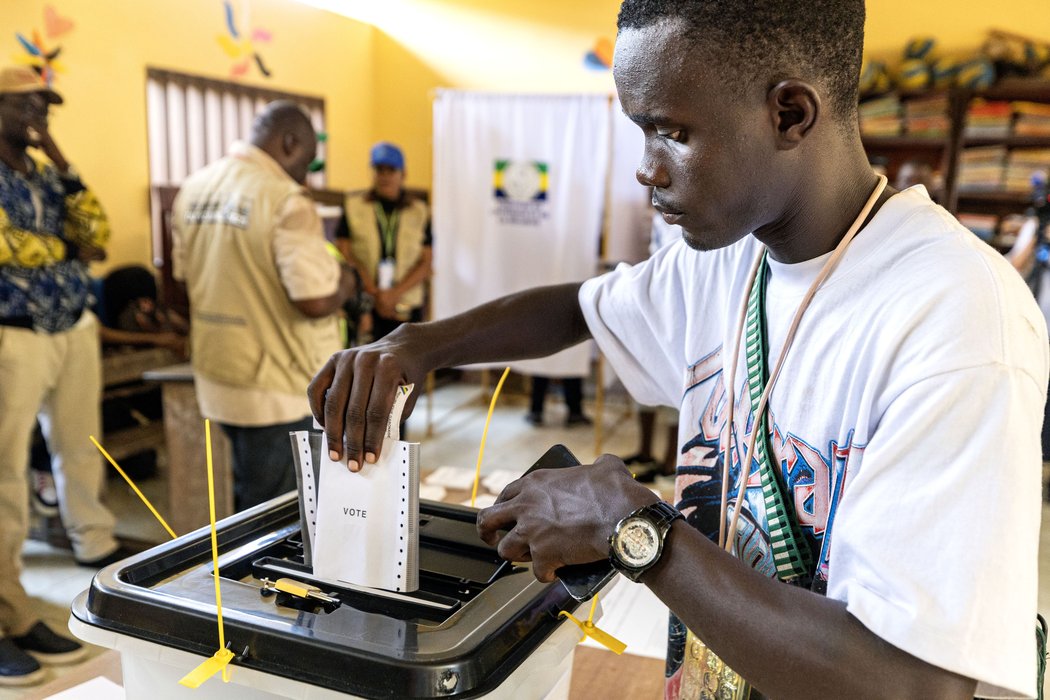
The presidential election took place on 12th April 2025. With over 70 percent turnout, military leader Nguema was declared the winner, garnering 90.35 percent of the vote. He pledged to “restore dignity to the Gabonese people” and to root out the country’s corruption. According to Tournons La Page Gabon (TLP-Gabon), only a few isolated incidents were reported. The TLP-Gabon citizen election observation mission mobilised 214 Gabonese observers, deployed across nine provinces. Despite high voter turnout and integrity of the election, Nguema’s most prominent opponent—former Prime Minister Alain Claude Bilie-By-Nze—accused Nguema of taking advantage of state resources to fund his campaign.
Amani Africa Media and Research Services underlined that the respect for the timeline agreed upon by the Gabon’s military-led transitional government is notable even though it still deplores that Article 25(4) of the African Charter on Democracy, Elections and Governance has not been respected. This article stipulates that “ The perpetrators of unconstitutional change of government shall not be allowed to participate in elections held to restore the democratic order or hold any position of responsibility in political institutions of their State”.
On 30th April 2025, the African Union lifted its sanctions against Gabon, allowing it to rejoin the organisation. Gabon had been suspended when General Nguema took power after overthrowing President Bongo.
On 27th September 2025, a few months after the presidential election, local and legislative elections were held. A few weeks earlier, former union leader Jean-Rémy Yama had been excluded from the process by the Ministry of the Interior, which organises these elections, and the Constitutional Court had again confirmed this disqualification. Nearly 800 candidates were vying for 145 seats in the National Assembly. According to some observers, the lines between the different political forces were blurred.
The military expanded their influence by distributing privileges. The first trap was to integrate opposition figures into the government. This allowed them to silence the former opposition, civil society leaders, and members of the regime that was ousted after the coup.
- Sentiment Ondo, coordinator in Gabon of the Tournons la page movement, a coalition of African associations committed to democracy and the alternation of power.
During both rounds of the legislative elections, the presidential party came well ahead. These very high figures are being criticized. Major irregularities were observed, even by the public organ in charge of controlling the elections, leading to the postponement of the vote in at least five constituencies following decisions by the Constitutional Court. On 28th October, the Constitutional Court started processing appeals related to the legislative elections.
Senate elections will take place in November 2025.
Trial of Bongo’s wife and son will probably take place in absentia
Former President Ali Bongo Ondimba, who was ousted in the 2023 military coup, had been placed under house arrest since then. The Bongo family amassed large sums of money over the years and prosecutors have linked the former ruler to irregular transfers totalling more than 400 million euros over a decade. Bongo's wife and son, who face corruption charges, had been detained, facing charges of money laundering, forgery and falsification of records. On 14th May 2025, the first specialised indictment chamber granted them provisional release, mainly due to their state of health. On 16th May 2025, they were released from detention and arrived in Luanda, Angola. On 3rd July 2025, Sylvia and Noureddin Bongo issued a statement claiming that they had been subject to kidnapping and torture while in detention.
Twelve defendants are being prosecuted for "embezzlement of public funds", "forgery and use of forged documents", "counterfeiting of the seals of the Republic", and "usurpation of title and function". The trial against the former first lady and her son is scheduled to begin before a Special Criminal Court on 10th November 2025. On 22nd October 2025, the family’s lawyer said that the former first lady and her son will not return to Libreville to face trial.
Victims of 2009 and 2016 post-election violence await truth and reparations
Association Reconciliation, the association of post-election victims of 2009 and 2016, expressed their frustration at the unfulfilled promise of setting up a Truth, Justice, and Reparations Commission (CVJR) for the deaths, injuries and arbitrary arrests of the past regime. They demand to know where the bodies of the victims of the 2016 political violence were buried and who killed them, and demand accountability and reparations.
EXPRESSION
Arrest of journalist for blog post
On 15th January 2025 at about 10 p.m., Chartrin Ondimba, editor-in-chief of Gabon Infos, was arrested at his residence by the Directorate General of Special Services of the Presidency of the Republic after the publication of a controversial article on his social media blog page, in which he denounced the alleged extravagant lifestyle of the daughter of one of the close collaborators of the transitional president. The daughter allegedly hired a plane to meet Father Christmas in Lapland – a transnational region located in the north of Fennoscandia, straddling the Norwegian, Swedish, Finnish and Russian territories. While in custody, the editor-in-chief was subjected to questioning and verbal intimidation to compel him into disclosing the source of the information. He was released the following day.
A free and independent press still in the making
According to RSF, although press freedom has seen some improvements following the 2023 coup d’état, “the emergence of a truly free and independent press remains an unfulfilled promise”. Since the coup, conditions for journalists have improved and several exiled journalists have been able to return to the country. However, the organisation notes that journalists are still being summoned by security and intelligence forces, and access to official sources is difficult.
Between 20th and 23rd March 2025, at the initiative of the United Nations Regional Office for Central Africa, a capacity-building workshop for Gabonese journalists was held in Lambaréné (Central-West Gabon) in the lead-up to the presidential election. The event focused on freedom of the press, the protection of journalists, and the fight against disinformation during the electoral period. It was organised in partnership with the High Authority for Communication (HAC), UNDP, and UNESCO, and brought together 34 media professionals (public and private) from all nine provinces of the country, including 15 women.
Influencer detained over TikTok video
On 2nd February 2025, Fanuel Ikapi Mamboundou, also known as influencer Novelas Overmax, decided to film the emergency room at the general hospital during a power outage. He filmed himself in the dark and wondered if the hospital had a backup generator. He also questioned the fate of patients on ventilators. Mamboundou then shared the video on TikTok.
On 5th February 2025, he was placed under arrest at the Libreville Central Prison following a complaint from the General Directorate of the Libreville University Hospital Center (CHUL), which claims to be defamed in the video.
According to GabonReview, during his detention at Libreville's central prison, Mamboundouu was reportedly not allowed to receive any visits. Mamboundou was granted provisional release on 12th February 2025.
Journalist detained over commercial dispute
On 15th October 2025, Harold Leckat, journalist and publisher of Gabon Media Time, was arrested upon his return from France. Gabon Media Time management stated in a press release that a complaint was filed against him on 9th October 2025 following a commercial dispute between Global Media Time (GMT), a communications agency managed by Harold Leckat, and the Caisse de dépôt et de consignation (CDC), a public financial institution. The charges are fraud, illegal awarding of public contracts, and overbilling related to a contract signed in 2020. A coalition of press organisations (Syprocom, Plateforme des Médias Indépendants, RSF, UPF-Gabon) denounced a "political and judicial conspiracy" as the journalist is often critical of authorities and that such a coercive measure is disproportionate and legally questionable in a dispute of a commercial nature. It was also raised that no one else had been cited or questioned in a case related to the awarding of a public contract, which involve many, including holders of public authority. The Network of Human Rights Defenders in Central Africa (REDHAC) and its Gabon Country Coalition demanded that all measures be taken for the immediate and unconditional release of Harold Thibault Leckat Igassela.
A few weeks prior, Leckat had been summoned to the Directorate General of Research regarding a criminal investigation targeting journalistic content published in Gabon Media Time. On 3rd. September 2025, a judicial police officer conducted a hearing. This hearing took place while proceedings were already under way before the High Authority for Communication. The Gabonese Media Employers' Organisation (OPAM), in a press release, denounced this summons and warned of repeated threats against press freedom in Gabon.
ASSOCIATION
Curfew finally lifted, after arrest of dozens of young people for violations
A year and a half after its implementation, the curfew imposed by the military was finally lifted in December 2024. Although eased several times, the measure had become increasingly denounced as inefficient and degrading due to the mistreatment suffered by some people apprehended at various checkpoints.
This lifting of the curfew comes just days after the mass arrest of people in Libreville, during what the gendarmerie called a "crackdown operation". Some of the young people arrested complained of having also had their heads shaved for violating the curfew.
New NGO bill discussed
On 16th May 2025, the Transitional National Assembly adopted in first reading the Bill on the creation, organization and functioning of non-governmental organizations presented by Geoffroy Foumboula Libeka Makosso, a member of this Assembly. It aims at modernising the 1962 legal framework. The Bill establishes a declaratory regime for NGO recognition, coupled with a "silence equals acceptance" clause—whereby legal recognition is automatically granted if the administration does not respond within three months.
On 21st August 2025, the organisation Tournons La Page (TLP) Gabon organised an activity entitled "Advocacy for an enabling environment for Civil Society during a period of Transition" and this proposed law was discussed.
This bill still needs to be examined by the Senate but its future is uncertain because the one who brought it forward, Geoffroy Foumboula Libeka Makosso, was not re-elected in the second round of the legislative elections of 12th October 2025.
The Network of Free Civil Society Organisations for Good Governance changes name
On 4th January 2025, during its extraordinary general assembly, ROLBG, the Network of Free Civil Society Organisations for Good Governance in Gabon adopted a new name while retaining its acronym. It will now be the Consortium for Governance and Inclusive Democracy in Gabon. According to the organisation, "after 16 years of operation, ROLBG is undergoing a major restructuring aimed at broadening its base, strengthening its operational capacities, and substantially improving its governance. The objective is to position the network as the leading civil society consortium in Gabon, with a focus on key sectors such as democracy, human rights, transparency in the extractive industries, the fight against corruption, the environment, as well as local development and corporate social responsibility (CSR)".
ASSEMBLY
Attack on freedom of assembly
On 13th February 2025, in Mitzic, Woleu-Ntem province, members of the Ensemble pour le Gabon (EPG) platform, led by Alain-Claude Bilie-By-Nze, were attacked and physically and mentally threatened by unknown individuals opposed to their presence in the area. This incident took place outside the hotel premises where the delegation was staying. This incident raised concerns about the political climate just a few weeks ahead of the presidential election. In response to the incident, on 14th February 2025, the Minister of the Interior and Security, Hermann Immongault, issued a press release reaffirming the fundamental principles enshrined in the Gabonese Constitution.
Banned protest
In February 2025, the Interior Minister Hermann Immongault decided to ban the protest march against power outages scheduled for 8th February in the capital and several other locations around the country. The Minister met with the organisers, but no official justification was communicated.
Peaceful protests
- On 18th May 2025, the Reconciliation Association, which brings together victims of the 2016 post-election violence, demonstrated in front of the Ministry of Justice to protest the release from prison of former First Lady Sylvia Bongo and her son. The Reconciliation Association believes that the former first lady and her son received preferential treatment and demands that their medical requests also be given due consideration.
- On 6th June 2025, families protested in Libreville against their evictions. The government launched an operation to evict and demolish houses built in flood-prone areas where an administrative complex and a boulevard, nicknamed "Transition Boulevard" will be constructed. The government maintains that these residents had already received compensation but the families deny this and demand support measures.
- Around 17th October 2025 (as reported), students at the University of Science and Technology of Masuku (USTM) held a protest in Franceville (Mpassa, Haut-Ogooue) demanding better study and living conditions. They denounced deteriorating infrastructure, lack of resources, and food insecurity. They decided to go on strike on 14th October 2025.
We are not asking for the moon. We simply demand to be able to study in decent conditions.
- Students of Masuku University of Science and Technology
After several weeks of paralysis at the University and three days of negotiations in Franceville with students, unions, and the university administration, a memorandum of understanding was signed with the Minister of Education.
- On 10th October 2025, residents of the 2nd arrondissement including women, youth, and community leaders, held a march in Libreville to denounce ritual and violent crimes that have recently ocurred in the area. A few days earlier, a shopkeeper was raped and murdered and the protesters demanded justice and urged authorities to end impunity.