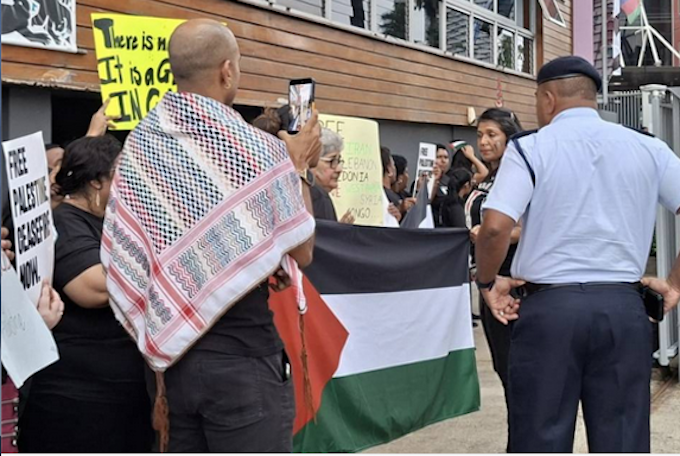
The state of civic space in Fiji is rated as ‘narrowed’ by the CIVICUS Monitor. Ongoing concerns include the Public Order (Amendment) Act, which has been used to restrict peaceful assembly and expression, and sedition provisions in the Crimes Act. The police have also restricted pro-Palestinian marches in recent years.
Human rights organisations called for reforms to Fiji's police and military systems after two people died in custody in April 2026. Sakiasi Radravu died from what his family alleges were injuries caused by torture and sexual abuse during a police raid over an alleged burglary, while Jone Vakarisi died in military custody after being taken for questioning by soldiers to the Republic of Fiji Military Forces (RFMF) headquarters in Suva. The police have yet to charge any suspects for his death in custody.
A National Referendum Bill 2025 - that is being reviewed by the Standing Committee on Justice, Law and Human Rights - contains provisions that critics say could restrict campaigning and political participation.
Twenty-seven years after its establishment, the Fiji Human Rights and Anti-Discrimination Commission has opened its first office in the Northern Division.
In recent months, police disrupted protests against the establishment of an Israeli embassy while police seized a journalist's phone over a Facebook post. The High Court ruled that criminal proceedings against journalist Charlie Charters violated his constitutional rights and abused the court process. There are concerns about provisions in the Fiji policing bill, while the UN calls for online safety laws to adhere to international standards.
Peaceful Assembly
Police disrupt protests against establishment of Israeli embassy
In June 2026, police officers disrupted a protest organised by NGO Coalition for Human Rights and the Fijians for Palestine groups against the establishment of the Israeli diplomatic mission in Fiji (see picture above).
The protest, that involved around a 100 civil society representatives and human rights advocates, was led by the Fiji Women's Crisis Centre at their office located opposite FHL Tower where the new Embassy of Israel is located. Protesters held banners and placards.
Shamima Ali, FWCC co-ordinator and chairperson of the Non-Government Organisation Coalition for Human Rights, strongly criticised the government's decision to strengthen diplomatic ties.
Police then intervened and instructed protesters to stop chanting, citing provisions of the Public Order Act. Shamima Ali expressed disappointment over the police action, arguing that the protest was being conducted on private property rather than in a public space. She questioned why the gathering was being treated as a security concern. Ali said the group had assembled peacefully to express its opposition to Israel and its actions in Gaza. Police did not explain what specific threat the security measures were intended to address.
As previously documented, activists have had to hold their gatherings within the premises of the FWCC office as the police have restricted solidarity marches for Palestine since November 2023, under the Public Order (Amendment) Act 2014.
Expression
Police seize journalist's phone over Facebook post
OCCRP condemns seizure of journalist’s phone in Fiji https://t.co/4yDtvCvNkK #Fiji #FijiNews
— The Fiji Times (@fijitimes) April 30, 2026
In May 2026, police seized a phone belonging to an investigative journalist after she made a social media post about alleged corruption within the police force.
Meri Radinibaravi, an investigative reporting fellow with the Organised Crime and Corruption Reporting Project (OCCRP), said the police called her and informed her they needed to question her regarding her Facebook post, which she had deleted shortly after posting.
According to OCCRP, her post referenced allegations of corruption during the tenure of former police chief Sitiveni Qiliho, who was convicted and jailed for interfering in a criminal investigation.
Radinibaravi went voluntarily to the Criminal Investigations Department in Suva, where she had to type out a formal statement. She was then forced to surrender her phone. She believed the pressure from police may have been connected to her ongoing reporting on sensitive corruption allegations within the department.
OCCRP editor-in-chief Miranda Patrucic said the move by the Fiji police "is an unacceptable attack on press freedom and independent media in Fiji. It is designed to harass the journalist and is a brazen attempt to target her sources."
High Court rules anti-corruption agency violated journalist’s constitutional rights
Police continue probe into two FICAC officers linked to Charlie Charters case https://t.co/Y9Zvj5grAc https://t.co/Y9Zvj5grAc
— The Fiji Times (@fijitimes) August 12, 2026
In July 2026, The High Court in Suva permanently stayed the criminal proceedings against journalist Charlie Charters, ruling that the Fiji Independent Commission Against Corruption (FICAC) violated his constitutional rights and abused the court process.
In his ruling, Justice Pita Bulamainaivalu found that Charters’ right to remain silent under Section 13 of the Constitution 2013 was violated by FICAC. The Judge also ruled that Charters’ right to freedom of speech, expression, thought, opinion and publication under Section 17 of the Constitution 2013, including the right not to divulge the sources of his journalistic information, was violated by FICAC.
As previously documented, Charters, a journalist and former senior manager at the Fiji Rugby Union, was detained at FICAC headquarters in Suva in February 2026. After 48 hours in detention, he was charged with two counts of aiding and abetting an unknown person in FICAC connected to a FICAC investigation by publishing official information relating to the functions of the Commission on his Facebook page without the permission of the FICAC Commissioner.
Charters has written extensively about the inner workings of FICAC and the Fiji Sports Council, citing publicly available documents and his own sources. He was prevented from travelling to Sydney by FICAC officials and offered a "deal" to reveal his sources and continue with his planned travel.
In August 2026, Fiji’s High Court granted an application seeking the release of seven electronic devices seized by police from Charters.
Concerns about provisions in the Fiji policing bill
There are concern that provisions in the Fiji Police Bill 2026, to replace a 1965 colonial law, could be used to restrict civic space.
In particular, Section 148 of the bill creates an offence of ‘causing disaffection or discontent among police staff’ that could be used to suppress criticism or silence whistleblowers.
The Fiji Council of Social Services (FCOSS) has also raised concerns around covert surveillance powers in the bill, which lacks independent oversight in Sections 57 to 61 and that could be misused against civil society groups, political opponents and journalists.
There are also concerns around provisions allowing police to investigate complaints against their own officers. Under international standards, the government should establish independent police oversight mechanisms to undertake investigations when police commit human rights violations.
UN calls for online safety law review to ensure international standards
In August 2026, Justice Minister and Acting Attorney-General Siromi Turaga said that the Fiji Law Reform Commission was advancing its review of the Online Safety Act 2018. The review recently completed its final validation workshop, allowing stakeholders to provide feedback on an interim final report and draft Bill.
The UN human rights office in the Pacific provided oral and written submissions to the Fiji Law Reform Commission. Its inputs emphasised the importance of a human rights-based and evidence-based approach to addressing online harms, including safeguards for freedom of expression, privacy and due process, alongside effective protection for people who may be particularly exposed to online harm. This includes children, journalists and human rights defenders, persons with disabilities, and persons of diverse sexual orientation, gender identity and expression, and sex characteristics.
It also encouraged meaningful and inclusive consultation with rights-holders and a structured assessment of the compatibility of proposed measures with international human rights standards.
Previously, CSOs had called for urgent reform of the Online Safety Act 2018, warning that its controversial ‘causing harm by electronic communication’ provision has been used to investigate and prosecute individuals in ways that threaten free expression.