The state of civic space in Fiji is rated as ‘narrowed’ by the CIVICUS Monitor. Ongoing concerns include the Public Order (Amendment) Act, which has been used to restrict peaceful assembly and expression, and sedition provisions in the Crimes Act. The police have also restricted pro-Palestinian marches in recent years.
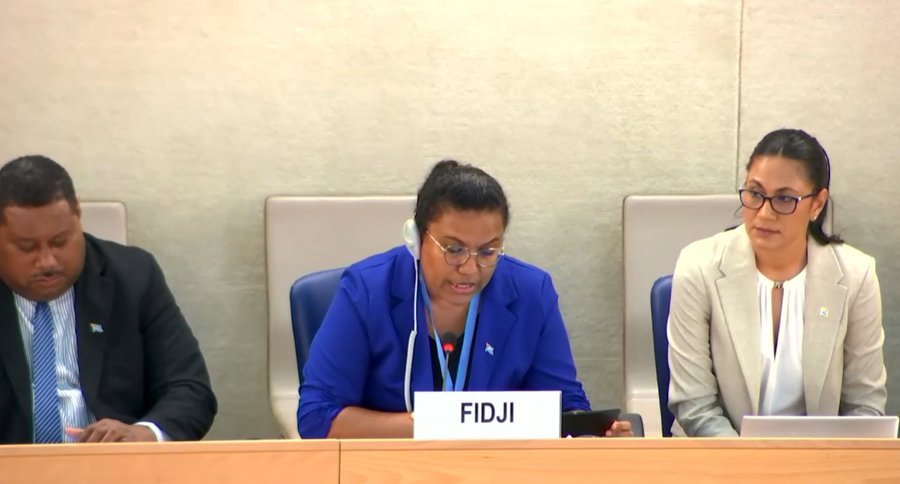
In July 2025, the UN Human Rights Council adopted the Universal Periodic Review (UPR) report of Fiji. The country received 12 recommendations on civic space, which they supported, including to safeguard the rights to freedoms of expression, peaceful assembly and association and repeal restrictive legislation, including the sedition provisions in the Crimes Act, and the amended Public Order Act that can be misused to restrict protests.
There were also recommendations to guarantee freedom of the press, promote a safe and enabling environment for human rights defenders and conduct impartial, thorough and independent investigations into all cases of attacks, harassment and intimidation against civil society members, human rights defenders and journalists.
On 10th July 2025, the Committee on the Elimination of Discrimination against Women, in its Concluding observations noted with concern that the Human Rights and Anti-Discrimination Commission of Fiji was accredited “B” status by the Global Alliance of National Human Rights Institutions in June 2021. The Global Alliance identified specific areas requiring further strengthening through legislative or administrative reforms, including the lack of a clear, transparent and participatory selection and appointment process for commissioners, the term of office of commissioners and the composition of the decision-making body of the Commission.
In the same month, the police in collaboration with the UN Office of the High Commissioner for Human Rights (OHCHR), concluded a high-level consultation on the revision of the Use of Force Policy. The consultation brought together 30 senior police officers, with the consultation marking a crucial step in the comprehensive review of the Use of Force Policy, aligning it with Fiji’s human rights obligations under international treaties.
In August 2025, Fiji's Supreme Court declared that the majority requirements for amending the 2013 Constitution should be lowered to only two thirds of all MPs, plus a simple majority of electors voting at referendum. An attempt to overhaul Fiji's 2013 Constitution - drafted by the military-backed regime of former Prime Minister Frank Bainimarama following the 2006 military coup - failed in Parliament in March 2025, as the government's amendment bill was defeated, falling short of the required 75 percent requirement.
In recent months, concerns have been raised about the rejection by the police of a permit to hold a protest, the lack of protection for women human rights defenders, and cyberlaws that could be used to silence online expression and the media.
Peaceful Assembly
Police deny permit for constitution protest
In August 2025, the Fiji Police Force refused a permit application for a public march against the 2013 constitution that has been planned on 21st August 2025, citing security concerns.
In a letter dated 15th August 2025, Divisional Police Commander Central, Ruci Nasemira, confirmed that the application from lawyer and activist Niko Nawaikula had been declined following a “security assessment.”
The march was intended to raise opposition to the 2013 Constitution of Fiji, which the organisers say was drafted without genuine public consultation and imposed without the consent of the people.
Niko Nawaikula, the president of SWN Advocacy, the organiser of the march, said the constitution had failed to protect iTaukei (indigenous) rights once safeguarded under the 1970 and 1997 constitutions, including recognition of the Great Council of Chiefs, customary laws, group rights, and land protections.
Organisers said this was a serious attack on human rights and democracy. Nawaikula said: “We categorically reject this justification. Peaceful protest is a cornerstone of any functioning democracy”. He said the denial was “a painful return to the alarming pattern of past years where dissenting voices and civil society actors are systematically silenced.”
The Public Order (Amendment) Act 2014 is inconsistent with international law and standards and allows the government to refuse permits for any public meeting or march deemed to prejudice the maintenance of peace or good order. It has often been misused by the authorities to restrict or block peaceful gatherings and demonstrations, restricting the right to peaceful assembly and association. It has been used in recent years to restrict pro-Palestine protests.
The UN Human Rights Council and human rights groups have called for the repeal of restrictive provisions in the law, including the requirement for a police permit for protests.
Association
Restrictive laws and gender-based violence affect women human rights defenders
#CEDAW welcomes #Fiji's laws & policies against gender-based violence, but raises concern over its high prevalence & the use of survivors’ sexual history in rape trials. CEDAW also calls for action to boost women’s representation in decision-making roles.https://t.co/D1HRo4JHwq pic.twitter.com/hiSxGvxKew
— UN Treaty Bodies (@UNTreatyBodies) July 7, 2025
In its Concluding Observations in July 2025, the Committee on the Elimination of Discrimination against Women raised concerns about the protection of women human rights defenders in Fiji.
The UN body stated that Section 6(5) of the Constitution and relevant provisions of the Public Order Act (1969), the Electoral Amendment Act (2022) and the Crimes Act (2009) restrict the rights to freedom of expression, assembly and association, which affects women civil society activists, women human rights defenders, women journalists and whistle-blowers.
The Committee also found that women human rights defenders in Fiji often face technology-facilitated gender-based violence, including cyberbullying, and there is a lack of participation of women human rights defenders in the design, implementation and monitoring of laws, policies and budgets for the advancement of women and gender equality.
The Committee recommended that Fiji repeal the restrictive provisions and laws in order to ensure that women civil society activists, women human rights defenders, women journalists and whistle-blowers can freely carry out their advocacy for women’s human rights and exercise their rights to freedom of expression, assembly and association.
The body also called on the government to protect women human rights defenders from harassment and technology-facilitated gender-based violence; effectively investigate, prosecute and adequately punish perpetrators of such acts; and provide effective remedies and reparation for victims.
It also called on the government to take measures to ensure the meaningful participation of women human rights defenders in the design, implementation and monitoring of laws, policies and budgets for the advancement of women and gender equality.
Expression
Calls to reform the Online Safety Act to protect online expression
BEHIND THE NEWS | The need to reform online safety act https://t.co/WYD8SXLLIx #Fiji #FijiNews
— The Fiji Times (@fijitimes) September 21, 2025
Dialogue Fiji renewed calls in September for urgent reform of the Online Safety Act 2018, warning that its controversial “causing harm by electronic communication” provision is being increasingly used to investigate and prosecute individuals in ways that threaten free expression.
Executive director of Dialogue Fiji, Nilesh Lal said the recent spate of cases under Section 24 of the Act highlighted long-standing fears about its potential misuse.
Dialogue Fiji argued that the risks the law poses today are the same as those raised seven years ago. He added: “The offence is vague, subjective, and overly broad. It risks criminalising legitimate political criticism, satire or commentary. This creates a chilling effect where people begin to self-censor out of fear.”
He stressed that in a democracy, citizens must be free to challenge policies, question leaders and debate robustly without facing the threat of prosecution.
Dialogue Fiji has been working in the area of inclusive and participatory decision making, democratic transition, good governance, conflict analysis and peace-building since 2009.
Concern that new laws regulating online content could restrict expression
In September 2025, it was reported that Fiji is considering tougher regulations for social media platforms and a comprehensive review of the Online Safety Act 2018, due to growing concerns about cyberbullying, misinformation, and online abuse. The government is also exploring new online safety laws for platforms like Facebook and YouTube, which may include age restrictions.
Legislation is expected to be presented to Parliament soon. But critics warn that blanket bans could threaten freedom of expression and may not hold up in court.
Dr. David Naylor, a comparative lawyer and Visiting Fellow at the Centre for European Studies at the Australian National University (ANU), cautions against overreaching laws that could infringe on non-harmful speech, including political or educational content. He also highlights the potential legal risks.
He added: “Imposing broad restrictions on platforms like Facebook or YouTube could face significant legal challenges. If the measures are too sweeping, like an outright ban, they risk violating Fiji’s own Bill of Rights and could be deemed unconstitutional.”
Dr. Shailendra Singh, an Associate Professor and Coordinator of the Journalism Programme at the University of the South Pacific, warns that tighter restrictions could complicate freedom of expression. He said: “Tighter control could catch media in the crossfire, and some may shut off public comments entirely, silencing even valid remarks.”