Peaceful Assembly
Pro-Morales protests trigger confrontations amid dispute over presidential candidacy
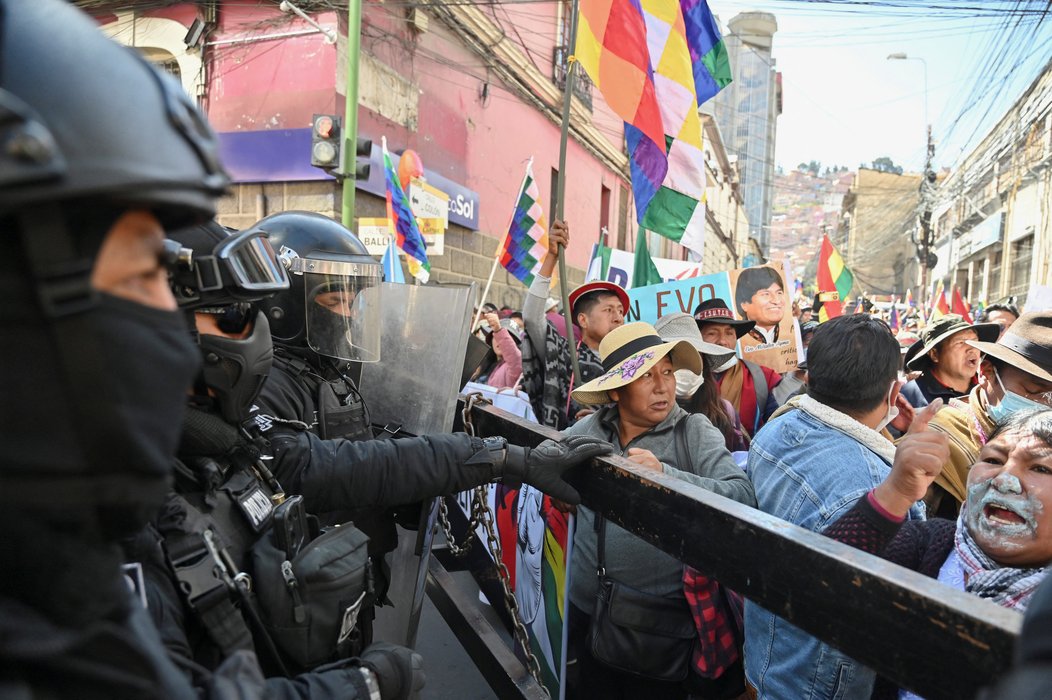
Bolivia experienced sustained unrest from late May into June 2025 as supporters of former president Evo Morales mobilised nationwide to demand his registration as a candidate for the August general elections. Tensions escalated on 29th May near the Supreme Electoral Tribunal (TSE) in La Paz, where hundreds of protesters attempted to reach the building. Police blocked access with a continuous security cordon. Protesters threw paint bags, stones, and dynamite, while police responded with tear gas and pepper spray, detaining 20 people and reporting three injured officers.
By 2nd June, mobilisation had expanded into coordinated marches and strategic road blockades. In Cochabamba, Morales’ stronghold, at least nine blockade points paralysed major routes linking Santa Cruz and La Paz. Bolivian media outlet by Brújula Digital counted 13 blockades nationwide, halting more than 800 fuel tankers. Protest leaders also blamed President Luis Arce for inflation, fuel shortages, scarce US dollars, and declining gas production. In La Paz, protesters, many arriving from El Alto with Bolivian and wiphala flags, marched through the city centre calling for Arce’s resignation. Police again blocked access to Plaza Murillo, home to the executive and legislature.
Disruptions intensified at chokepoints such as Sipe Sipe, where long queues of buses and trucks forced passengers to cross on foot. Minister of Government Roberto Ríos accused some groups of attempting to restrict the sale of essential goods and destabilise the electoral process in favour of an ineligible candidate.
ACLED recorded 135 pro-Morales protests in June, around two-thirds of all demonstrations nationwide, marking a 55 per cent increase compared with May. Roadblocks continued for 15 consecutive days, mainly in Cochabamba. Although most protests remained peaceful, violence spiked when residents opposing the blockades clashed with Morales supporters in Llallagua (Potosí), injuring 30 people. The government then deployed police and military units to clear strategic roads in Cochabamba and Potosí, triggering further confrontations in which four police officers and two civilians were killed, the deadliest protest-related violence recorded by ACLED since the 2019 post-election crisis that ended Morales’ presidency.
The incident unfolds amid deep political fragmentation, with Morales, President Arce, and Senate leader Andrónico Rodríguez leading rival factions. Morales remains constitutionally barred from standing after serving three terms and was unable to register following his departure from the ruling Movement for Socialism (MAS) in February 2025. Despite this, supporters insisted that electoral authorities accept his candidacy and framed the constitutional ruling as political persecution.
Union denounces attacks by municipal officials and party supporters in Santa Cruz
On 18th July 2025, municipal officials and supporters of the Unidad Cívica Solidaridad (UCS) party violently disrupted a peaceful protest by the Municipal Guard Workers’ Union in Santa Cruz de la Sierra, Bolivia’s largest city. The union had gathered to demand that Mayor Jhonny Fernández comply with an arbitral ruling requiring the municipality to incorporate municipal guards under the General Labour Law, which provides formal employment protections.
Union representatives reported that eight guards were injured, including a pregnant woman who later received medical attention, and another worker who suffered a fractured nose. According to spokesperson Estefanía Calle, municipal employees and groups linked to the La Fuerza del Pueblo political alliance participated in the assault. Despite the violence, the union continues an indefinite strike.
Following the incident, the union filed a police complaint for minor and serious injuries. Calle stated that the municipality has initiated summary disciplinary proceedings and dismissal actions against union leaders, which she described as retaliation for securing the arbitral award. She criticised the mayor for failing to enforce the ruling and for offering no guarantees for workers’ rights.
Association
Indigenous defenders brutally attacked after opposing mining expansion in Potosí
On 25th June 2025, Indigenous defender Jacobo Copa Mamani from the Ayllu Cala Cala (Quijarro province, Potosí) faced severe violence after he attempted to stop the Mollepata mining cooperative from expanding into his community’s ancestral territory and water sources. Copa and other community members travelled to the Miriuri sector to deliver a precautionary measure asserting their authority to protect the valley, a high-biodiversity area where the cooperative had begun extraction in May 2025. Miners attacked the group with dynamite and stones, forcing them to retreat and spend the night camped nearby.
Violence escalated the next morning. Miners ambushed the group again and targeted Copa and fellow defender Romel Pérez. As Copa fled toward the river, miners captured him, pinned him face-down and beat him, striking his eye and mouth and knocking out several teeth. He lost consciousness. Miners then bound him, loaded him into a pickup truck and transported him to Potosí, where the cooperative’s legal representative waited. They handed him over to police with false accusations of drug and weapon possession. Police dismissed the allegations after confirming that he carried only medicinal plants and a small tool.
When Copa stepped out of the miners’ vehicle to accompany the officers, police forced him to the ground, pressed his head to the pavement and beat him again while his hands remained tied. They denied him medical attention and legal assistance and later abandoned him at a police office despite his injuries.
Local authorities have warned that mining in the headwater zone threatens local livelihoods, including livestock, agriculture and pisciculture. They also said that extraction could collapse the fragile ecosystem that sustains the valley. The Ayllu leadership submitted alerts to multiple state institutions but mining activity continues unchecked.
Civil society organisations have documented escalating risks for environmental defenders in Potosí. The Sociedad Potosina de Ecología reported increased intimidation and the absence of departmental protection, noting that communities often feel “orphaned” as mining interests override territorial defence.
The attack on Copa reflects a pattern of retaliation against environmental and Indigenous defenders. Data from the UNITAS Defenders Observatory showed that Bolivia recorded 22 violations against human rights defenders between January and April 2025, with criminalisation the most frequent tactic.
Death threats against Viacha environmental defenders after exposing illegal mining pollution
On 18th May 2025, Indigenous environmental defender Juan Pablo Yujra, president of the Watershed Management Body (OGC) of the Pallina micro-basin in Viacha, reported a violent threat at his home. Two masked men on a motorcycle approached him and his wife, shouted his name and displayed a firearm. The couple shut their door before the men could advance.
The incident followed a series of anonymous calls threatening rape and murder unless Yujra resigned. He also said that OGC vice-president Alex Callisaya had received similar threats.
These attacks form part of a broader pattern of intimidation against defenders who have denounced severe mining pollution affecting nine communities in Viacha, a municipality near La Paz.
Days earlier, during the UN Permanent Forum on Indigenous Issues in late April 2025, community justice authority Pastor Carvajal allegedly faced verbal threats from a national union leader after he raised concerns about contamination of rivers and aquifers by 23 mining companies operating without environmental licences. Local leaders also reported a smear campaign on social media, where anonymous accounts circulate baseless accusations of corruption and collusion with mining operators.
The OGC has documented contamination, including a cyanide spill confirmed in 2024 and the presence of heavy metals, zinc, cadmium, mercury and lead, in water sources used for human and animal consumption. Although the municipality closed 12 mining operations, residents report that many continue operating clandestinely, and that communities remain excluded from inspection and monitoring processes, despite repeated alerts to authorities.
🚨 Líderes de Viacha, La Paz, denuncian amenazas y hostigamientos por oponerse a la contaminación minera.
— Red UNITAS (@redunitas) May 30, 2025
🔎 Lee el análisis del Programa Defensores de UNITAS https://t.co/rJvdAUbZpJ pic.twitter.com/BYXhN4gUTG
Prosecutors charge 12 Tariquía leaders amid long-running conflict over extractive projects
On 29th April 2025, the Prosecutor’s Office in Tarija filed formal charges against 12 Indigenous community members from Tariquía, accusing them of attacks against freedom of work, impeding public functions and related offences. The case stems from an October 2024 complaint submitted by Yacimientos Petrolíferos Fiscales Bolivianos (YPFB), Bolivia’s state-owned hydrocarbons company, after residents allegedly obstructed operations by YPFB and Petrobras at the Oso Domo X3 well in Chiquiacá, part of the Tariquía Flora and Fauna National Reserve. Prosecutors dismissed charges against 17 of the 29 people initially under investigation.
Defence lawyer Roger Ibarra said residents had established a vigil at the Saicán entrance to block what they considered unauthorised access to the well. He explained that neither company had permission to enter and that 11 local communities jointly resolved to halt operations. In January 2025, the initial prosecutor rejected the complaint for lack of evidence, stating it could not proceed to trial. However, the departmental prosecutor later overturned that decision, arguing that several procedural steps remained pending.
The April 2025 indictment seeks restrictive precautionary measures for the 12 accused, including monthly court appearances, bans on contacting witnesses or alleged victims, and prohibitions on entering designated locations. The case now sits before the Fourth Criminal Investigating Court, which will hold a hearing to determine precautionary measures.
Ibarra criticised the prosecution for failing to individualise conduct or provide sufficient evidence, emphasising that his clients acted collectively to defend their territory. He also noted that prosecutors never carried out an on-site inspection or reconstruction, relying instead on line-up identifications in which four YPFB and Petrobras employees claimed to recognise the accused through a Gecel camera — a process in which nine other residents declined to take part.
This criminal case extends more than a decade of recurrent criminalisation targeting Tariquía communities that oppose extractive activities in the protected reserve. The proceedings raise concerns about selective prosecution, weak due process guarantees, and the continued use of criminal charges to deter Indigenous communities from asserting their rights to defend land, water and territory.
Court applies Escazú Agreement to safeguard environmental defenders
On 23rd April 2025, Bolivia’s Agro-Environmental Court granted precautionary measures in a major environmental case concerning the illegal killing of five jaguars, ordering protection measures for both the species and its habitat, as well as for environmental defenders involved in the proceedings. The Court further instructed authorities to extend protective measures to any additional defenders who join the process.
Congresswoman María René Álvarez filed the case in February 2025 following reports of jaguar poaching inside the San Matías Integrated Natural Area of Management, a protected area in Santa Cruz. The complaint alleges the existence of an international poaching network connected to Argentine national Jorge Néstor Noya and Spanish businessman Luis Villalba Ruiz, who is currently wanted by Bolivian authorities.
The Court’s decision directs several state institutions to adopt specific measures, including the Ombudsman’s Office, the Public Prosecutor’s Office, the Bolivian Police, the Ministry of Justice and Institutional Transparency, the Ministry of Government and the Supreme Court of Justice. Compliance remains pending. The Ombudsman’s Office has announced plans to file an appeal for clarification and amendment, particularly to specify deadlines for implementation.
The ruling sets a significant precedent for environmental defence in Bolivia. It applies both the Escazú Agreement and the Bolivian Constitution to guarantee defenders’ rights to life, integrity, freedom of expression, participation and association in contexts involving threats, harassment or the improper use of force.
(2/4) Algunas de las medidas son: Se decreta pausa ecológica, protección para defensores ambientales, control contra el tráfico de especies y la creación de un Fondo Nacional de Conservación del Jaguar. pic.twitter.com/twnEykEVPp
— WWF Bolivia (@wwf_bolivia) April 24, 2025
Expression
Bolivian journalists threatened by traders while filming at the Peru Border market
On 23rd May 2025, a reporter and cameraman from Urgente.bo, a local news outlet, travelled to Desaguadero, a major border crossing between Bolivia and Peru, to document local commercial activity. While filming, around twelve traders confronted them, ordered them to stop recording and threatened to throw them into the river if they did not delete the footage. Fearing for their safety, the journalists deleted the material under coercion.
Desaguadero hosts intense cross-border commerce, including the movement of food and fuel from Bolivia into Peru to take advantage of currency and price differences. This trade often operates informally and can generate tension when journalists attempt to report on it.
Polarised political environment fuels hostility toward media
On 10th June 2025, roadblock groups on the Oruro-Cochabamba highway, a major transport corridor in western Bolivia, intercepted and threatened two journalists as they travelled near the locality of Pongo. The blockaders seized their mobile phones, accused them of being “intelligence agents” and threatened to burn them. One of the journalists reported that the group reviewed his photos and videos, violating his privacy, and later forced him to remove his hat while chanting “sell-out press” (“prensa vendida”), a slogan often used by groups aligned with former president Evo Morales.
The journalists had been accompanying leaders from Bolivia’s long-distance transport sector who were delivering food to drivers stranded by more than ten days of road blockades. Protesters insisted that only a pro-Morales radio station provided what they considered “reliable” coverage of their demands, deepening distrust of independent media and creating hostility toward external reporters.
The National Press Association (ANP), the Association of Journalists of Oruro (APO) and the Press Workers’ Union of Oruro (STPO) warned that such rhetoric aggravates risks for journalists covering politically charged protests. They stressed that intimidation, forced searches and threats of violence directly restrict press freedom and undermine safe reporting conditions in an already polarised environment.
En Bolivia, bloqueadores amenazaron a periodistas con quemarlos. Lea el informe de los diarios asociados en @ANPBOLIVIA que reporta agresiones al periodismo desde hace 17 años en alianza con defensores de la libertad de prensa.https://t.co/NOZlbkytbt pic.twitter.com/VRKwbJPFqs
— ANP Bolivia (@ANPBOLIVIA) June 13, 2025
In a separate incident, on 8th June 2025, journalist Soledad Mabel Prado Nogales, correspondent for El Deber in Yapacaní (Santa Cruz), received death threats after reporting on a motorcycle rally organised by supporters of former president Evo Morales. The threats came amid a wave of intimidation targeting journalists covering demonstrations demanding Morales’s reinstatement as a candidate in the upcoming August 2025 general elections.
That same week in Cochabamba, a protester marching alongside Morales’s supporters publicly threatened to burn down media outlets that refused to broadcast calls for the resignation of President Luis Arce. The National Press Association (ANP) warned that such verbal and physical threats against the press have intensified as road blockades and marches by Morales’s supporters entered their second week.
Fact-checkers expose large-scale paid disinformation operation in Bolivia’s election period
Between May and July 2025, fact-checkers documented a large-scale disinformation campaign that spent nearly BOB 200,000 (approx. USD 29,000) on Facebook to circulate fabricated news videos targeting presidential candidates Jorge Quiroga and Samuel Doria Medina. The operation used two Facebook pages, Click News and Bolivia News, which published manipulated videos falsely presented as reports from BBC Mundo, Univisión and CNN en Español. None of these reports existed, and Bolivia Verifica, a leading national fact-checking organisation, debunked all claims.
The pages, administered from Bolivia and Mexico, paid Meta to promote the videos across multiple Bolivian departments, reaching audiences estimated in the millions. The fabricated narratives alleged drug-related financing, the purchase of polling results, foreign funding and other criminal acts. Operators amplified this content across Instagram and TikTok, and several adverts used AI-generated audio to mimic the voices of political candidates.
Meta’s Ad Library indicated that some payments originated from accounts linked to Daglin Camacho Lazarte, a political supporter of presidential candidate Manfred Reyes Villa, a former mayor and influential political figure. Both Click News and Bolivia News published numerous posts favouring Reyes Villa while attacking rival candidates, despite presenting themselves as neutral journalistic outlets.
Investigators identified recurrent identity-spoofing of reputable news organisations, repeated renaming of Facebook pages to obscure their origins, and targeted advertising aimed at key electoral constituencies, including young voters and urban populations. Although some ads were eventually removed or expired, many manipulated videos remained active during the campaign period, sustaining their reach.