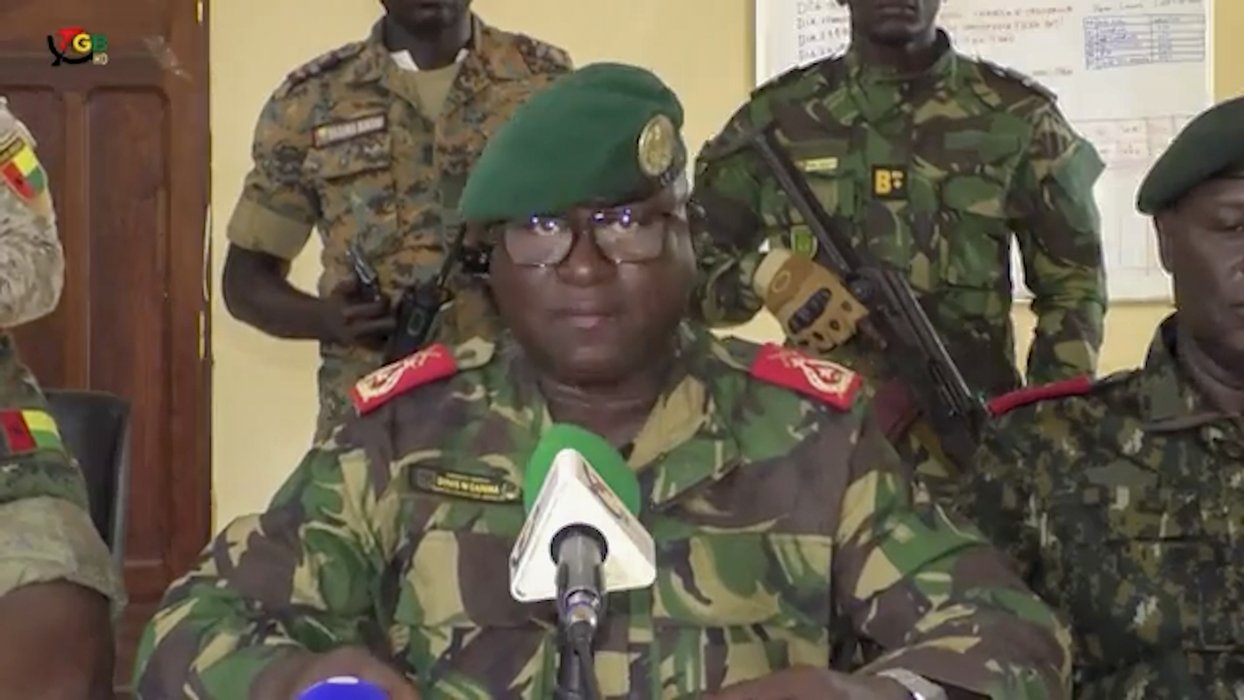
Army officers said they toppled President Umaro Sissoco Embalo in coup-prone Guinea-Bissau, halting the election count, closing borders and imposing a curfew as gunfire rang out in the capital https://t.co/6GOqXLGgJt https://t.co/3Rk3lcLB4U
— Reuters (@Reuters) November 27, 2025
Introduction
Elections followed by military takeover
On 23rd November 2025, presidential and legislative elections took place in Guinea Bissau, after they had been delayed by a year by the then-President Umaro Sissoco Embaló, who ran for a second term, facing 11 other candidates. Main opposition contender Domingos Simões Pereira of African Party for the Independence of Guinea and Cape Verde (PAIGC), saw his candidacy invalidated in a controversial ruling by the Supreme Court.
A day before the publication of the preliminary election results, on 26th November 2026, a group of soldiers calling themselves the ‘High Military Command for the Restoration of National Security and Public Order’ announced, in a televised statement, a “total control” of Guinea Bissau, and which would rule the country until further notice. Furthermore, the group announced the ousting of President Umaro Sissoco Embaló, the suspension of institutions and the ongoing elections, the closure of borders and air space, the introduction of a curfew and a media blackout (see under Expression). At least 18 people were arbitrarily arrested in the aftermath of the military coup, according to the UN, including government officials, political opposition and magistrates. Armed men seized ballots, tally sheets and computers from the national electoral commission and destroyed its servers.
General Horta Inta-A Na Man was sworn in as the transitional president on 27th November 2025. Two weeks later, the Military High Command adopted a 12-month transitional charter and established a National Transitional Council.
Constitutional referendum
During a constitutional referendum, which took place on 30th August 2026, voters approved sweeping constitutional amendments resulting in expanded presidential powers. The president will have the power to appoint or dismiss the prime minister and cabinets, create or abolish ministries and dissolve the Parliament in the event of a grave political crisis. The two-term limit for presidents, for a period of five years each, was retained in the new Constitution. Meanwhile, the number of seats in the National Assembly was reduced from 102 to 65, and the electoral constituencies were cut back from 29 to 12 .
The constitutional referendum was part of the political transition, and was to lay the legal framework for elections planned in December 2026. On 8th October 2026, however, Guinea Bissau’s Prime Minister Ilídio Vieira Té announced that the presidential and parliamentary elections, initially set for 6th December 2026, were to be delayed.
Guinea-Bissau: We are shocked by the brutal killing of civil society activist Vigário Luís Balanta. There must be a prompt, thorough and impartial investigation into his death. Those responsible must be brought to justice. https://t.co/65P2FA6eup https://t.co/J2p35mFVK8
— UN Human Rights (@UNHumanRights) April 2, 2026
Association
Killing of HRD
On 31st March 2026, the lifeless body of rapper and civil society activist Vigário Luís Balanta, reportedly with signs of extreme violence, was found in Ndam, a rural area about 30km away from Bissau. Balanta was the spokesperson for the Movimento Revolucionário Pó de Terra (Pó di Terra Revolutionary Movement), had been a critic of the military transitional authorities and was involved in the organisation and mobilisation of protests to demand the restoration of constitutional order.
The UN High Commissioner for Human Rights said in a statement that the activist’s death came amid “a progressive reduction of democratic and civic space,” with opposition members and HRDs being “arbitrarily detained, assaulted, harassed and intimidated”.
Civil society groups, including Movimento Revolucionário Pó de Terra and the Liga Guineense dos Direitos Humanos (LGDH; Guinean Human Rights League) accused the transitional military authorities, or military-linked forces tied to them, of having orchestrated Balanta’s killing.
On 3rd April 2026, protests erupted after Balanta’s funeral (see under Peaceful Assembly).
Abduction, physical attacks on HRDs
On 12th January 2026, four armed individuals abducted Iaia Carraque, a member of the Movimento Revolucionário Pó de Terra in Bissau. Lawyer and political commentator Augusto Nansambe was reportedly abducted on 28th December 2025, and taken to an undisclosed location. On 27th December 2025, Abubacar Martins Sambú, coordinator of the Movimento Guineense para a Democracia e o Desenvolvimento (Guinean Movement for Democracy and Development) was reportedly assaulted by four armed men at his residence. On 21st December 2025, leader of the political movement Movimento para Alternância Democrática (MADEM-G15; Movement for Democratic Alternation), Vladimir Deuna, was beaten by a group of armed and hooded men at his home.
Police attack, invade Casa dos Direitos (House of Rights) twice
On 22nd December 2025, officers of the Rapid Intervention Police invaded the Casa dos Direitos (House of Rights), a consortium of human rights organisations and the location of the offices of human rights organisation Liga Guineense dos Direitos Humanos (LGDH; Guinean Human Rights League), reportedly after a peaceful vigil inside the building to demand the release of political prisoners. According to a statement by LGDH, two of their staff members were arbitrarily arrested, taken to the Ministry of the Interior and violently beaten, necessitating medical treatment. The following day, on 23rd December 2025, two police officers returned to the premises, forced staff to leave and blocked anyone from entering.
On 7th February 2026, dozens of heavily armed and hooded police officers forcibly entered the Casa dos Direitos and forced everyone to leave the premises. This occurred while the ambassador of the European Union, Frederico Bianchi, was visiting the human rights consortium. No explanation or justification was given by the police officers.
Expression
Media blackout following military coup
On the evening of 26th November 2026, the head of the presidential military office, Denis N’Canha, announced that “all bodies of social communication” were to be suspended “until further notice”. Shortly before the announcement of the military takeover, soldiers reportedly interrupted the broadcast of the popular Radio Sol Mansi with force. According to the Committee to Protect Journalists (CPJ), who spoke with local journalists, only the state broadcaster Televisão da Guiné-Bissau remained on air to broadcast the military group’s announcements. Three days later, other media outlets gradually resumed broadcasting, albeit with caution. Diamantino Lopes, the Secretary General of the Sindicato dos Jornalistas e Técnicos da Comunicação Social (Union of Journalists and Social Communication Technicians) told RFI in an interview:
Some radio stations are resuming their activities according to the information we are receiving, but in the current situation, one cannot expect much from journalists. The moment is so complex that there is a feeling of insecurity that leads to self-censorship. … Considering the context, any critical approach to the situation, for example, debate programs, could lead to repression, considering the content that will be produced
- Diamantino Lopes, the Secretary General of the Sindicato dos Jornalistas e Técnicos da Comunicação Social (Union of Journalists and Social Communication Technicians)
Journalists were reportedly also the target of attacks on social media. According to Diamantino Lopes, journalist Alison Cabral was targeted with insults and accusations from a group of fake profiles on social media.
Ban on “unauthorised” press conferences and public statements
In a statement on 9th January 2026, the High Military Command banned “unauthorised” press conferences and prohibited anyone from making “unauthorised” public statements. They further warned that anyone defying this ban would be “severely reprimanded”. The statement further claims that certain political figures and organised groups have been promoting “secret meetings to incite violence and disrespect for the prohibitions established in the Political Transition Charter".
Previously, on 9th December 2025, the High Military Command had already threatened media outlets with closure for disseminating information or messages that call for violence and civil disobedience. The statement was reportedly made after three civil society organisations, Frente Popular, Firkidja di Pubis and Movimento Revolucionário Pó de Terra, had called for civil disobedience and a general strike in protest against the military coup.
Brief closure of private radio stations over unpaid licence fees
On 31st March 2026, around 10 private radio stations, including Sol Mansi and Capital FM, ceased broadcasting after having been served with a notification by the Ministry of Social Communication suspending their operations for a period of seven days over unpaid licence fees and failure to renew licences. The licence fees, set at 5 million CFA (approximately 8,540 USD), have been under discussion between Fórum das Rádios Privadas (Private Radio Forum) and successive governments, as private radio stations say the fee is excessive.
At the end of the day, on 31st March 2026, the radio stations were allowed to resume broadcasting while negotiations with the Private Radio Forum continued.
Law on false information on the internet adopted
On 20th May 2026, the National Transitional Council adopted the Law on Digital Integrity to “curb false information on the internet”. According to media sources, a digital verification commission will be created, responsible for analysing digital content related to crime. At the time of writing, no further information was available.
Arbitrary detention of journalists
On 30th August 2026, the day of the constitutional referendum, police detained two journalists of private radio station Capital FM, Sulai Moreira Seide and Nelson António da Silva, a sound technician.
Moreira Seide said he believed his arrest was in relation to the sharing of an article published by Capital FM denouncing the reasons given by the Ministry of the Interior and Public Order that he was arrested as a result of a disagreement between the journalist and the president of a polling station during the vote count. The two media professionals were released after a few hours.
Peaceful Assembly
Blanket ban on protests following public mobilisation
Following the military takeover, the High Military Command banned protests, strikes and any activity considered as a “threat to peace and stability”.
Anti-coup protests
On 27th November 2025, the day after the military takeover, spontaneous protests erupted in Bissau to demand the release of the election results. According to LGDH, at least 50 people were detained. They were released two days later, with some of them having been allegedly beaten while in detention.
On 12th December 2025, a day before an ECOWAS summit, hundreds of people protested in Safim, on the outskirts of Bissau, to denounce the military takeover and to demand the release of opposition political leaders.
Nationwide protests planned for 31st December 2025, to demand a return to the restoration of constitutional order, were prevented by security forces in Bissau, who were reportedly deployed “in every corner” of the city.
Protests erupt after funeral of slain HRD
After the funeral of slain HRD Vigário Luís Balanta on 3rd April 2026, hundreds of people marched in Bissau to demand justice for Balanta. Protesters gathered at the Antula Cemetery in Bissau, chanting slogans such as "We are all Vigario", "We want justice", and "Down with the dictatorship”. Security forces used tear gas and batons to disperse the protesters and dozens of people were reportedly arrested.
Protest over young man’s death
Hundreds of people protested on 7th January 2026 following the death of a young man, Luis Bedam, after having been beaten, allegedly by military officers. Police reportedly used force to disperse the protesters, including tear gas and live ammunition. Several people were detained and held for ‘contempt’. Among those detained was David Domingos da Silva, leader of the collective Coletivo dos Líderes e Ativistas de Bôr para a Ação (Collective of Leaders and Activists of Bôr for Action).