Freedom of association
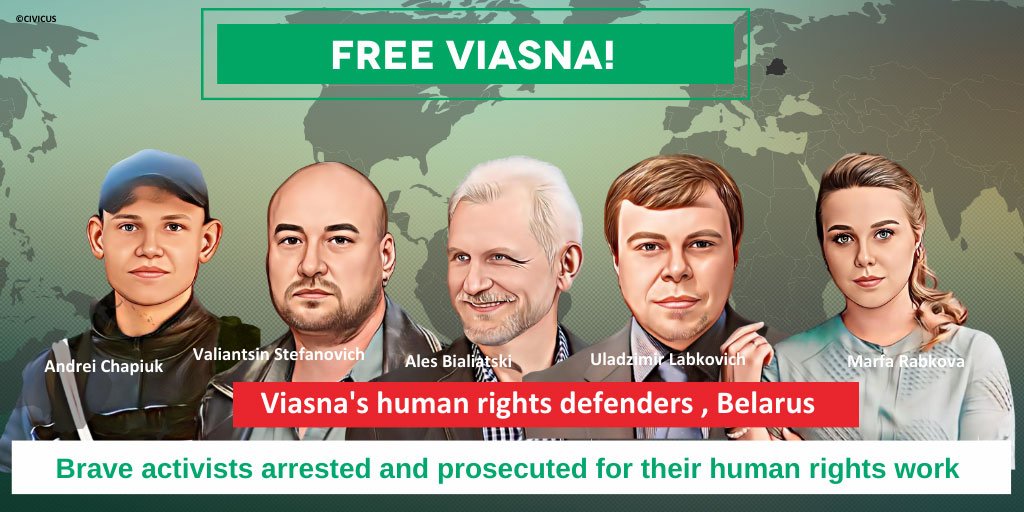
Belarus Releases Viasna Human Rights Defenders Marfa Rabkova and Valiantsin Stefanovich
On 19th March 2026, Belarusian authorities released and pardoned approximately 250 political prisoners as part of a deal brokered by the USA, in exchange for Washington lifting sanctions on top Belarusian financial institutions and potash producers. Those released included International Federation for Human Rights (FIDH) Vice-President Valiantsin Stefanovich, Viasna human rights defender Marfa Rabkova and human rights defender Nasta Loika. Journalists were also among those released (see under Freedom of expression).
Rabkova, a coordinator of Viasna’s volunteer service, had spent five and a half years in prison after being detained on 17th September 2020. She had been sentenced to 15 years’ imprisonment and a substantial fine on a range of charges related to “extremism” and organising riots. Her health reportedly deteriorated significantly during her imprisonment.
Stefanovich had been imprisoned for more than four years and eight months. He was detained on 14th July 2021, alongside several other Viasna human rights defenders. He, Ales Bialiatski, Uladzimir Labkovich and others were subsequently charged with “smuggling” and “financing group actions that grossly violate public order”. In March 2023, Labkovich was sentenced to seven years, Stefanovich to nine years and Bialiatski to 10 years in a penal colony. All three pleaded not guilty.
Loika had spent more than three years and three months in prison. She was detained on 28th October 2022. In June 2023, the Minsk City Court sentenced her to seven years in a penal colony on charges of “inciting hatred” and “insulting government officials” for preparing a report critical of law enforcement entitled Persecution of Anarchists, Antifascists, Leftists, and Social Activists in Belarus (2017–August 2018).
Following their release, Rabkova, Stefanovich and Loika, together with 12 other political prisoners, were de facto deported from Belarus to Lithuania without identification documents and without being given the option to remain in Belarus.
The March release was the largest of its kind to date. It followed other releases of Viasna human rights defenders. On 13th December 2025, the authorities released Bialiatski and Labkovich after years of imprisonment for their human rights work. Earlier, on 18th April 2025, Viasna volunteer Andrei Chapiuk completed his sentence and was released.
Continued restrictions on civil society: forced liquidation ramps up
Belarus remains an extremely difficult environment for civil society and political opposition in 2026. Despite the recent releases of political prisoners, the overall environment continues to be characterised by repression, severe restrictions on freedom of association, and the use of detention as a tool of political control.
Civil society organisations continue to face systematic pressure from the authorities. According to Lawtrend, at least 10 non-governmental organisations and two public associations were forcibly liquidated between December 2025 and February 2026. This brought the total number of civil society organisations dissolved by the authorities or forced to self-liquidate since the start of the 2020 protests to more than 2,000. According to Lawtrend, the recent liquidations marked the first mass liquidation of non-governmental institutions since a similar campaign in 2021. At the same time, Lawtrend noted that dozens of CSO and religious organisation representatives, as well as at least 20 representatives of trade unions and the labour movement, remained imprisoned for their professional or civic activities.
These restrictions have also extended to the charitable sector, with legislation being prepared to increase oversight of organisations involved in fundraising and assistance to vulnerable groups. On 30th January 2026, it was reported that the Investigative Committee was pursuing a criminal case against the director of the Help for Seriously Ill Children Foundation, which collected donations for the treatment of seriously ill children. The foundation’s director is accused of falsifying information about children for whom money was being collected as well as of keeping the money for himself. He was detained and charged under Part 4 of Article 210 of the Criminal Code for embezzlement through abuse of official authority on an especially large scale, which carries a sentence of up to 12 years’ imprisonment, as well as a fine. Against the backdrop of this very public case, a new law is being prepared to govern charitable activities, including fundraising mechanisms, reporting requirements, oversight of the use of funds, and the use of donation collection boxes.
Freedom of peaceful assembly
Detentions at a spring rite
Reports indicate continued severe restrictions on freedom of assembly in Belarus, with several people detained during peaceful events that were not intended to criticise government policies or political decisions.
According to information published by the Viasna Human Rights Centre and reported by independent media, on 21st March 2026, several dozen people, including children, attended a traditional Belarusian spring rite, Hukannie Viasny (Calling of Spring), in the enclosed courtyard of a restaurant in Homieĺ. The event had been sanctioned by the regional executive committee. Nevertheless, some participants were subsequently detained. One person was sentenced to 15 days’ administrative arrest, while others were fined at least 4,500 Belarusian roubles (more than €1,300) for allegedly violating the procedure for holding mass events. Among those fined was Viktar Shypkou, a Homieĺ district police major and folklorist who has received state recognition for his contribution to preserving folk traditions. A week earlier, a planned Hukannie Viasny celebration in Vietka, Homieĺ region, had been cancelled following a recommendation against holding mass events due to the anniversary of the Second World War Khatyn massacre.
The detentions illustrate the restrictions facing even small-scale cultural and traditional gatherings in Belarus.
Freedom of expression
Journalists among 250 political prisoners released in Belarus
The release of around 250 political prisoners in Belarus following an agreement brokered by the United States also included several journalists and media workers. According to the European Federation of Journalists (EFJ), journalist Katsiaryna Andreeva and blogger Eduard Palchys were deported to Lithuania without passports. Others were released in Belarus, including journalists and media workers Oleg Petrovich Suprunyuk, Dzmitry Navazhylau, Ales Marchanka, Valerija Kastsiuhova and Anton Kazelski.
Andreeva was detained on 15th November 2020 while livestreaming a memorial for a protester who had been killed. She was initially sentenced to two years’ imprisonment. In July 2022, she was convicted in a closed hearing of “giving away state secrets” as a form of treason and sentenced to a further eight years in prison. The authorities did not disclose the grounds for the charge.
Palchys was arrested on 27th September 2020 and initially sentenced to 30 days’ detention for protesting. He was subsequently charged with “incitement of hatred”, “organising mass riots”, “gross violation of public order” and “calls for sanctions”. In December 2021, he was sentenced to 13 years’ imprisonment and ordered to pay the equivalent of US$224,250 to municipal enterprises that allegedly incurred losses as a result of the protests.
Press freedom organisations, including the EFJ, the Committee to Protect Journalists and the Belarusian Association of Journalists (BAJ) welcomed the releases while stressing that many other journalists remain imprisoned and that the media environment remains severely restricted.
The releases have also taken place alongside continued legal pressure on journalists. On 3rd February 2026, the BAJ reported that the investigation into political prisoner and journalist Pavel Dabravolski had been completed and his case transferred to the Minsk City Court. Dabravolski faces a charge of “high treason”, which carries a sentence of up to 15 years’ imprisonment. According to sources consulted by BAJ, the charge is linked to his journalistic work. He previously worked for Belarusian and foreign media, including the independent news agency BelaPAN and Ukrainian magazine NV.ua. He was detained in Minsk on 22nd January 2025, several months after returning to Belarus following more than three years abroad.