Peaceful Assembly
REPRESSION OF PROTESTS IN THE OCCUPIED WESTERN SAHARA
Authorities continued to restrict the rights to freedom of association and peaceful assembly in occupied Western Sahara.
According to a report by ACAPS Catalunya and Novact Institute for Nonviolence (NOVACT), in 2024, the Sahrawi university student movement at the Ibn Zohr University of Agadir, the closest university to the Occupied Territories of Western Sahara, was targeted. This trend continued in 2025. According to the Sahrawi National Committee for Human Rights, on 16th June 2025, the authorities brutally cracked down against a student protest staged in solidarity with Sahrawi political prisoners detained in Moroccan occupation prisons. Authorities targeted protesters through physical assaults, verbal abuse, arbitrary detention, and acts of intimidation. The Faculty of Legal, Economic, and Social Sciences initiated disciplinary proceedings against students, including potential suspension and exclusion, for their participation in the protests.
Other Sahrawi activists protesting for the right to self-determination have also faced repression, including:
● On 8th January 2024, Moroccan occupation police violently intervened against a peaceful protest staged in objection to Morocco’s candidacy for the presidency of the UN Human Rights Council, in Laayoune, resulting in injuries.
● On 20th May 2024, a peaceful protest by a group of Sahrawi women commemorating the anniversary of the start of the Polisario Front’s armed struggle in Laayoune, Western Sahara, was met with excessive force and verbal and physical assaults by Moroccan occupation police, resulting in injuries.
● On the occasion of the ‘Zemla uprising’, a turning point in the liberation struggle of the Saharawi people, a demonstration on 17th June 2024 in El Ayoun was broken up by the police. Activists reported that they were beaten with sharp objects and were followed by police in an unmarked car.
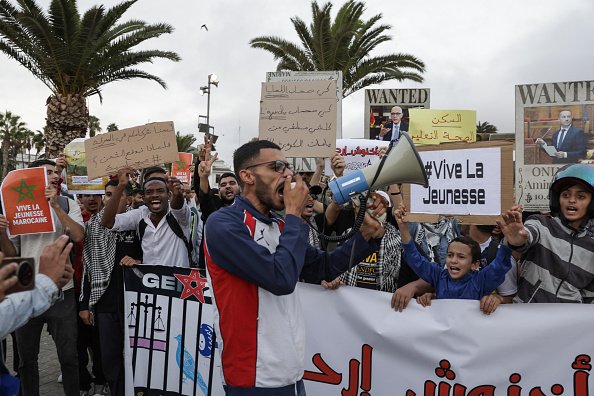
‘Gen Z 212’ PROTESTS
In late September 2025, protests erupted in several cities in Morocco, including Casablanca, Agadir, Marrakech, Tangier, Salé, Oujda, and Rabat, over failing public services, high unemployment, corruption and major spending on the 2030 World Cup. The protests, which have been largely decentralised and organised through social media platforms such as TikTok, Instagram, and Discord, are led by the youth-led movement, dubbed “Gen Z 212.” The initial protests were sparked following the death of eight women in mid-September in an Agadir hospital, following cesarean deliveries.
While protests have largely remained peaceful, violence was reported at some protests on 30th September and 1st October. In a statement, Amnesty International condemned the security forces' use of tear gas, rubber bullets, and lethal ammunition. According to AI, three protesters have been killed, dozens of others injured, and more than 400 people arrested, as of 3rd October.
“We are deeply alarmed by emerging evidence of Moroccan security forces’ use of excessive force and mass arrests of protesters and bystanders. The authorities should ensure a transparent investigation into the deaths that occurred and must respond to any incidents of violence by exercising restraint in line with international guidelines….” said Heba Morayef, Regional Director for the Middle East and North Africa at Amnesty International.
- https://www.amnesty.org/en/latest/news/2025/10/morocco-halt-use-of-excessive-force-following-crackdown-on-youth-protests/
The protesters facing trial, including minors, are currently facing charges under Article 591 of the Moroccan Penal Code, which criminalises participation in gatherings deemed violent. According to the National Union of Moroccan Journalists, journalists and photographers have faced some obstructions from security forces while documenting events, including attempts to remove cameras and excessive physical force.
Association
RESTRICTING CIVIL SOCIETY’S ROLE IN ANTI-CORRUPTION CASES
Civil society has criticised an amendment to the criminal procedure law (Bill 03.23 ), which was approved in August 2024. The amendments prevent civil society organisations from initiating legal action in cases involving the misuse of public funds and property, unless requested by the public prosecutor. Previously, NGOs had the authority to initiate legal action against civil servants and elected officials suspected of embezzlement or corruption.” CSOs argue that the amendment is “a significant setback for civil society’s role” as it restricts prosecution only to official bodies and thus “risks marginalising the critical role these groups play in monitoring and exposing corruption.”
Cases related to human rights defenders (HRDs)
● On 9th March 2024, human rights defender and journalist Rida Benotmane was released after serving 18 months in prison. He is a member of the Moroccan Association for Human Rights (AMDH) and the Freedom Now association. He was convicted for “apology of terrorism” for his social media posts and YouTube videos dating from 2021, in which he criticised abuses by the security forces, called for the release of political detainees and accused the government of oppressing free speech.
● On 5th February 2025, human rights defender and agricultural engineer Ismail Lghazaoui was released from prison. Lghazaoui is a Moroccan pro-Palestinian human rights defender, activist, and agricultural engineer who peacefully advocates for the rights of the Palestinian people, denouncing Morocco’s normalisation of relations with Israel.
● In February and September 2024, the UN Human Rights Committee requested that authorities put in place interim measures to protect the health of the 81-year-old human rights lawyer and ex-minister for human rights, Mohamed Ziane, who was sentenced in November 2022 on bogus charges related to his human rights work. However, authorities failed to comply with the request. In March 2025, a new detention order was issued against Ziane based on similarly false and unfounded charges.
● In August 2024, the UN Working Group on Arbitrary Detention adopted an opinion finding that human rights defender Nasser Zefzafi detention violates international law and called for his immediate release. Zefzafi is an Indigenous activist who led the Hirak El-Rif movement, which called for an end to the marginalisation of Amazigh-speaking communities, and demanded improvements to public services, against corruption, and better employment opportunities. In July 2025, several organisations wrote to the King of Morocco requesting that the government release the HRD on humanitarian grounds so he can care for his elderly father, who was recently diagnosed with cancer.
● Woman human rights defender (WHRD) and blogger Saida EL Alami was arrested on 1st July 2025, after she was pardoned in June 2024. She was detained on charges of “insulting a legally organised body, disseminating false allegations and insulting the judiciary”. On 15th July 2025, she appeared before the Casablanca Court of First Instance while on a hunger and water strike against her arbitrary arrest.
TARGETING OF SAHWARI ACTIVISTS
As documented in a report by ACAPS Catalunya and Novact Institute for Nonviolence (NOVACT), in 2024, arbitrary arrests and detentions against Sahwari activists have continued in the Occupied Territories of Western Sahara. It notes that 14 people have been arrested or detained in 2024.
For instance, on 6th June 2024, the Maroon Court of Justice of Agadir sentenced Saharan students, Hussein Bourkab and Ayman Yathribi, to ten years in prison. In its report, CODESA noted that the Moroccan occupation police use various tactics to target Sahwari human rights defenders, including surveillance, phone tapping, confiscation and inspection of mobile phones, defamation, and violations of privacy and personal life.
On 9th October 2024, human rights defenders Ahmed Ettanji and Mohamed Mayara were questioned, threatened with arrest by Moroccan authorities at a checkpoint upon arrival in the town of Cape Bojador in occupied Western Sahara. The HRDs advocate for the rights of the Sahrawi people in Western Sahara. Mayara co-founded the ‘Sahrawi Association of Victims of Serious Human Rights Violations (ASVDH)’ in 2005 and the organisation ‘Équipe Média’ in 2009, while Ettanji is the president of Équipe Média.
A report titled “Resilience is Resistance: The struggle of Sahwari women under Moroccan occupation,” published in November 2024, highlights the repressions that Sahwari WHRDs face, which include arbitrary detention, physical and psychological torture, beatings, sexual harassment and abuse, rape, defamation, and economic marginalisation.
The Sahrawi Defenders’ Collectif des Droits Humains (CODESA) has been subjected to harassment, intimidation and surveillance. On 15th January 2025, Hassan Zerouali, a member of the Administrative Committee of CODESA and its local branch, Salah Dlimi (another member) were arrested and interrogated, during which they were subjected to physical and verbal abuse. They were released five hours later. Days later, on 19th January 2025, Hassan Zerouali, a member of the Administrative Committee of CODESA and its local branch, was violently attacked by Moroccan police in the city of Dakhla, Western Sahara. The attack took place during a meeting by a Spanish journalist and two delegates from the NGO Coordinadora estatal de asociaciones solidarias con el Sáhara (Ceas-Sahara), which was aimed at documenting testimonies of Sahrawi human rights violations. According to Fédération Internationale pour les Droits Humaines (FIDH), the intervention was “clearly aimed at preventing these documentation activities.” Later in August 2025, Zerouali was harassed and detained by police at a checkpoint while travelling from the cities of El Aaiun to Dakhla. Earlier in October 2024, the car of Khadijatou Douih, Vice President of Codesa, was vandalised. Douih was also physically assaulted during a protest in January 2024.
In June 2025, eight UN Special Rapporteurs issued a statement denouncing Morocco’s ongoing campaign of repression, racial discrimination, and violence against Sahrawi human rights defenders, journalists, and advocates for self-determination. It detailed ongoing home demolitions, which the authorities have weaponised. For instance, on 8 January, the police besieged the houses of several Saharawi activists, such as Khadijatou Douih, Mahfouda Lefkir, Jamila El-Moujahid (vice-president of the Moroccan Association of Human Rights (AMDH), Salka Aamar (CODESA), and Salha Boutanguiza, who were organising to protest against the candidacy of Morocco for the presidency of the United Nations Human Rights Council.
Expression
In July 2024, around 2,460 prisoners, including several high-profile journalists and human rights defenders, were released by royal pardon. They included journalists Omar Radi, Taouûk Bouachrine and Suleiman Raissouni, as well as YouTuber Mohamed Réda Taoujni.
Bouachrine, Raissouni, and Radi were sentenced to 15, five, and six years, respectively, on sexual assault and other charges, which local journalists believe were in retaliation for their critical reporting on the government.
However, since their release, the journalists continue to face harassment and smear campaigns.
For instance, pro-government news website Al-Jarida 24 called them “fake heroes” and attacked a human rights group that hosted them at a press conference for “glorifying individuals with a dark past of sexual assault and human trafficking.” Radi was followed after his release and received threatening phone calls.
There have been several cases of cracking down on human rights defenders and bloggers for posts deemed critical on social media.
● In April 2024, blogger Abderrahman Zankad, who is affiliated with an Islamist party, was sentenced to five years in prison for insulting the king, deemed an “insult to a constitutional institution and incitement” over Facebook posts critical of Morocco’s decision to “normalise” relations with Israel.
● In May 2024, blogger Youssef El Hireche was sentenced to 18 months in prison for Facebook posts “[i]nsulting a public official, insulting organised bodies, and distributing confidential information without the owner’s consent.”
● On 30th October 2024, Moroccan police arrested prominent human rights and democracy activist Fouad Abdelmoumni due to a Facebook post which criticised Moroccan-French relations. The day after, he was charged with “insulting organised bodies [institutions], publishing false allegations, and reporting an imaginary crime that he knows did not occur.” On 3rd March 2025 the activist was sentenced to six months in prison and a fine of 2,000 dirhams ($208). A petition signed by nearly 300 activists and human rights defenders called on Moroccan authorities to overturn Fouad Abdelmoumni's conviction and also called for "the release of all prisoners of conscience in Morocco and other Maghreb countries."
● In November 2024, journalist Hamid El Mahdaoui, the director of the Badil website, was sentenced to 18 months in prison and a fine of approximately. 130,000 euros, for disseminating false allegations and defamation. The case stems from a complaint filed by Minister of Justice, Abdellatif Ouahbi, after a video that implicated the minister in an affair was published on the Badil website. The journalist has appealed his sentence.
● On 3rd September 2025, activist Ibtissame Lachgar, was sentenced to 30 months in prison and a fine of 50,000 Moroccan dirhams (approximately US$5,500) for violating the Penal code by “causing harm to Islam” after posting a photo on social media of herself wearing a shirt with the words “Allah is lesbian.” Human Rights Watch called on authorities to abolish the draconian legislation.
DEPORTATION OF JOURNALISTS FROM OCCUPIED WESTERN SAHARA
Journalists who have attempted to document the developments in the occupied Western Sahara have faced challenges. On 2nd May 2025, the Committee to Protect Journalists called on Moroccan authorities to stop suppressing independent reporting from the occupied Western Sahara after two Italian journalists were deported from the territory. On 27th April 2025, Italian journalist Matteo Garavoglia and photographer Giovanni Colmoni were expelled from occupied territory for committing a “provocative act” as they did not have official authorisation and had previously attempted to enter Western Sahara via air. Morocco considers Western Sahara part of its territory and requires journalists to obtain authorisation to report from the region.